

Archive position — measured, not model output
0 likes on Devpost
2,263 of the 7,850 archived projects have more likes, and 5,587 share exactly 0 — so this project's #5,928 place in the like-ranked listing is a tie-break inside that group, not a ranking.
Projects (log scale)
Likes on Devpost. ▲ marks this project's group.
Show the figures
| Likes | Projects | Share of archive |
|---|---|---|
| 0 | 5,587 | 71.2% |
| 1 | 1,758 | 22.4% |
| 2 | 284 | 3.6% |
| 3–4 | 132 | 1.7% |
| 5–9 | 75 | 1.0% |
| 10+ | 14 | 0.2% |
 User Stories BotA demo video on every pull request
Get a demo video on every new feature
GitHub App that watches your pull requests and records a narrated, captioned demo.
Save time on demo prep and make informed decisions faster with a video walkthrough of every new feature.
Executive Summary
Project: photo-diary
Self-reported basis: The entire analysis is based on the author's own description of the project as submitted to the OpenAI 2026 hackathon on Devpost. No external verification or historical data is available.
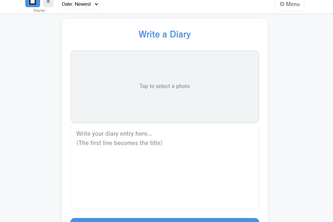
What it appears to be: A local-first, cloud-free Progressive Web App (PWA) diary that allows users to store text and photo entries across devices without relying on a remote database. The app is built using web technologies and AI-assisted development tools.
What changed: This is a hackathon submission with no evidence of prior existence or evolution. It represents an initial prototype or proof-of-concept, not a developed product.
Single most important open question: Is there any evidence of user adoption, feedback, or traction beyond the author's own account?
What The Product Actually Is
The description states that photo-diary is a cloud-free PWA diary. It allows users to:
- Type out reflections
- Attach photos
- Save entries locally
- Access the app across smartphones, tablets, and PCs
It uses web standards for cross-platform compatibility and local-first data storage.
Evidence: The author's own write-up describes it as a PWA that works offline and stores data locally. It is built using JavaScript and other web technologies.
Inference: The product is a lightweight utility app focused on privacy and accessibility across devices.
Positioning & Claim Evolution
The author positions photo-diary as:
- A privacy-focused diary
- An offline-first tool
- A multi-device experience
- A local-first alternative to cloud-based apps
It is described as a solution for people who want to "capture their daily thoughts, ideas, and photographic memories" without relying on the cloud.
Evidence: The author's own write-up includes the tagline and inspiration statement.
Inference: The positioning reflects a niche market need for offline-first personal tools, possibly targeting privacy-conscious users or those wary of cloud storage.
Target Customer & ICP
The description does not explicitly name target customers or define an Ideal Customer Profile (ICP).
It implies a user base that:
- Values privacy
- Prefers offline functionality
- Uses smartphones, tablets, and PCs
- Wants to capture thoughts and memories
Evidence: The author's own write-up mentions the desire for a "simple, intuitive space" and a focus on privacy.
Inference: The ICP likely includes individuals who are privacy-conscious or tech-savvy but not necessarily enterprise or B2B users.
Business Model & Pricing Evidence
There is no evidence of any business model or pricing structure in the description.
The project is described as a personal prototype, not a commercial product.
Evidence: The author states this was a hackathon submission and does not mention monetization, subscriptions, or sales.
Inference: No commercial model is evident. It may be an open-source or personal tool with no revenue path.
Technical & Delivery Signals
The app is built as:
- A Progressive Web App (PWA)
- Using JavaScript
- With local-first storage
- Utilizing OpenAI Codex and GPT-5.6 Terra for development assistance
- Designed to work across platforms (iOS, Android, desktop browsers)
Evidence: The author's own write-up details the tech stack and development process.
Inference: The use of AI tools suggests rapid prototyping but does not indicate scalability or production readiness.
Traction & Maturity Signals
There is no evidence of traction, customers, or product maturity beyond the hackathon submission.
The project is described as a single-person effort, with no mention of:
- Users
- Adoption
- Feedback
- Iteration history
Evidence: The author states "Team size: 1" and that it was submitted to a hackathon.
Inference: This is an early-stage prototype, not a mature product or service.
Competitive Context
The description does not mention any competitors or market context.
It is positioned as a local-first diary app, which may overlap with:
- Offline note-taking tools
- Privacy-focused apps
- Personal digital diaries or journals
Evidence: None provided.
Inference: The competitive landscape is unknown, but it likely competes with apps that offer offline or local storage options.
Open Questions & Risks
- No traction or adoption evidence: This is a prototype, not a product in use.
- Single-person development: No team or support structure for scaling or maintenance.
- Unproven market demand: No data on whether users actually want this solution.
- AI dependency: Reliance on AI tools for development may not be sustainable or scalable.
- Limited scope: The app is described as a "simple" tool, which may limit its commercial viability.
Evidence: All of the above are inferred from the lack of evidence in the description.
Questions the description leaves open
- What specific user needs does this tool address that existing solutions don’t?
- Have you tested it with real users or gathered feedback beyond your own use?
- Are there any plans to monetize or scale this beyond a personal prototype?
- How do you plan to handle data migration or long-term storage for users?
- What are the technical limitations of local-first storage in practice?
Overall Assessment
Not evidenced: There is no evidence of product-market fit, revenue, traction, or commercial viability.
The project is described as a hackathon submission, not a business or product in development.
Confidence level: Low. The description provides no signals of commercial readiness or scalability.
Assessment: Not suitable for investment or partnership at this stage. It may be an early-stage idea or prototype with no demonstrated traction or business model.
User Stories BotA demo video on every pull request
Get a demo video on every new feature
GitHub App that watches your pull requests and records a narrated, captioned demo.
Save time on demo prep and make informed decisions faster with a video walkthrough of every new feature.
Source
Submitted to the OpenAI 2026 hackathon on Devpost. Project home on Devpost. Back to the full gallery on Devpost.
This competitive analysis was produced by top-founders.com (opens in a new tab)
Generated by a language model from this project's public Devpost page — its tagline, the author's own write-up and any built-with tags listed there — as captured in August 2026. Short quotations are the author's words. It is an opinion on the idea as a business, not on the people behind it, and it reflects the description as published then. If the project has moved on, request a correction below. The analysis is not independent research and contains no verified traction, revenue or customer data.
An independent guide by KFG International LLC — not affiliated with, endorsed by, or connected to Devpost or OpenAI.