

Archive position — measured, not model output
7 likes on Devpost
26 of the 7,850 archived projects have more likes, and 9 share exactly 7 — so this project's #31 place in the like-ranked listing is a tie-break inside that group, not a ranking.
Projects (log scale)
Likes on Devpost. ▲ marks this project's group.
Show the figures
| Likes | Projects | Share of archive |
|---|---|---|
| 0 | 5,587 | 71.2% |
| 1 | 1,758 | 22.4% |
| 2 | 284 | 3.6% |
| 3–4 | 132 | 1.7% |
| 5–9 | 75 | 1.0% |
| 10+ | 14 | 0.2% |
 User Stories BotA demo video on every pull request
Get a demo video on every new feature
GitHub App that watches your pull requests and records a narrated, captioned demo.
Save time on demo prep and make informed decisions faster with a video walkthrough of every new feature.
Executive Summary
What the company appears to be
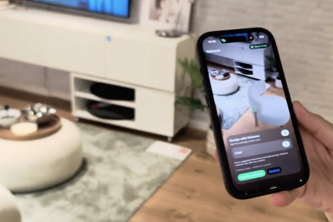
Reframe is a self-reported live diminished/augmented reality room editor for iPhone, built as a hackathon project. It uses voice commands (GPT Realtime 2.1), computer vision, and AI models to allow users to replace, remove, or edit real-world objects in a live AR feed. The system claims to reconstruct backgrounds using monocular depth estimation and TSDF fusion without LiDAR, and supports offline editing with session replay.
What changed
The project is presented as an experimental tool built for the OpenAI 2026 hackathon. It does not appear to have launched or scaled beyond this context. No commercial product, revenue, or customer data are evidenced.
Single most important open question
Is there any evidence of traction, monetization, or a path to product-market fit beyond the hackathon submission?
What The Product Actually Is
The description states that Reframe is a live diminished/augmented reality room editor for iPhone, which allows users to:
- Place catalog assets on the floor
- Swap real objects with virtual ones
- Pull real objects out to reveal reconstructed background
- Undo edits instantly
- Work offline, including replaying and re-editing sessions via a
.rfcapfile
It integrates voice (via GPT Realtime 2.1), tap input, and reticle interaction into a single intent structure.
The system uses:
- A Qdrant vector DB with a catalog of 20k+ furniture items
- GPT-5.6 Sol for planning agentic edits
- SAM 3.1 video tracking
- Monocular depth estimation and TSDF fusion
- ARKit, RealityKit, Metal compositing
- A deterministic commit system with idempotency keys
The product is described as a cross-runtime implementation (Swift, TypeScript, Python) using a binary FramePacket contract.
Claim: Reframe is an AR editing tool for iPhone that supports real-time object replacement and background reconstruction.
Evidence: Self-reported in the project write-up. No independent verification or demonstration provided.
Positioning & Claim Evolution
The authors state:
- The inspiration was to solve a problem with existing AR furniture apps: they can place virtual objects but cannot remove existing ones.
- Reframe aims to allow users to point at an object, say “replace this with something warmer and red,” and have it resolve on a live feed without touching the camera or environment.
The positioning is:
- Problem-focused: AR editing that works with real-world occlusions
- Voice-driven: Uses voice commands (GPT Realtime) as primary input
- AI-powered: Leverages GPT-5.6 Sol and vector search for intent resolution
Claim: Reframe positions itself as a tool to enable seamless, voice-driven AR editing that removes the limitations of traditional compositing.
Evidence: Self-reported in the project write-up.
Target Customer & ICP
The description does not state:
- Who the target customer is
- The ideal customer profile (ICP)
- Any segmentation or persona details
It implies a use case for home users or furniture shoppers, but no explicit targeting is stated.
Claim: The product targets home users or furniture shoppers who want to visualize changes in real-time.
Evidence: Inferred from the problem statement and use case. Not explicitly stated.
Business Model & Pricing Evidence
There is no evidence of:
- A pricing model
- Revenue streams
- Monetization strategy
- Customer acquisition plans
The project is described as a hackathon submission, not a commercial product.
Claim: No business model or pricing information is provided.
Evidence: Self-reported only. No data on monetization or customer value exchange.
Technical & Delivery Signals
Key technical elements:
- Uses GPT-5.6 Sol for planning edits
- Integrates Qdrant vector DB, SAM 3.1, TSDF fusion, and monocular depth estimation
- Implements a deterministic commit system with idempotency keys
- Supports multi-track geometry processing (fast vs dense)
- Uses GPU lane scheduler, cross-runtime contracts, and binary FramePacket schema
- Built with SwiftUI, ARKit, RealityKit, Metal, and Python workers in Docker
Claim: Reframe is a technically sophisticated system built for performance and correctness.
Evidence: Self-reported. No independent validation of technical claims.
Traction & Maturity Signals
There is no evidence of:
- Customers
- Revenue
- Product adoption
- Market traction
- Product maturity beyond the hackathon phase
The project is described as a hackathon submission and not a commercial product.
Claim: No traction or maturity signals are evident.
Evidence: Self-reported only. No data on usage, revenue, or customer base.
Competitive Context
The description does not mention:
- Competitors
- Market positioning relative to existing AR tools
- Differentiation from other AR editing platforms
It implies that current AR apps cannot remove real objects, which is a gap it aims to fill.
Claim: Reframe addresses a gap in current AR furniture apps.
Evidence: Self-reported. No competitive analysis or market data provided.
Open Questions & Risks
- Unverified claims: The system relies heavily on self-reported technical and functional details.
- No commercialization path: The project is described as a hackathon submission with no evidence of product-market fit or monetization.
- High technical complexity without traction: The system uses advanced AI and computer vision, but no real-world usage or validation is shown.
- Limited team size: Only 3 people worked on it in a week-long hackathon — raises questions about scalability and long-term viability.
Claim: Reframe lacks commercialization evidence and may not be ready for market.
Evidence: Inferred from project description. No independent validation or traction data.
Questions the description leaves open
- What is the actual user experience of using Reframe in a real-world setting?
- How does the system handle edge cases like low-light conditions or occlusions?
- Is there any plan to monetize this product beyond the hackathon?
- What are the technical limitations that prevent scaling to production?
- Are there any existing users or pilot programs for Reframe?
- How is the 20k+ catalog maintained and updated?
- What are the performance trade-offs of running this on-device vs cloud?
Claim: These questions aim to uncover gaps in the self-reported claims.
Evidence: Based on the project description and inferred technical and commercial risks.
Overall Assessment
There is no evidence that Reframe has moved beyond a hackathon prototype. No revenue, customers, or traction are reported. The system is technically impressive but lacks commercial viability or market validation.
Claim: Reframe is an experimental project with no demonstrated product-market fit.
Evidence: Self-reported only. No data on adoption, monetization, or scalability.
User Stories BotA demo video on every pull request
Get a demo video on every new feature
GitHub App that watches your pull requests and records a narrated, captioned demo.
Save time on demo prep and make informed decisions faster with a video walkthrough of every new feature.
Source
Submitted to the OpenAI 2026 hackathon on Devpost. Project home on Devpost. Back to the full gallery on Devpost.
This competitive analysis was produced by top-founders.com (opens in a new tab)
Generated by a language model from this project's public Devpost page — its tagline, the author's own write-up and any built-with tags listed there — as captured in August 2026. Short quotations are the author's words. It is an opinion on the idea as a business, not on the people behind it, and it reflects the description as published then. If the project has moved on, request a correction below. The analysis is not independent research and contains no verified traction, revenue or customer data.
An independent guide by KFG International LLC — not affiliated with, endorsed by, or connected to Devpost or OpenAI.