

Archive position — measured, not model output
0 likes on Devpost
2,263 of the 7,850 archived projects have more likes, and 5,587 share exactly 0 — so this project's #3,957 place in the like-ranked listing is a tie-break inside that group, not a ranking.
Projects (log scale)
Likes on Devpost. ▲ marks this project's group.
Show the figures
| Likes | Projects | Share of archive |
|---|---|---|
| 0 | 5,587 | 71.2% |
| 1 | 1,758 | 22.4% |
| 2 | 284 | 3.6% |
| 3–4 | 132 | 1.7% |
| 5–9 | 75 | 1.0% |
| 10+ | 14 | 0.2% |
 User Stories BotA demo video on every pull request
Get a demo video on every new feature
GitHub App that watches your pull requests and records a narrated, captioned demo.
Save time on demo prep and make informed decisions faster with a video walkthrough of every new feature.
Executive Summary
What the company appears to be
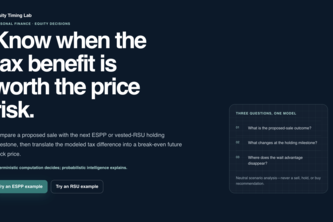
Equity Timing Lab is a self-reported financial tool designed to help employees evaluate whether waiting to sell ESPP or RSU equity — for better tax treatment — is worth the stock-price risk. It uses deterministic calculations and GPT-5.6 for explanations, without making recommendations.
What changed
The project was built as part of an OpenAI hackathon (Devpost submission), with no evidence of prior traction, revenue, or customers.
Single most important open question
Is the tool’s approach to tax modeling and AI integration sufficient to support a scalable product, or is it limited to educational or prototype use?
What The Product Actually Is
The description states that Equity Timing Lab:
- Models ESPP or vested-RSU sales.
- Compares them with holding milestones.
- Calculates federal ordinary-income tax, capital-gain tax, NIIT, and California tax.
- Finds a break-even stock price at which the wait scenario’s net proceeds meet or exceed the proposed sale.
- Shows both scenarios, tax drivers, official sources, assumptions, and limitations.
- Optionally uses GPT-5.6 to explain verified results without authoring financial values.
- Includes synthetic examples for users to explore workflows.
It is described as a deterministic tool with a TypeScript engine, source-backed tax rules, and a Next.js UI deployed via OpenAI Sites.
Inference The product appears to be a single-user, educational tool focused on tax decision-making for employees. It does not appear to have a marketplace or multi-tenant functionality.
Positioning & Claim Evolution
The author states:
- Employees often know waiting may improve tax treatment but are unsure about stock-price risk.
- Traditional tools explain tax classifications and calculations but do not answer the practical question: How far could the stock fall before the tax benefit disappears?
- The tool’s insight is to provide a neutral break-even threshold that helps individuals understand the trade-off.
Inference The positioning is educational and neutral, not advisory. It aims to inform rather than recommend — a key distinction in financial tools.
Target Customer & ICP
The description states:
- The tool is for employees who are considering selling ESPP or RSU equity.
- It includes synthetic examples so users can explore workflows without entering personal data.
Inference The primary user is an individual employee, not a company or institutional buyer. The tool is likely aimed at high-income earners in tech companies with equity compensation.
Business Model & Pricing Evidence
The description states:
- The tool is built as a public application.
- It includes synthetic examples and does not require personal financial data.
- No pricing model, monetization strategy, or revenue streams are mentioned.
Inference There is no evidence of a business model or pricing structure. The product appears to be a prototype or demo with no commercial intent described.
Technical & Delivery Signals
The description states:
- Built with TypeScript, Next.js, OpenAI GPT-5.6, and Codex.
- Uses deterministic calculations with high-precision decimal arithmetic.
- Integrates GPT-5.6 via server-only API using Structured Outputs.
- Prevents GPT from authoring financial values.
- Includes 181 automated tests, type checking, linting, security review, and deployment verification.
- Deployed through OpenAI Sites.
Inference The tool is technically sound for its scope. It shows attention to precision, governance, and AI integration boundaries. However, it lacks evidence of scalability or enterprise-grade infrastructure.
Traction & Maturity Signals
The description states:
- The project was submitted to the OpenAI 2026 hackathon.
- It was built in a short timeframe (three to four days).
- No revenue, customers, or adoption data are provided.
- The author is a single individual (Yogesh Weling).
Inference There is no evidence of traction, users, or commercial adoption. The product is at the prototype or demo stage.
Competitive Context
The description does not mention any competitors or market context beyond general tax tools and AI assistants.
Inference No competitive landscape is evident from the self-reported description. It is unclear whether similar tools exist in the market or how this tool would differentiate.
Open Questions & Risks
- No commercial model or revenue data: The tool is not demonstrated to be monetized.
- Single-person team: No evidence of a scalable team or product development process.
- Prototype-only status: Built for a hackathon, with no indication of long-term product strategy.
- AI integration boundary: While GPT-5.6 is used for explanation, the tool’s reliance on it may be limited without further validation.
- No external validation or tax review: No mention of professional tax review or regulatory compliance.
Questions the description leaves open
- What are the specific official tax sources used to define the rules in the engine?
- How is the tool’s accuracy validated, and has it been reviewed by a tax professional?
- Is there any plan to expand beyond ESPP and RSU, or to support other jurisdictions or tax years?
- How would you scale this product for enterprise use or broader adoption?
- What are the legal and compliance risks of offering financial decision support without explicit disclaimers or certifications?
Overall Assessment
Not evidenced.
The description does not provide sufficient evidence to assess whether Equity Timing Lab is a viable investment or partnership opportunity. It is a self-reported prototype with no commercial traction, revenue, or customer data. The tool’s technical approach appears sound for its scope, but it lacks any indication of scalability, monetization, or market readiness.
Confidence Low. The project is described as a hackathon submission with no evidence of product-market fit, commercial viability, or long-term strategy.
User Stories BotA demo video on every pull request
Get a demo video on every new feature
GitHub App that watches your pull requests and records a narrated, captioned demo.
Save time on demo prep and make informed decisions faster with a video walkthrough of every new feature.
Source
Submitted to the OpenAI 2026 hackathon on Devpost. Project home on Devpost. Back to the full gallery on Devpost.
This competitive analysis was produced by top-founders.com (opens in a new tab)
Generated by a language model from this project's public Devpost page — its tagline, the author's own write-up and any built-with tags listed there — as captured in August 2026. Short quotations are the author's words. It is an opinion on the idea as a business, not on the people behind it, and it reflects the description as published then. If the project has moved on, request a correction below. The analysis is not independent research and contains no verified traction, revenue or customer data.
An independent guide by KFG International LLC — not affiliated with, endorsed by, or connected to Devpost or OpenAI.