

Archive position — measured, not model output
0 likes on Devpost
2,263 of the 7,850 archived projects have more likes, and 5,587 share exactly 0 — so this project's #4,478 place in the like-ranked listing is a tie-break inside that group, not a ranking.
Projects (log scale)
Likes on Devpost. ▲ marks this project's group.
Show the figures
| Likes | Projects | Share of archive |
|---|---|---|
| 0 | 5,587 | 71.2% |
| 1 | 1,758 | 22.4% |
| 2 | 284 | 3.6% |
| 3–4 | 132 | 1.7% |
| 5–9 | 75 | 1.0% |
| 10+ | 14 | 0.2% |
 User Stories BotA demo video on every pull request
Get a demo video on every new feature
GitHub App that watches your pull requests and records a narrated, captioned demo.
Save time on demo prep and make informed decisions faster with a video walkthrough of every new feature.
Executive Summary
The company appears to be a solo-built mobile application project named "Helios Artistic AI Platform," submitted as a hackathon entry. The description states it uses AI to scan artwork, tell stories through voice, locate local performances, and facilitate collaborations — all within a therapeutic, mythologically themed UI.
What changed
This is a self-reported, unverified project submitted for an OpenAI 2026 hackathon. No evidence of commercial traction, revenue, or customer adoption exists in the description.
Single most important open question
Is there any evidence of user engagement, monetization, or product-market fit beyond the author’s personal narrative?
What The Product Actually Is
- The description states Helios is a mobile application built with React Native/Expo, using Gemini APIs, Firebase, and Veo.
- It claims to scan artwork, perform image segmentation, apply AI edits, animate the results, and tell stories via voice.
- The app includes features such as:
- Local performance discovery
- Painter memory games
- Real-time collaboration tools
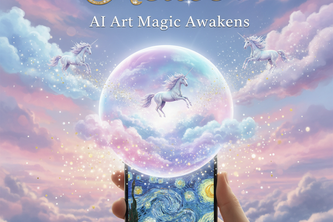
- A therapeutic UI with pastel colors and unicorn motifs
- It integrates multimodal AI APIs (e.g., Gemini, Veo) to process images and generate narratives.
- The app is described as a “heaven of soothing cloud unicorns” with a pastel light pink, blue, purple, golden, and metallic silver theme.
Note
The project is self-reported and unverified. No evidence of actual product deployment, users, or monetization exists.
Positioning & Claim Evolution
- The author positions Helios as an art therapy tool that blends AI magic, Greek mythology, and personal healing.
- It claims to be a “collective process” where users unlock their inner artist through AI-enhanced art experiences.
- The app is described as a “warm hug” and a “digital soulmate” for users, emphasizing emotional engagement over technical polish.
- The project is framed as a personal journey, not a commercial product — with no mention of market validation or scalability.
Inference The positioning appears to be emotionally driven rather than commercially validated. No evidence of market research or competitive differentiation beyond the author’s personal narrative.
Target Customer & ICP
- The description states that Helios is intended for users who seek art therapy and want to unlock their inner artist.
- It targets individuals who are emotionally connected to art, possibly including:
- Art enthusiasts
- People in need of emotional support or healing
- Users interested in collaborative art-making
Note
No evidence of defined personas, user segments, or customer acquisition strategies is provided.
Business Model & Pricing Evidence
- The description does not mention any pricing model, revenue streams, or monetization strategy.
- It implies a community-based sharing model, where users can share artwork and stories.
- There is no indication of subscription plans, in-app purchases, or B2B partnerships.
Inference The business model remains undefined. The project appears to be a personal or hackathon effort with no commercial intent evident.
Technical & Delivery Signals
- Built with:
- React Native/Expo
- Firebase (for auth/community)
- Gemini APIs (for edits/generations)
- Veo (for video animation)
- TailwindCSS, Lottie, Framer Motion
- The app integrates multimodal AI APIs to process images and generate narratives.
- Challenges mentioned include:
- Chaining multimodal APIs
- Creating a therapeutic UI
- Syncing voices/animations on mobile without lag
Note
No evidence of production deployment, scalability, or performance metrics is provided.
Traction & Maturity Signals
- The project is described as a hackathon submission (OpenAI 2026).
- It was built by a single team member, Nehal Sharma.
- The author states:
- “Ready for a piece in the book chapter”
- “Developed out of personal healing”
- No evidence of:
- Users
- Revenue
- Customer feedback
- Product-market fit
- Iteration history
Inference The project is at an early stage, likely a prototype or proof-of-concept. No traction or maturity indicators are evident.
Competitive Context
- The description does not mention any direct competitors.
- It references AI art tools, art therapy apps, and collaborative platforms, but no specific market analysis is provided.
- The app’s unique positioning is based on mythology + AI + emotional healing, which may be niche.
Inference No competitive landscape or differentiation strategy is evident. The project appears to be in a narrow, unproven niche.
Open Questions & Risks
- Solo-built project: No team, no external validation.
- No commercial traction: No users, revenue, or adoption.
- Unverified claims: All features and outcomes are self-reported.
- Emotional positioning without market data: The app is framed as a personal healing tool, not a scalable product.
- Technical complexity without evidence of execution: Multimodal API chaining and animation on mobile are mentioned but not demonstrated.
Inference High risk due to lack of evidence for viability or scalability. The project may be a prototype with no commercial potential.
Questions the description leaves open
- What is the actual user engagement or feedback you’ve received from people trying this?
- Have you tested the app with real users, and what were their reactions?
- How do you plan to monetize this product beyond personal use?
- Do you have a roadmap for scaling beyond a single-person hackathon project?
- What is your strategy for integrating with existing art platforms or communities?
Overall Assessment
- Not evidenced — no commercial data, revenue, or traction exists.
- The project is described as a personal, emotionally driven hackathon effort, not a scalable business.
- No evidence of:
- Product-market fit
- Revenue model
- Team or market validation
- Commercial readiness
Inference This is a pre-product-stage idea with no commercial due-diligence basis. It may be a prototype or personal project, not an investment or partnership opportunity.
User Stories BotA demo video on every pull request
Get a demo video on every new feature
GitHub App that watches your pull requests and records a narrated, captioned demo.
Save time on demo prep and make informed decisions faster with a video walkthrough of every new feature.
Source
Submitted to the OpenAI 2026 hackathon on Devpost. Project home on Devpost. Back to the full gallery on Devpost.
This competitive analysis was produced by top-founders.com (opens in a new tab)
Generated by a language model from this project's public Devpost page — its tagline, the author's own write-up and any built-with tags listed there — as captured in August 2026. Short quotations are the author's words. It is an opinion on the idea as a business, not on the people behind it, and it reflects the description as published then. If the project has moved on, request a correction below. The analysis is not independent research and contains no verified traction, revenue or customer data.
An independent guide by KFG International LLC — not affiliated with, endorsed by, or connected to Devpost or OpenAI.