

Archive position — measured, not model output
0 likes on Devpost
2,263 of the 7,850 archived projects have more likes, and 5,587 share exactly 0 — so this project's #6,441 place in the like-ranked listing is a tie-break inside that group, not a ranking.
Projects (log scale)
Likes on Devpost. ▲ marks this project's group.
Show the figures
| Likes | Projects | Share of archive |
|---|---|---|
| 0 | 5,587 | 71.2% |
| 1 | 1,758 | 22.4% |
| 2 | 284 | 3.6% |
| 3–4 | 132 | 1.7% |
| 5–9 | 75 | 1.0% |
| 10+ | 14 | 0.2% |
 User Stories BotA demo video on every pull request
Get a demo video on every new feature
GitHub App that watches your pull requests and records a narrated, captioned demo.
Save time on demo prep and make informed decisions faster with a video walkthrough of every new feature.
Executive Summary
What the company appears to be
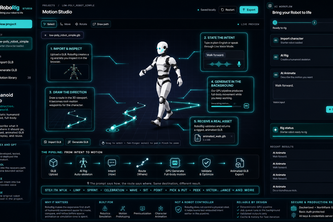
RoboRig, as described by its authors, is a tool that allows robotics engineers and animators to generate animated 3D humanoid assets from static GLB models using natural language prompts and drawn routes. It supports workflows involving motion prototyping, previsualization, and simulation testing.
What changed
The project was submitted to the OpenAI 2026 hackathon by two individuals (Rohith Raghunathan Nair and Anjali Kookal Padmanabhan). The description indicates a rapid development process using AI tools like Codex and GPT-5.6-Sol, with an emphasis on building a single, integrated workflow from idea to deployment.
Single most important open question
Is there any evidence of real-world usage or traction beyond the hackathon submission?
What The Product Actually Is
The description states that RoboRig:
- Takes a static humanoid 3D model (GLB format)
- Creates a rig and allows inspection in the browser
- Accepts intent via plain English or live voice input
- Uses drawn routes in the 3D viewport as root-motion waypoints
- Generates full-body movement using GPU pipelines while keeping the workspace usable
- Returns a validated animated GLB, not video or stock motion
Inference The system appears to be an interactive web-based application that integrates AI-driven rigging and animation with user-defined intent and spatial direction.
Not evidenced No information on whether it supports other formats beyond GLB, how many models it can process simultaneously, or if it includes export options beyond GLB.
Positioning & Claim Evolution
The description states:
- RoboRig helps teams test embodied intent earlier in robotics simulation and animation workflows.
- It is built for motion prototyping, previsualization, and character-animation workflows.
- It does not control physical robots; it focuses on digital asset creation.
- The system supports a wide range of actions including locomotion, gestures, expressive actions, interactions, and sequences.
Inference The positioning is focused on accelerating early-stage design and testing in robotics and animation, emphasizing speed and ease of iteration over final output quality.
Not evidenced No mention of specific target industries, competitors, or how this differs from existing tools like Blender, Maya, or proprietary motion capture systems.
Target Customer & ICP
The description states:
- Target users are robotics engineers and animators.
- It supports workflows involving simulation testing, previsualization, and character animation.
Inference The primary customer segments appear to be professionals working in robotics simulation and digital content creation who need fast prototyping capabilities.
Not evidenced No data on customer size, industry verticals, or specific use cases beyond general categories. No evidence of early adopters or pilot programs.
Business Model & Pricing Evidence
The description does not contain any information about:
- Revenue streams
- Pricing models
- Monetization strategy
- Subscription plans or licensing terms
Not evidenced There is no indication of how the product would be sold or whether it's intended for commercial use beyond the hackathon.
Technical & Delivery Signals
The description states:
- Built with Codex and GPT-5.6-Sol.
- Uses technologies including CUDA, Docker, Next.js, React, Three.js, Python, PyTorch, WebRTC, OpenAI Agents SDK, and NVIDIA GPUs.
- The system runs on Northflank GPU hosting.
- Includes features like background job processing, validation systems, server-side credential protection, and deterministic fallbacks for failed jobs.
Inference The product is a GPU-accelerated web application built using modern AI tooling and cloud infrastructure. It emphasizes reliability through deterministic failure handling and secure deployment practices.
Not evidenced No details on scalability limits, performance benchmarks, or integration capabilities with existing software ecosystems.
Traction & Maturity Signals
The description states:
- Submitted to the OpenAI 2026 hackathon.
- Developed by two team members (Rohith Raghunathan Nair and Anjali Kookal Padmanabhan).
- The project was built using Codex and GPT-5.6-Sol.
Not evidenced No evidence of:
- Revenue or monetization
- Customers or user base
- Product adoption metrics
- Iteration history or roadmap
- Post-hackathon development status
Competitive Context
The description does not provide any information about:
- Direct competitors
- Market positioning relative to existing tools
- Differentiation from similar platforms in the robotics or animation space
Not evidenced No competitive analysis, pricing comparisons, or market share data.
Open Questions & Risks
Based on the self-reported description:
- The project is a hackathon submission with no known traction or revenue.
- Reliance on AI tools (Codex, GPT-5.6-Sol) raises questions about long-term viability and dependency risks.
- No evidence of product-market fit or customer feedback.
- Limited team size suggests potential scalability issues.
- Lack of clear monetization strategy or business model.
Inference The risk of failure is high due to lack of real-world validation, unclear path to profitability, and dependence on experimental AI models.
Questions the description leaves open
- What specific problems are you solving in robotics simulation or animation workflows?
- How do you plan to monetize this tool beyond the hackathon?
- Have you tested the system with actual users from your target market?
- What is your roadmap for product development post-hackathon?
- Are there any technical dependencies that could become obstacles (e.g., access to GPT-5.6-Sol)?
- How do you intend to scale beyond a two-person team?
Overall Assessment
Assessment Not evidenced.
The description provides no evidence of traction, revenue, or customer adoption. The project is presented as a hackathon submission with no indication of commercial viability or scalability. While the technical approach seems feasible, there is insufficient data to assess whether this represents a viable business opportunity or strategic asset for investment or partnership.
Confidence Level Low — based entirely on self-reported information without external validation or evidence of real-world usage.
User Stories BotA demo video on every pull request
Get a demo video on every new feature
GitHub App that watches your pull requests and records a narrated, captioned demo.
Save time on demo prep and make informed decisions faster with a video walkthrough of every new feature.
Source
Submitted to the OpenAI 2026 hackathon on Devpost. Project home on Devpost. Back to the full gallery on Devpost.
This competitive analysis was produced by top-founders.com (opens in a new tab)
Generated by a language model from this project's public Devpost page — its tagline, the author's own write-up and any built-with tags listed there — as captured in August 2026. Short quotations are the author's words. It is an opinion on the idea as a business, not on the people behind it, and it reflects the description as published then. If the project has moved on, request a correction below. The analysis is not independent research and contains no verified traction, revenue or customer data.
An independent guide by KFG International LLC — not affiliated with, endorsed by, or connected to Devpost or OpenAI.