

Archive position — measured, not model output
0 likes on Devpost
2,263 of the 7,850 archived projects have more likes, and 5,587 share exactly 0 — so this project's #2,517 place in the like-ranked listing is a tie-break inside that group, not a ranking.
Projects (log scale)
Likes on Devpost. ▲ marks this project's group.
Show the figures
| Likes | Projects | Share of archive |
|---|---|---|
| 0 | 5,587 | 71.2% |
| 1 | 1,758 | 22.4% |
| 2 | 284 | 3.6% |
| 3–4 | 132 | 1.7% |
| 5–9 | 75 | 1.0% |
| 10+ | 14 | 0.2% |
 User Stories BotA demo video on every pull request
Get a demo video on every new feature
GitHub App that watches your pull requests and records a narrated, captioned demo.
Save time on demo prep and make informed decisions faster with a video walkthrough of every new feature.
Executive Summary
The company appears to be a solo research initiative focused on developing an AI-powered regulatory decision support system for public-sector professionals. The project is described as a human-centred framework that uses Explainable AI (XAI) to assist with compliance tasks, particularly in fire safety and public procurement. It emphasizes transparency, traceability, and human oversight, positioning itself as a tool for augmenting rather than replacing human judgment.
The author states the system is built using OpenAI models and Codex-assisted workflows, with an architecture designed around document intelligence, regulatory reasoning engines, and explainability layers. The project includes prototype workflows, interface concepts, and real-world compliance analysis based on legislation and technical standards.
Key change
This initiative represents a personal research effort by one individual (Anastasios Paterakis) submitted to the OpenAI 2026 hackathon, not a commercial product or company in operation. It is described as a conceptual prototype with no evidence of revenue, customers, or traction.
Single most important open question
Is there any evidence that this concept has been tested in real-world public-sector environments, or whether it has moved beyond the research and prototype stage into functional use?
What The Product Actually Is
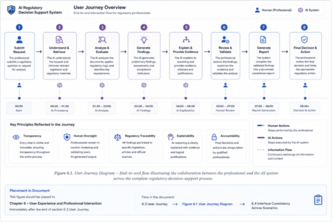
The description states that AI Regulatory Decision Support Systems is a human-centred framework for applying Explainable Artificial Intelligence to regulatory compliance. It combines:
- Large Language Models
- Structured regulatory knowledge
- Document intelligence
- Transparent reasoning
- Human review
It is designed to analyze complex documentation, identify applicable legal and technical requirements, detect inconsistencies, and produce explainable findings supported by evidence and regulatory references.
The system includes a set of architectural components:
- Document Intelligence Layer
- Regulatory Knowledge Layer
- Regulatory Reasoning Engine
- Compliance Verification Engine
- Explainability Layer
- Human Review Layer
It is explicitly described as decision support, not autonomous decision-making. Every recommendation remains traceable, reviewable, and subject to professional validation.
Inference The product appears to be a research prototype or proof-of-concept rather than a commercial offering. It is not evidenced to have been deployed in production or used by end users beyond the author’s own demonstration.
Positioning & Claim Evolution
The description states that this project was inspired by direct professional experience in public safety, fire safety compliance and public procurement, and aims to explore how Explainable AI can support professionals in demanding regulatory environments without replacing human judgment or responsibility.
The positioning is clear: it is a human-in-the-loop system designed for public-sector professionals who need to interpret regulations, analyze documents, and make transparent, evidence-based decisions. The author emphasizes that the goal is not to automate compliance but to augment human decision-making with AI assistance, preserving accountability.
The claim evolution shows:
- Initial inspiration from real-world regulatory challenges
- A focus on explainability, traceability, and legal compliance
- A shift toward a reusable platform for trustworthy AI-assisted regulatory decision support in public administration
Inference The positioning is consistent with current trends in XAI and ethical AI use cases in regulated environments. However, the project remains at the research or prototype stage, with no evidence of adoption or commercialization.
Target Customer & ICP
The description states that the system targets public-sector professionals working with complex legislation, technical standards, administrative procedures, and large volumes of documentation. Two use cases are mentioned:
- Fire Safety Compliance Assistant
- Public Procurement Compliance Assistant
These are described as representative examples of regulatory domains where the system could be applied.
Inference The ICP appears to be regulatory professionals in public administration, particularly those involved in compliance and safety regulation, with a focus on high-stakes environments like fire safety or procurement. No specific customer segments beyond this are identified.
Business Model & Pricing Evidence
There is no evidence of a business model or pricing structure in the description. The project is described as a personal research initiative submitted to a hackathon and not as a commercial product or service offering.
Inference No information is provided about monetization, licensing, or customer acquisition strategies. The system is presented as a prototype or concept, not a revenue-generating entity.
Technical & Delivery Signals
The project was built using:
- OpenAI models
- Codex-assisted workflows
It includes the following architectural components:
- Document Intelligence Layer
- Regulatory Knowledge Layer
- Regulatory Reasoning Engine
- Compliance Verification Engine
- Explainability Layer
- Human Review Layer
The system is described as being designed for decision support, not autonomous decision-making.
Inference The technical approach involves LLMs and structured AI workflows, with an emphasis on explainability and human-in-the-loop design. However, no evidence of actual deployment or delivery to users is provided.
Traction & Maturity Signals
The description states that the project produced a complete research package, including:
- Research Proposal
- Executive Summary
- Technical Appendix
- Demonstration Concept
- Presentation Deck
- Prototype workflows and interface concepts
- Real-world fire safety compliance analysis based on legislation, technical standards, and building plans
It also mentions that the next phase is to develop a functional prototype, beginning with the Fire Safety Compliance Assistant.
Inference The project has reached the prototype stage, but there is no evidence of:
- Live deployment
- Customer adoption
- Revenue generation
- Product-market fit
- Real-world usage beyond the author’s own demonstration
Competitive Context
The description does not mention any direct competitors. However, it references the use of Explainable AI (XAI) and retrieval-augmented generation (RAG) in regulatory environments.
Inference The space includes:
- XAI tools for regulated industries
- Regulatory compliance software
- AI-powered document analysis platforms
But no specific competitive landscape is described or evidenced.
Open Questions & Risks
- Single-person operation: The project is described as a solo effort, which raises concerns about scalability and execution capability.
- No commercial traction: There is no evidence of revenue, customers, or product-market fit beyond the author’s own research.
- Prototype-only status: The system is presented as a prototype, not a functioning product, with no indication of progress toward deployment.
- Unverified claims: All descriptions are self-reported and unverified; there is no independent validation of functionality or impact.
Questions the description leaves open
- What specific regulatory domains have you tested this system in, if any?
- Have you conducted any user evaluations with public-sector professionals?
- What is the current status of the functional prototype? Is it being developed further?
- How do you plan to scale beyond a single-person research effort?
- Are there any partnerships or pilot programs with public agencies already underway?
Overall Assessment
Not evidenced.
The project is described as a personal research initiative, submitted to a hackathon, and not as a commercial entity or product in operation. There is no evidence of:
- Revenue
- Customers
- Product-market fit
- Team expansion
- Commercial traction
It remains at the conceptual and prototype stage, with no indication that it has moved beyond the research phase.
Inference This project does not meet the criteria for investment or partnership at this time. It is a solo effort with potential, but lacks demonstrated progress toward commercial viability or real-world application.
User Stories BotA demo video on every pull request
Get a demo video on every new feature
GitHub App that watches your pull requests and records a narrated, captioned demo.
Save time on demo prep and make informed decisions faster with a video walkthrough of every new feature.
Source
Submitted to the OpenAI 2026 hackathon on Devpost. Project home on Devpost. Back to the full gallery on Devpost.
This competitive analysis was produced by top-founders.com (opens in a new tab)
Generated by a language model from this project's public Devpost page — its tagline, the author's own write-up and any built-with tags listed there — as captured in August 2026. Short quotations are the author's words. It is an opinion on the idea as a business, not on the people behind it, and it reflects the description as published then. If the project has moved on, request a correction below. The analysis is not independent research and contains no verified traction, revenue or customer data.
An independent guide by KFG International LLC — not affiliated with, endorsed by, or connected to Devpost or OpenAI.