

Archive position — measured, not model output
0 likes on Devpost
2,263 of the 7,850 archived projects have more likes, and 5,587 share exactly 0 — so this project's #2,518 place in the like-ranked listing is a tie-break inside that group, not a ranking.
Projects (log scale)
Likes on Devpost. ▲ marks this project's group.
Show the figures
| Likes | Projects | Share of archive |
|---|---|---|
| 0 | 5,587 | 71.2% |
| 1 | 1,758 | 22.4% |
| 2 | 284 | 3.6% |
| 3–4 | 132 | 1.7% |
| 5–9 | 75 | 1.0% |
| 10+ | 14 | 0.2% |
 User Stories BotA demo video on every pull request
Get a demo video on every new feature
GitHub App that watches your pull requests and records a narrated, captioned demo.
Save time on demo prep and make informed decisions faster with a video walkthrough of every new feature.
Executive Summary
What the company appears to be
The author states that AI Review Engine is a deterministic review system designed to verify AI-generated outputs against user requests and documentation. It is described as a developer-focused tool that identifies missing requirements, conflicts, and unsupported claims in AI responses, with evidence-based reporting.
What changed
This project was submitted as part of the OpenAI 2026 hackathon. The description indicates it evolved from prior experience in documentation analysis and OSINT workflows into a new, publicly demonstrable product during Build Week.
The single most important open question — the commercial due-diligence read
Is there evidence that this tool has been adopted or used beyond the prototype stage? The self-reported description shows no traction, revenue, customers, or usage data. It is unclear whether the system will be extended beyond its current MVP form for broader commercial application.
What The Product Actually Is
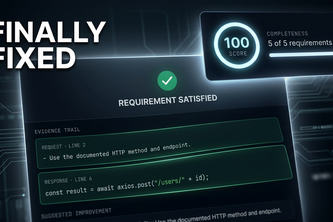
The description states that AI Review Engine is a local, deterministic TypeScript review engine with a React interface, built to compare:
- A user request
- Documentation (specifications or instructions)
- An AI response
It generates an evidence-backed report containing findings such as:
- Missing requirements
- Conflicts with documentation
- Unsupported claims
- Covered requirements
- Evidence references with source, line and quotation
- A deterministic completeness score
- Suggested areas for human verification
The system is described as not making runtime model calls; it uses GPT-5.6 only for shaping product architecture and reasoning, not for execution.
Inference The tool appears to be a developer-focused review engine, designed to help developers validate AI outputs against requirements and documentation in a structured way.
Positioning & Claim Evolution
The author claims that the system is not another chatbot, but rather a reviewer. It positions itself as:
- A tool for verifying AI-generated content
- A deterministic system that connects findings to evidence
- A human-in-the-loop solution, not an automated assessment engine
It emphasizes:
- Deterministic scoring
- Evidence-based reporting
- Human review boundaries
- Avoiding false positives or overconfidence in findings
Inference The positioning reflects a shift from generative AI tools toward validation and accountability systems, with a focus on traceability and epistemic restraint.
Target Customer & ICP
The description states that the system is built for developer workflows, and includes two prepared demonstrations:
- Reviewing an API implementation against its request and specification
- Reviewing a README against project requirements and documentation
It also mentions that future modules could support:
- Documentation Review
- Research Review
- Policy Review
- Contract Review
- Instruction Consistency Review
- AI Output Audit
Inference The initial ICP appears to be developers, with potential expansion into other domains like research, compliance, or policy review.
Business Model & Pricing Evidence
There is no evidence in the description of a business model or pricing strategy. The system is described as running locally without accounts, databases, API keys, or browser-side model calls. It is presented as a public prototype, not a commercial offering.
Inference No business model or pricing data is evidenced. The tool may be intended for open-source or internal use, or could evolve into a SaaS product later.
Technical & Delivery Signals
The system is built with:
- TypeScript
- React
- Node.js
- Vite
- Vitest
- GitHub integration
- Accessibility features (keyboard navigation, focus management)
- Responsive design
It uses:
- GPT-5.6 for shaping architecture and reasoning
- Codex for engineering workflow acceleration
Key technical features include:
- Requirement extraction and normalization
- Deduplication of findings
- Evidence matching and conflict detection
- Deterministic scoring
- Stable finding IDs derived from content
- Expandable evidence trails
Inference The system is a well-structured MVP, with clear separation between logic and presentation, and strong engineering practices like testing and documentation.
Traction & Maturity Signals
The description states that this is an MVP built during Build Week, and includes:
- A dedicated repository
- Two reproducible developer demonstrations
- Automated tests
- Accessible UI
- Explicit review boundaries and safeguards
However, there is no evidence of:
- Revenue
- Customers
- Usage metrics
- Product adoption beyond the prototype
- Post-MVP development or commercialization plans
Inference The system is early-stage, with no demonstrated traction or maturity beyond a hackathon prototype.
Competitive Context
The description does not mention any direct competitors. It positions itself as distinct from chatbots and other generative tools, focusing instead on review and verification workflows.
It implies that the tool addresses a gap in AI output validation, especially for developers who need to ensure alignment between AI-generated content and requirements or documentation.
Inference The competitive context is not clearly defined. It may compete with general-purpose AI review tools or developer tooling for code quality and compliance, but no specific competitors are named.
Open Questions & Risks
- No traction or adoption: No evidence of customers, usage, or revenue.
- Limited scope: The MVP is developer-focused; unclear if it will scale beyond this.
- Unproven commercial viability: No pricing model, monetization strategy, or business plan.
- Dependency on self-reported claims: The system's performance and accuracy are not independently verified.
- No external validation or feedback loops: The tool is described as a prototype with no real-world testing.
Inference The project is highly speculative, with no commercial evidence to support its potential for growth or scalability.
Questions the description leaves open
- Has the system been tested in real-world developer workflows?
- What are the plans for monetization and product evolution beyond the MVP?
- Are there any early adopters or pilot users?
- How does the tool handle edge cases, such as ambiguous documentation or multi-source inputs?
- Is there a roadmap for expanding beyond developer use cases (e.g., policy review)?
- What are the long-term plans for integrating with AI models or APIs?
Overall Assessment
Not evidenced: There is no evidence of revenue, customers, traction, or commercial viability. The system is described as a hackathon prototype, not a product in development or deployment.
The author states that this is an MVP built during Build Week, with no indication of ongoing development or market readiness.
Confidence level: Low
This project is not ready for investment or partnership without further evidence of traction, adoption, or commercial strategy. It remains a concept and prototype, not a validated product.
User Stories BotA demo video on every pull request
Get a demo video on every new feature
GitHub App that watches your pull requests and records a narrated, captioned demo.
Save time on demo prep and make informed decisions faster with a video walkthrough of every new feature.
Source
Submitted to the OpenAI 2026 hackathon on Devpost. Project home on Devpost. Back to the full gallery on Devpost.
This competitive analysis was produced by top-founders.com (opens in a new tab)
Generated by a language model from this project's public Devpost page — its tagline, the author's own write-up and any built-with tags listed there — as captured in August 2026. Short quotations are the author's words. It is an opinion on the idea as a business, not on the people behind it, and it reflects the description as published then. If the project has moved on, request a correction below. The analysis is not independent research and contains no verified traction, revenue or customer data.
An independent guide by KFG International LLC — not affiliated with, endorsed by, or connected to Devpost or OpenAI.