

Archive position — measured, not model output
0 likes on Devpost
2,263 of the 7,850 archived projects have more likes, and 5,587 share exactly 0 — so this project's #4,480 place in the like-ranked listing is a tie-break inside that group, not a ranking.
Projects (log scale)
Likes on Devpost. ▲ marks this project's group.
Show the figures
| Likes | Projects | Share of archive |
|---|---|---|
| 0 | 5,587 | 71.2% |
| 1 | 1,758 | 22.4% |
| 2 | 284 | 3.6% |
| 3–4 | 132 | 1.7% |
| 5–9 | 75 | 1.0% |
| 10+ | 14 | 0.2% |
 User Stories BotA demo video on every pull request
Get a demo video on every new feature
GitHub App that watches your pull requests and records a narrated, captioned demo.
Save time on demo prep and make informed decisions faster with a video walkthrough of every new feature.
Executive Summary
What the company appears to be
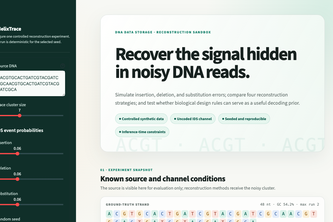
HelixTrace is a self-reported software prototype for recovering files from noisy synthetic DNA reads using machine learning-assisted reconstruction methods. It was built as part of an OpenAI hackathon submission and focuses on one aspect of future DNA storage systems: reliable read-back from imperfect evidence.
What changed
The project description indicates no prior version or evolution; it is presented as a single, self-contained prototype with no stated history or prior development.
The single most important open question — the commercial due-diligence read
Is there any evidence that this prototype has moved beyond experimental status into a functional product or service that could be monetized or integrated into larger systems?
What The Product Actually Is
The description states that HelixTrace is an ML-assisted prototype for recovering files from noisy synthetic-DNA reads without access to the original sequence. It includes:
- A Python package with a Streamlit interface
- A command-line experiment runner
- Deterministic benchmark scripts
- Committed model provenance
- 151 automated tests
The system encodes a file into DNA, simulates errors (insertions, deletions, substitutions), and then reconstructs the original file from noisy reads using a combination of deterministic methods and a small trained ridge model.
Inference The product is not described as a production-ready system but rather as a controlled software prototype designed to test one part of a future storage system.
Positioning & Claim Evolution
The author positions HelixTrace as a proof-of-concept for DNA archive recovery, focusing on the challenge of reconstructing files from imperfect evidence. It is not positioned as a replacement for existing storage technologies, but rather as a potential component in long-term cold data archival systems.
Key claims:
- The goal was not to build an educational DNA visualizer.
- It tests one practical part of a future storage system: can noisy DNA fragments be reconstructed into the original file?
- It proves that the result is exact rather than merely plausible.
Inference This suggests a focus on reliability and cryptographic verification, not scalability or commercial viability.
Target Customer & ICP
Not evidenced. The description does not identify any specific customer segments, target industries, or use cases beyond academic or experimental applications.
Business Model & Pricing Evidence
Not evidenced. There is no mention of pricing models, monetization strategies, or business structures in the project description.
Technical & Delivery Signals
The system uses:
- Python
- Streamlit for UI
- OpenAI Codex (GPT-5.6 Sol) as an engineering partner
- A reversible encoder that guarantees 50% GC content and no adjacent repeated bases
- A reconstruction engine combining trace medoid, global alignment, boundary-aware insertion handling, alignment consensus, and local-search refinements
- A small ridge model to rank candidates based on read agreement, sequence features, candidate agreement, and biological summaries
The project includes:
- 151 automated tests
- Deterministic experiments with seed-based reproducibility
- Benchmark scripts
- A strand sandbox for comparing methods under same evidence and search budget
Inference The technical stack is lightweight and focused on prototyping. It does not indicate any production infrastructure or scalability features.
Traction & Maturity Signals
Not evidenced. There is no mention of revenue, customers, adoption, or usage metrics beyond the author's own testing.
Competitive Context
Not evidenced. No competitors or market positioning are mentioned in the description.
Open Questions & Risks
- Prototype only: The project is explicitly described as a controlled software prototype, not a production-ready system.
- No real-world validation: It uses simulated reads and known fragment clusters; no wet-lab or empirical sequencer calibration.
- Limited scope: Focuses on one barrier—reliable read-back—but does not address synthesis cost, read latency, rewriting, or other major barriers to DNA storage.
- ML component is small and inspectable: The ML model is deliberately kept minimal and does not invent DNA sequences; it ranks candidates only.
- No API key or paid credits required for public app: This implies no monetization layer in the current version.
Questions the description leaves open
- What are the next steps beyond this prototype? Is there a plan to scale or integrate with real-world DNA storage systems?
- How does the current system handle larger files, and what are the limitations of its approach at scale?
- Are there any plans for production error-correcting codes, demultiplexing, or empirical sequencer calibration?
- What is the intended path to commercialization or integration into existing DNA storage platforms?
- Has the team considered how this prototype might be used in real-world applications beyond the current simulation setup?
Overall Assessment
Not evidenced. The description provides no information about funding, valuation, or investment interest.
Self-reported basis only: This is a controlled software prototype submitted to a hackathon. It does not demonstrate traction, revenue, customers, or a clear path to monetization. There is no evidence of product-market fit, scalability, or commercial viability beyond the experimental scope described.
The project shows technical capability in a narrow domain but lacks signals of broader applicability or business maturity. Any investment or partnership decision would require further evidence of progress beyond prototype status and alignment with real-world DNA storage needs.
User Stories BotA demo video on every pull request
Get a demo video on every new feature
GitHub App that watches your pull requests and records a narrated, captioned demo.
Save time on demo prep and make informed decisions faster with a video walkthrough of every new feature.
Source
Submitted to the OpenAI 2026 hackathon on Devpost. Project home on Devpost. Back to the full gallery on Devpost.
This competitive analysis was produced by top-founders.com (opens in a new tab)
Generated by a language model from this project's public Devpost page — its tagline, the author's own write-up and any built-with tags listed there — as captured in August 2026. Short quotations are the author's words. It is an opinion on the idea as a business, not on the people behind it, and it reflects the description as published then. If the project has moved on, request a correction below. The analysis is not independent research and contains no verified traction, revenue or customer data.
An independent guide by KFG International LLC — not affiliated with, endorsed by, or connected to Devpost or OpenAI.