

Archive position — measured, not model output
0 likes on Devpost
2,263 of the 7,850 archived projects have more likes, and 5,587 share exactly 0 — so this project's #4,482 place in the like-ranked listing is a tie-break inside that group, not a ranking.
Projects (log scale)
Likes on Devpost. ▲ marks this project's group.
Show the figures
| Likes | Projects | Share of archive |
|---|---|---|
| 0 | 5,587 | 71.2% |
| 1 | 1,758 | 22.4% |
| 2 | 284 | 3.6% |
| 3–4 | 132 | 1.7% |
| 5–9 | 75 | 1.0% |
| 10+ | 14 | 0.2% |
 User Stories BotA demo video on every pull request
Get a demo video on every new feature
GitHub App that watches your pull requests and records a narrated, captioned demo.
Save time on demo prep and make informed decisions faster with a video walkthrough of every new feature.
Executive Summary
What the company appears to be
Hello Again is described as a smartphone-only reunion assistant that helps users remember names and context when meeting friends again—without facial recognition, continuous tracking, or extra hardware. It allows two people to exchange profiles via QR code, camera, or six-character code, then register one location snapshot valid for one hour. When nearby, it restores name, organization, private notes, and conversation cues.
What changed
The project is an individual submission built with Codex, submitted to the OpenAI 2026 hackathon. It was designed as a mobile-first React/TypeScript app running on Cloudflare Workers, using GPT-5.6 for structured outputs and image generation. The author states that it was built by one person (Fumiya Imazato) with help from Codex.
Single most important open question
Is there any evidence of real-world usage or user feedback beyond the demo and self-reported build process?
Note: This analysis is based entirely on the self-reported, unverified description provided by the author. No third-party verification, traction data, revenue figures, or customer information are available.
What The Product Actually Is
The description states that Hello Again is a smartphone-only reunion assistant. It enables two people to exchange profiles using QR code, camera scan, or six-character code. Users can voluntarily register one location snapshot valid for one hour when meeting again. At that time, the app restores a friend’s name, organization, private note, and conversation cue.
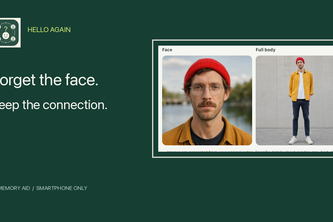
It does not perform facial recognition, continuous tracking, or biometric enrollment. Profile photos may be old or unhelpful; users can generate photorealistic fictional memory images from written visual traits using GPT-5.6 image generation tools. These AI-generated portraits are labeled as non-identifying and clearly marked as AI-imagined.
The product is built as a mobile-first React and TypeScript application running on Cloudflare Workers through vinext, storing data in Cloudflare D1 and R2. It supports multiple languages including Japanese, English, Simplified Chinese, Korean, Spanish, French, German, and Portuguese.
Claim: The app uses GPT-5.6 for structured outputs and image generation.
Evidence: Described by the author as integrated via Responses API with strict Structured Outputs and store: false; GPT Image 2 generates face and full-body images from written traits.
Inference: The product is a prototype or demo version, not yet commercialized.
Supporting evidence: Submitted to a hackathon; no mention of production deployment or monetization.
Positioning & Claim Evolution
The author positions Hello Again as a tool that improves social interactions by reducing the stress of meeting someone for the second time. It emphasizes privacy and consent by avoiding facial recognition, continuous tracking, and automated judgment.
Key claims include:
- No facial recognition or biometric enrollment.
- No background location tracking or real-time updates.
- AI-generated portraits are clearly labeled as fictional and non-identifying.
- Users control all private notes, caution flags, and profile data.
- Consent is versioned and stored with the profile.
- The system prohibits AI from evaluating danger, trustworthiness, or personality.
Claim: The app avoids treating face memory as a test people must pass in order to belong.
Evidence: Stated directly in the inspiration section.
Inference: The positioning reflects a focus on empathy and user autonomy.
Supporting evidence: Emphasis on voluntary actions, private note editing, and human control over AI outputs.
Target Customer & ICP
The description does not explicitly define target customers or ideal customer profiles (ICP). However, it implies use cases for:
- People who frequently meet friends or colleagues in person.
- Individuals who struggle with remembering names or context during reconnections.
- Users concerned about privacy and data control.
Claim: The product targets people who find name recall stressful.
Evidence: Mentioned in the inspiration section.
Inference: Likely audience includes professionals, students, alumni networks, conference attendees, and community members.
Supporting evidence: Future business paths mentioned include workplace partnerships, conferences, and alumni groups.
Business Model & Pricing Evidence
There is no evidence of a business model or pricing strategy in the description. The project is described as an individual hackathon submission with no indication of monetization plans or revenue streams.
Claim: No explicit business model or pricing information provided.
Evidence: Author does not describe how the product will be sold, licensed, or funded.
Technical & Delivery Signals
The product is built using:
- Mobile-first React and TypeScript
- Cloudflare Workers via vinext
- Cloudflare D1 for data storage
- Cloudflare R2 for image storage
- QR generation and camera scanning for profile exchange
- GPT-5.6 APIs for structured outputs and image creation
- Multilingual UI support (eight languages)
It includes features like:
- One-hour location snapshots
- Private note editing
- AI-generated fictional portraits
- Verified-email restoration
- Consent management with versioning
Claim: The product is a working public demo.
Evidence: Author states it has a “working public judge demo” and includes a demo video.
Inference: The architecture is designed for minimal hardware dependency and mobile-first UX.
Supporting evidence: Use of browser-based technologies, no dedicated hardware, one-tap judge mode.
Traction & Maturity Signals
There is no evidence of traction, users, or adoption beyond the demo. The author describes a “working public judge demo” but provides no data on:
- Number of active users
- Frequency of use
- User engagement metrics
- Customer feedback or retention
Claim: No traction or user data available.
Evidence: Author does not report any usage statistics, customer base, or adoption rates.
Competitive Context
The description does not reference competitors or existing solutions in the market. It focuses on unique aspects such as:
- No facial recognition
- No continuous tracking
- AI-generated fictional portraits
- Voluntary location snapshots
- Explicit consent mechanisms
Claim: No mention of competitive landscape.
Evidence: No comparison to other apps, tools, or platforms.
Open Questions & Risks
Key risks and open questions include:
- Unproven market demand: No evidence of real-world usage or user feedback.
- Limited scalability: Built as a hackathon submission; unclear if it can scale beyond demo.
- AI dependency: Relies heavily on GPT-5.6 for core functionality, which may not be reliable long-term.
- Single-person development: One developer built the entire product, raising concerns about sustainability and future maintenance.
- Privacy claims vs. implementation: While privacy is emphasized, there’s no independent verification of how well these protections are enforced.
Inference: Lack of commercial viability or traction raises questions about long-term sustainability.
Supporting evidence: No revenue, customers, or business model described.
Questions the description leaves open
- What is the expected user journey beyond the demo?
- How will you ensure consistent performance and reliability in real-world conditions?
- Are there plans to monetize the product? If so, what is your go-to-market strategy?
- How do you plan to scale beyond a single developer?
- What are the technical limitations of relying on browser-based APIs for location tracking?
- Have you considered how users might misuse or abuse the caution flag feature?
- Is there any plan to integrate with existing social or professional platforms?
Overall Assessment
There is insufficient evidence to assess investment or partnership potential at this stage.
Claim: No commercial traction, revenue, or customer data.
Evidence: The description is limited to a hackathon submission and self-reported build process.
Inference: This project may be an early-stage idea with high conceptual value but low demonstrated viability.
Supporting evidence: No sign of product-market fit, user engagement, or business model traction.
User Stories BotA demo video on every pull request
Get a demo video on every new feature
GitHub App that watches your pull requests and records a narrated, captioned demo.
Save time on demo prep and make informed decisions faster with a video walkthrough of every new feature.
Source
Submitted to the OpenAI 2026 hackathon on Devpost. Project home on Devpost. Back to the full gallery on Devpost.
This competitive analysis was produced by top-founders.com (opens in a new tab)
Generated by a language model from this project's public Devpost page — its tagline, the author's own write-up and any built-with tags listed there — as captured in August 2026. Short quotations are the author's words. It is an opinion on the idea as a business, not on the people behind it, and it reflects the description as published then. If the project has moved on, request a correction below. The analysis is not independent research and contains no verified traction, revenue or customer data.
An independent guide by KFG International LLC — not affiliated with, endorsed by, or connected to Devpost or OpenAI.