

Archive position — measured, not model output
1 like on Devpost
505 of the 7,850 archived projects have more likes, and 1,758 share exactly 1 — so this project's #556 place in the like-ranked listing is a tie-break inside that group, not a ranking.
Projects (log scale)
Likes on Devpost. ▲ marks this project's group.
Show the figures
| Likes | Projects | Share of archive |
|---|---|---|
| 0 | 5,587 | 71.2% |
| 1 | 1,758 | 22.4% |
| 2 | 284 | 3.6% |
| 3–4 | 132 | 1.7% |
| 5–9 | 75 | 1.0% |
| 10+ | 14 | 0.2% |
 User Stories BotA demo video on every pull request
Get a demo video on every new feature
GitHub App that watches your pull requests and records a narrated, captioned demo.
Save time on demo prep and make informed decisions faster with a video walkthrough of every new feature.
Executive Summary
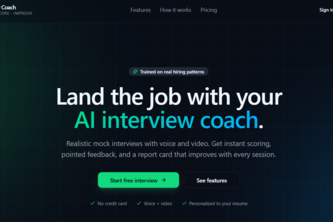
The description states that "AI Interview Coach" is an AI-powered web application designed to simulate real interview experiences for students and professionals. The author claims it offers features such as resume analysis, AI-generated interview questions, voice-based interviews with speech recognition, emotion and confidence analysis, eye contact detection, performance scoring, and personalized feedback.
The project appears to be a single-person effort built during a hackathon, using technologies like React.js, FastAPI, Python, MongoDB, OpenCV, MediaPipe, Whisper API, and Llama 3/GPT-based language models. It is positioned as a tool for interview preparation that aims to provide personalized feedback and improve confidence.
The most important open question is whether this concept can scale beyond a hackathon prototype into a viable product with real users, traction, or monetization — which is not evidenced in the description.
What The Product Actually Is
The description states that AI Interview Coach is an "intelligent web application that simulates real interview experiences using Artificial Intelligence." It combines multiple AI technologies including Natural Language Processing (NLP), Machine Learning (ML), and Computer Vision (CV).
Key technical components include:
- Frontend: React.js, Tailwind CSS
- Backend: FastAPI (Python)
- Database: MongoDB
- ML models: Scikit-learn, Hugging Face Transformers
- CV tools: OpenCV, MediaPipe
- Speech recognition: Whisper API
- AI models: Llama 3 / GPT-based language model
The application allows users to upload resumes and start mock interviews. It processes resumes, generates interview questions, analyzes speech and facial expressions, and provides AI-powered feedback.
Not evidenced: actual functionality beyond the author's claims; no demonstration or user testing data.
Positioning & Claim Evolution
The description states that the project was inspired by students struggling to prepare for technical and HR interviews due to lack of personalized feedback. The authors claim they wanted to create an AI-powered interview coach that helps users practice anytime, receive instant feedback, and improve confidence.
The positioning is described as a "career growth companion" with a focus on accessibility — aiming to make mock interviews available without requiring mentors or paid platforms.
The vision outlined includes expanding into:
- AI avatar interviewer
- Multi-language support
- Live coding interview environment
- Company-specific preparation
- Personalized career roadmap
- Cover letter generation
- Mobile app development
These claims represent a progression from a basic prototype to a full platform, but no evidence of actual implementation or market traction exists.
Target Customer & ICP
The description states that the target audience includes "students" and "professionals" preparing for interviews. The inspiration behind the project was specifically about helping students who lack access to mentors or paid platforms.
No further segmentation is provided in the description beyond this general grouping of users seeking interview preparation help.
Not evidenced: specific customer personas, user demographics, or detailed buyer profiles.
Business Model & Pricing Evidence
The description does not contain any information about pricing models, monetization strategies, or business model assumptions. The authors do not state how they intend to charge for the service or what revenue streams they expect.
Not evidenced: business model, pricing tiers, monetization approach.
Technical & Delivery Signals
The description states that the project was built using:
- Frontend: React.js, Tailwind CSS
- Backend: FastAPI (Python)
- Database: MongoDB
- ML tools: Scikit-learn, Hugging Face Transformers
- CV tools: OpenCV, MediaPipe
- Speech recognition: Whisper API
- AI models: Llama 3 / GPT-based language model
Deployment was done via Vercel (frontend) and Render (backend). The authors mention challenges such as integrating multiple AI models, optimizing for real-time performance, and handling different accents.
Not evidenced: actual delivery quality, scalability, or production readiness beyond the hackathon prototype.
Traction & Maturity Signals
The description states that this was a project submitted to the OpenAI 2026 hackathon. It is described as a "complete AI-powered interview assistant" built in a short timeframe by one person (Ravi Nandan Kulmi).
No evidence of user adoption, customer base, revenue, or usage metrics is provided.
Not evidenced: traction, user engagement, or product maturity beyond the prototype stage.
Competitive Context
The description does not provide any information about existing competitors or market positioning relative to other tools in the space. The authors do not reference similar products or platforms that offer interview coaching or preparation services.
Not evidenced: competitive landscape, differentiation strategy, or market analysis.
Open Questions & Risks
- Single-person development: The project was built by one individual, raising questions about scalability and long-term maintenance.
- Prototype nature: It is described as a hackathon submission with no evidence of real-world usage or product-market fit.
- Technical complexity: Integration of multiple AI models (speech recognition, computer vision, NLP) presents significant engineering challenges that may not have been fully resolved in the prototype.
- Lack of commercial viability signals: No pricing, monetization, or revenue data is provided.
- Unverified claims: All features and capabilities are self-reported without independent validation.
Questions the description leaves open
- What specific problems do you observe in current interview preparation tools?
- How did you validate the need for this product with potential users?
- Have you tested the accuracy of emotion/eye contact detection under various lighting conditions?
- What are your plans for scaling beyond a single developer?
- How do you plan to monetize the platform once it moves beyond prototype status?
- What is your roadmap for integrating live coding or company-specific interview features?
- Are there any partnerships or integrations with educational institutions or job portals planned?
Overall Assessment
Not evidenced: No information provided regarding financials, traction, or commercial viability to support an investment or partnership decision.
The description indicates a single-person hackathon project with no verified users, revenue, or product-market fit. The claims about functionality and future features are unvalidated. There is insufficient evidence to assess whether this represents a viable business opportunity or if it requires significant development before reaching market readiness.
This is a self-reported concept that has not demonstrated any commercial traction or proven user demand. Any investment or partnership would be based on speculative potential rather than demonstrated value.
User Stories BotA demo video on every pull request
Get a demo video on every new feature
GitHub App that watches your pull requests and records a narrated, captioned demo.
Save time on demo prep and make informed decisions faster with a video walkthrough of every new feature.
Source
Submitted to the OpenAI 2026 hackathon on Devpost. Project home on Devpost. Back to the full gallery on Devpost.
This competitive analysis was produced by top-founders.com (opens in a new tab)
Generated by a language model from this project's public Devpost page — its tagline, the author's own write-up and any built-with tags listed there — as captured in August 2026. Short quotations are the author's words. It is an opinion on the idea as a business, not on the people behind it, and it reflects the description as published then. If the project has moved on, request a correction below. The analysis is not independent research and contains no verified traction, revenue or customer data.
An independent guide by KFG International LLC — not affiliated with, endorsed by, or connected to Devpost or OpenAI.