

Archive position — measured, not model output
0 likes on Devpost
2,263 of the 7,850 archived projects have more likes, and 5,587 share exactly 0 — so this project's #4,471 place in the like-ranked listing is a tie-break inside that group, not a ranking.
Projects (log scale)
Likes on Devpost. ▲ marks this project's group.
Show the figures
| Likes | Projects | Share of archive |
|---|---|---|
| 0 | 5,587 | 71.2% |
| 1 | 1,758 | 22.4% |
| 2 | 284 | 3.6% |
| 3–4 | 132 | 1.7% |
| 5–9 | 75 | 1.0% |
| 10+ | 14 | 0.2% |
 User Stories BotA demo video on every pull request
Get a demo video on every new feature
GitHub App that watches your pull requests and records a narrated, captioned demo.
Save time on demo prep and make informed decisions faster with a video walkthrough of every new feature.
Executive Summary
What the company appears to be
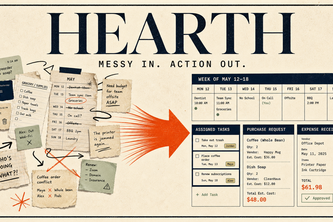
Hearth is a self-reported AI-powered tool that processes unstructured messages (e.g., household or workplace communications) into structured action plans. It extracts tasks, people, dates, purchases and conflicts, presenting them for human review before committing changes to a shared workspace.
What changed
The author initially conceived Hearth as a household organizer but expanded its scope to include workplace operations during development. This evolution was driven by the recognition that similar communication challenges exist in both domains.
The single most important open question
Does Hearth have any real-world usage or adoption beyond the author’s own prototype, and if so, how does it perform in practice against messy, real-world inputs?
Note: All claims are self-reported and unverified. No evidence of revenue, customers, traction or commercial activity is provided.
What The Product Actually Is
The description states that Hearth:
- Processes unstructured messages into structured actions.
- Identifies groceries, chores, appointments, bills, scheduling conflicts (household).
- Identifies purchase requests, tasks, meetings, deadlines, expenses and invoices (workplace).
- Uses GPT-5.6 via OpenAI API to extract information from pasted text.
- Presents extracted items in a review screen with source evidence, confidence scores and conflict detection.
- Requires user approval before saving any changes to the shared workspace.
- Is built using Next.js, React, TypeScript, Prisma, SQLite, Zod, Codex, and OpenAI API.
Inference: The product appears to be an AI-assisted workflow automation tool for organizing communication into actionable items. It is not a full collaboration platform or CRM but rather a message-to-task extractor with a human-in-the-loop validation step.
Positioning & Claim Evolution
The author states:
- Initially, Hearth was conceived as a household organizer.
- During development, the idea evolved to include workplace operations.
- The core premise remains: paste messy messages and get clear action plans.
- It is positioned as a tool that prevents useful actions from “disappearing inside” communication.
Inference: The positioning shifted from niche (household) to broader (both home and work), suggesting an intent to scale the use case. However, there is no evidence of market testing or user feedback driving this evolution.
Target Customer & ICP
The description states:
- Household users who want to turn verbal or written messages into grocery lists, chore assignments, etc.
- Workplace teams looking to extract tasks, meetings and purchase requests from informal updates.
- Users who communicate via text-based platforms like Slack, email or group chats.
Inference: The ICP seems to be individuals or small teams managing shared workspaces where communication is unstructured. No evidence of segmentation beyond these two broad categories.
Business Model & Pricing Evidence
The description does not mention:
- Any pricing model
- Revenue streams
- Monetization strategy
- Subscription tiers or usage-based billing
Not evidenced: There is no indication of how Hearth intends to generate revenue or whether it has a business model beyond its prototype.
Technical & Delivery Signals
The description states:
- Built with Next.js, React, TypeScript, Prisma, SQLite, Zod, Codex, OpenAI API.
- Uses GPT-5.6 for extraction.
- Implements structured AI responses validated by Zod before display.
- Includes review screen with confidence scores and source evidence.
- Supports atomic database commits.
- Has responsive layouts for mobile and desktop.
- Features activity history and member management.
Inference: The technical stack suggests a modern, full-stack web application. The use of validation (Zod) and structured AI responses indicates some attention to data integrity and UX design.
Traction & Maturity Signals
The description states:
- This is a hackathon submission.
- No revenue or customer data are provided.
- The author built it alone in one project cycle.
- It includes many features beyond basic functionality, such as calendars, fulfillment tracking, and member management.
Not evidenced: There is no evidence of traction, adoption, or usage beyond the prototype. No metrics, users, or product-market fit indicators are included.
Competitive Context
The description does not mention:
- Competitors
- Market size
- Existing solutions in this space
- Differentiation from similar tools
Not evidenced: No competitive analysis or positioning relative to existing tools is provided.
Open Questions & Risks
Key risks and open questions based on the description:
- The product is described as a single-person hackathon project with no evidence of real-world usage.
- AI reliability issues are acknowledged (e.g., ambiguous dates, missing assumptions), which could lead to poor user experience or errors in extraction.
- No mention of scalability, security, or enterprise readiness.
- The lack of pricing, monetization or business model raises questions about long-term viability.
- The product is not described as having any integration with existing communication tools (Slack, email, etc.), limiting its utility.
Inference: Without real-world testing or commercial traction, the risk of misalignment between intended functionality and actual user needs is high.
Questions the description leaves open
- What specific types of messages have you tested Hearth with? How well does it handle ambiguity?
- Have you conducted any usability studies or gathered feedback from real users?
- Are there plans to integrate with Slack, email or other communication platforms?
- How do you plan to monetize this product, and what is your go-to-market strategy?
- What are the technical limitations of GPT-5.6 in extracting structured data reliably across different domains?
- Is there any internal testing or pilot use case that shows real-world performance?
Overall Assessment
The description states:
- Hearth is a hackathon project built by one person.
- It has no revenue, customers or commercial traction.
- It includes advanced features like AI validation and conflict detection.
Assessment: This is an early-stage idea with strong technical execution and a clear problem-solution fit. However, due to the lack of evidence for traction, adoption or business model, it does not yet meet criteria for investment or partnership consideration. It may be a promising prototype, but further validation is needed before any strategic move.
Confidence: Low — based on self-reported, unverified information only.
User Stories BotA demo video on every pull request
Get a demo video on every new feature
GitHub App that watches your pull requests and records a narrated, captioned demo.
Save time on demo prep and make informed decisions faster with a video walkthrough of every new feature.
Source
Submitted to the OpenAI 2026 hackathon on Devpost. Project home on Devpost. Back to the full gallery on Devpost.
This competitive analysis was produced by top-founders.com (opens in a new tab)
Generated by a language model from this project's public Devpost page — its tagline, the author's own write-up and any built-with tags listed there — as captured in August 2026. Short quotations are the author's words. It is an opinion on the idea as a business, not on the people behind it, and it reflects the description as published then. If the project has moved on, request a correction below. The analysis is not independent research and contains no verified traction, revenue or customer data.
An independent guide by KFG International LLC — not affiliated with, endorsed by, or connected to Devpost or OpenAI.