

Archive position — measured, not model output
0 likes on Devpost
2,263 of the 7,850 archived projects have more likes, and 5,587 share exactly 0 — so this project's #6,434 place in the like-ranked listing is a tie-break inside that group, not a ranking.
Projects (log scale)
Likes on Devpost. ▲ marks this project's group.
Show the figures
| Likes | Projects | Share of archive |
|---|---|---|
| 0 | 5,587 | 71.2% |
| 1 | 1,758 | 22.4% |
| 2 | 284 | 3.6% |
| 3–4 | 132 | 1.7% |
| 5–9 | 75 | 1.0% |
| 10+ | 14 | 0.2% |
 User Stories BotA demo video on every pull request
Get a demo video on every new feature
GitHub App that watches your pull requests and records a narrated, captioned demo.
Save time on demo prep and make informed decisions faster with a video walkthrough of every new feature.
Executive Summary
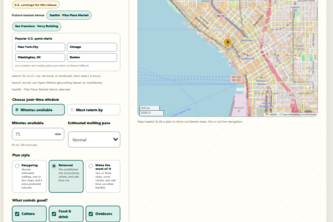
What the company appears to be: RoamBuffer is a U.S.-focused travel planning tool built as a hackathon project. It allows users to create time-boxed mini-itineraries based on current location, return time, walking pace, and preferences. The tool integrates weather data, OpenStreetMap places, and deterministic scoring to suggest nearby stops within a safe exploration window.
What changed: The author states that the project was built for a hackathon and is not yet in production or commercial use. It includes no revenue, customers, or adoption data.
Single most important open question: Is there any evidence of traction, monetization, or user feedback beyond the self-reported hackathon submission?
Analysis basis: This report is based entirely on the self-reported, unverified description provided by the author. No third-party verification, archived data, or external sources are available.
What The Product Actually Is
The description states that RoamBuffer is a travel planning tool designed to help users explore nearby locations during unexpected downtime while ensuring they return on time. It creates time-boxed itineraries using:
- U.S.-based location data
- Weather context from Open-Meteo
- Place data from OpenStreetMap
- Deterministic scoring logic (not LLM-based)
- Walking time estimation via Haversine distance with conservative route multiplier
It supports three planning styles: Easygoing, Balanced, and Make the most of it. It includes features like:
- Return-time buffer enforcement
- Local saving and sharing via URL
- Browser-local storage
- No account required
- Progressive Web App (PWA) interface
Inference: The tool is built as a single-user, non-commercial application with no server-side data persistence or user accounts.
Positioning & Claim Evolution
The author claims RoamBuffer addresses the problem of “unexpected travel downtime” by offering a way to explore nearby locations without losing track of return time. It positions itself as a solution for travelers who have "enough time to explore—but not enough time to confidently decide where to go and still return on schedule."
It emphasizes:
- Time-bound planning
- Weather-aware recommendations
- Deterministic, explainable results
- No account or data collection
Claim vs. Fact: The description states the tool is built for a hackathon and does not mention any commercial product, user feedback, or market traction.
Target Customer & ICP
The author describes RoamBuffer as intended for travelers with unexpected downtime—such as those experiencing train delays or early hotel arrivals—who want to explore nearby locations without risking missed connections.
It targets:
- U.S.-based users
- Travelers seeking spontaneous but time-bound exploration
- Users who value deterministic planning over AI-generated suggestions
Inference: The tool is not designed for regular travelers, tourists, or commercial travel services. It is a niche solution for short-term, unplanned exploration.
Business Model & Pricing Evidence
The description does not indicate any business model or pricing structure. The author states:
- No account is required
- No server-side data collection
- No paid APIs or subscriptions
- No mention of monetization or revenue streams
Claim vs. Fact: The tool appears to be a non-commercial prototype, with no evidence of a monetization strategy.
Technical & Delivery Signals
The project was built using:
- Backend: Python, FastAPI, Pydantic, HTTPX, Uvicorn
- Frontend: Jinja2, HTML5, CSS3, JavaScript, Leaflet.js
- Data sources: OpenStreetMap, Open-Meteo, GeoNames
- Deployment: Render, GitHub Actions
- Testing: pytest, Playwright, browser tests
It includes:
- Typed external-service adapters
- Caching and bounded retries
- Request pacing
- Fixture fallbacks
- Structured error states
- PWA shell
- Responsive layout
- Accessible controls
Inference: The tool is technically robust for a hackathon prototype but lacks commercial-grade scalability or user management features.
Traction & Maturity Signals
There is no evidence of traction, adoption, or usage beyond the author’s own submission. The project:
- Was built in a hackathon
- Has no customer base
- No revenue or ARR data
- No user feedback or reviews
- No production deployment or public access
Absence of evidence: No data on user engagement, retention, or market response.
Competitive Context
The description does not mention any competitors. However, the author’s emphasis on deterministic planning and time-bound exploration suggests a niche in contrast to AI-driven itinerary tools or general travel apps that offer open-ended suggestions.
Inference: RoamBuffer may compete with or complement existing travel apps by focusing on constrained, weather-aware exploration rather than open-ended discovery.
Open Questions & Risks
- No commercial traction or revenue: The project is a hackathon submission with no evidence of market adoption.
- Limited scope: U.S.-only coverage and no international expansion plans.
- No user feedback or testing: No data on how users interact with the tool or whether it solves real problems.
- Unproven scalability: Built as a single-person prototype, not designed for large-scale use.
- No monetization path: No indication of how the tool would generate revenue.
Inference: The project is in early development and lacks commercial viability or strategic positioning.
Questions the description leaves open
- What inspired you to build this as a travel planning tool?
- Have you tested RoamBuffer with real users beyond yourself?
- Are there any plans to expand beyond U.S. locations?
- How do you plan to monetize or scale the product if at all?
- What are your long-term goals for RoamBuffer?
- Do you have any feedback from judges or participants of the hackathon?
Overall Assessment
Not evidenced: There is no evidence of a commercial product, revenue, customers, or market traction.
Confidence level: Very low — this is a self-reported hackathon project with no external validation or business metrics. It does not meet criteria for investment or partnership at this stage.
User Stories BotA demo video on every pull request
Get a demo video on every new feature
GitHub App that watches your pull requests and records a narrated, captioned demo.
Save time on demo prep and make informed decisions faster with a video walkthrough of every new feature.
Source
Submitted to the OpenAI 2026 hackathon on Devpost. Project home on Devpost. Back to the full gallery on Devpost.
This competitive analysis was produced by top-founders.com (opens in a new tab)
Generated by a language model from this project's public Devpost page — its tagline, the author's own write-up and any built-with tags listed there — as captured in August 2026. Short quotations are the author's words. It is an opinion on the idea as a business, not on the people behind it, and it reflects the description as published then. If the project has moved on, request a correction below. The analysis is not independent research and contains no verified traction, revenue or customer data.
An independent guide by KFG International LLC — not affiliated with, endorsed by, or connected to Devpost or OpenAI.