

Archive position — measured, not model output
0 likes on Devpost
2,263 of the 7,850 archived projects have more likes, and 5,587 share exactly 0 — so this project's #4,448 place in the like-ranked listing is a tie-break inside that group, not a ranking.
Projects (log scale)
Likes on Devpost. ▲ marks this project's group.
Show the figures
| Likes | Projects | Share of archive |
|---|---|---|
| 0 | 5,587 | 71.2% |
| 1 | 1,758 | 22.4% |
| 2 | 284 | 3.6% |
| 3–4 | 132 | 1.7% |
| 5–9 | 75 | 1.0% |
| 10+ | 14 | 0.2% |
 User Stories BotA demo video on every pull request
Get a demo video on every new feature
GitHub App that watches your pull requests and records a narrated, captioned demo.
Save time on demo prep and make informed decisions faster with a video walkthrough of every new feature.
Executive Summary
What the company appears to be
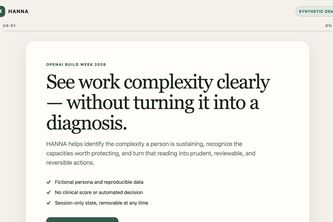
HANNA is an AI-assisted cognitive architecture designed to support complex work environments by preserving human judgment and capacity. The project is a self-contained web application built as a demonstration for the OpenAI 2026 hackathon, using GPT-5.6 and structured outputs to guide users through synthetic case reviews.
What changed
The author describes HANNA as a prototype that implements a workflow where AI generates preliminary analysis but requires human review before any output can be downloaded or saved. It emphasizes non-scored qualitative visualization, evidence separation, and human control over interpretation and decision-making.
Single most important open question
Is there evidence of traction, revenue, or real-world adoption beyond the hackathon demo? The description does not indicate any commercial activity or customer base.
What The Product Actually Is
The description states that HANNA is an AI-assisted cognitive architecture implemented as a web application built with Next.js and TypeScript. It uses GPT-5.6 for structured analysis, integrates with GitHub and Vercel, and operates without storing data in a database. The system supports a workflow involving:
- capturing work context
- identifying qualitative dimensions of complexity
- mapping available support
- generating non-scored visualizations
- using AI to produce preliminary outputs
- requiring human review before download or approval
The application is described as running entirely on the frontend and backend with no persistent storage, and all session data is deleted upon closing the demo.
Evidence
- Built with Next.js, TypeScript, React, Node.js, OpenAI API, GPT-5.6
- Uses Codex for development
- No database used; store: false in OpenAI requests
- Session state removed on close
Inference This is a proof-of-concept prototype built for demonstration purposes.
Positioning & Claim Evolution
The author positions HANNA as an AI-assisted cognitive architecture that preserves human capacity—not replaces it. It aims to support individuals who sustain complex work environments, such as those who "clarify decisions, connect workstreams, follow up across teams, and protect continuity."
Key claims include:
- Not a diagnostic tool or evaluator
- Designed to make sustained complexity easier to examine
- Protects privacy and human judgment
- Human control is not limited to final approval but changes the output
Evidence
- Tagline: “HANNA is an AI-assisted cognitive architecture designed to preserve human capacity—not replace it.”
- Workflow includes human review that modifies outputs
- Emphasis on non-scored visualization, reversible recommendations, and traceable disagreement
Inference The positioning reflects a philosophical stance against automation of judgment, which may appeal to organizations concerned with ethical AI use.
Target Customer & ICP
The description does not name specific customers or define an ideal customer profile (ICP). However, it implies that HANNA targets individuals working in complex environments who need support managing sustained complexity and continuity.
It also suggests a potential audience for pilot testing:
- Organizations interested in ethical AI use
- Teams seeking tools to enhance human judgment without replacing it
Evidence
- Focus on people who "clarify decisions, connect workstreams, follow up across teams"
- Mention of future pilots with consented participants
- No explicit customer segmentation or persona details
Inference The target is likely professionals in roles requiring sustained cognitive effort and decision-making under uncertainty.
Business Model & Pricing Evidence
There is no evidence of a business model or pricing structure. The project is presented as a hackathon submission with no indication of monetization, licensing, or commercial deployment plans.
Evidence
- No mention of revenue streams
- No pricing information
- No indication of paid services or subscriptions
Inference The current version is a prototype with no known commercialization strategy.
Technical & Delivery Signals
HANNA was built using:
- Frontend: Next.js, React, TypeScript
- Backend: Node.js, OpenAI API (GPT-5.6)
- Development tools: Codex, GitHub, Vercel
- Output format: JSON schema with structured contracts
- Security features: No database, store: false in OpenAI requests, session deletion
The system supports:
- Structured output from AI
- Human review that modifies results
- Mobile and accessibility verification
- Unit tests (11 of 11 passing)
- Zero known vulnerabilities in production dependencies
Evidence
- Built with specific tech stack including GPT-5.6, JSON schema, Zod
- Uses OpenAI API with store: false
- Session data deleted on close
- Mobile and accessibility tested
- Unit tests passed
- No known vulnerabilities reported
Inference Technical implementation shows attention to design constraints like privacy and traceability.
Traction & Maturity Signals
There is no evidence of traction, revenue, or customer adoption beyond the hackathon demo. The project has not been released for public use or commercial deployment.
Evidence
- Public demonstration only
- No mention of users, customers, or usage metrics
- No indication of product-market fit or scaling efforts
Inference This is a pre-product prototype with no demonstrated market traction.
Competitive Context
The description does not reference competitors or similar products. It focuses on the unique value proposition of preserving human judgment in AI-assisted workflows rather than comparing itself to existing tools.
Evidence
- No mention of competing solutions
- No competitive analysis provided
Inference It may compete with AI tools that automate decision-making, but no direct comparison is made.
Open Questions & Risks
Key risks include:
- Lack of commercial traction or evidence of real-world demand
- Prototype-only status with no indication of scalability or product development beyond the hackathon
- Unclear path to monetization or market entry
- No data on user feedback, usability testing, or long-term viability
Evidence
- No revenue, customers, or adoption metrics
- No roadmap for commercialization
- No mention of feedback loops or iterative improvements
Inference The project lacks evidence of a viable business model or product-market fit.
Questions the description leaves open
- What is the intended path from prototype to product?
- Are there any plans for user testing or pilot programs beyond the hackathon?
- How does HANNA handle real-world data privacy and compliance concerns?
- What are the technical limitations of the current architecture that would prevent scaling?
- Is there a plan to expand beyond synthetic cases into real-world applications?
Overall Assessment
Not evidenced.
There is no evidence of revenue, customers, or traction beyond the hackathon demo. The project remains in prototype form with no indication of commercial viability or strategic partnerships.
The description states that HANNA is a demonstration for the OpenAI 2026 hackathon and does not indicate any ongoing development or investment interest from third parties.
Confidence level Low — based on self-reported evidence only, no external validation.
User Stories BotA demo video on every pull request
Get a demo video on every new feature
GitHub App that watches your pull requests and records a narrated, captioned demo.
Save time on demo prep and make informed decisions faster with a video walkthrough of every new feature.
Source
Submitted to the OpenAI 2026 hackathon on Devpost. Project home on Devpost. Back to the full gallery on Devpost.
This competitive analysis was produced by top-founders.com (opens in a new tab)
Generated by a language model from this project's public Devpost page — its tagline, the author's own write-up and any built-with tags listed there — as captured in August 2026. Short quotations are the author's words. It is an opinion on the idea as a business, not on the people behind it, and it reflects the description as published then. If the project has moved on, request a correction below. The analysis is not independent research and contains no verified traction, revenue or customer data.
An independent guide by KFG International LLC — not affiliated with, endorsed by, or connected to Devpost or OpenAI.