

Archive position — measured, not model output
0 likes on Devpost
2,263 of the 7,850 archived projects have more likes, and 5,587 share exactly 0 — so this project's #4,377 place in the like-ranked listing is a tie-break inside that group, not a ranking.
Projects (log scale)
Likes on Devpost. ▲ marks this project's group.
Show the figures
| Likes | Projects | Share of archive |
|---|---|---|
| 0 | 5,587 | 71.2% |
| 1 | 1,758 | 22.4% |
| 2 | 284 | 3.6% |
| 3–4 | 132 | 1.7% |
| 5–9 | 75 | 1.0% |
| 10+ | 14 | 0.2% |
 User Stories BotA demo video on every pull request
Get a demo video on every new feature
GitHub App that watches your pull requests and records a narrated, captioned demo.
Save time on demo prep and make informed decisions faster with a video walkthrough of every new feature.
Executive Summary
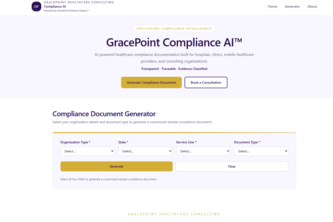
What the company appears to be: GracePoint Compliance AI™ is a self-reported prototype application that generates sample healthcare compliance documents using an AI-powered "Evidence Engine" to classify recommendations by source authority (e.g., federal requirement, accreditation standard). It was built during OpenAI Build Week and deployed via Vercel with GitHub integration. The author states it is intended for demonstration purposes only and does not represent legal advice or regulatory certification.
What changed: The project evolved from a healthcare consulting idea into a working prototype that uses GPT-5.6 through Codex to structure compliance documentation, classify recommendations, and display evidence sources. It includes UI elements like evidence badges, source panels, and dashboards for transparency.
The single most important open question: Is there any evidence of traction, revenue, or customer adoption beyond the author's own demonstration? The description contains no data on usage, customers, or monetization.
What The Product Actually Is
- The description states that GracePoint Compliance AI™ generates organization-specific sample compliance documents.
- It uses four selections: Organization type, State, Service line, Document type.
- Every generated recommendation is classified by the GracePoint Evidence Engine™ into one of five categories:
- Federal Requirement
- State Requirement
- Accreditation Standard
- GracePoint Best Practice™
- Professional Guidance
- The output includes an Evidence Classification Legend, evidence badges, regulatory-source panels, and an Evidence Summary Dashboard.
- It is described as a prototype built with GPT-5.6 through Codex during OpenAI Build Week.
- The application uses Next.js, React, TypeScript, Tailwind CSS, and is deployed via Vercel.
Not evidenced: No information on actual document generation workflows, user feedback, or production use cases beyond the prototype.
Positioning & Claim Evolution
- The author claims that traditional compliance templates often combine mandatory requirements with operational recommendations without clear distinction.
- GracePoint Compliance AI™ aims to make healthcare compliance documentation "transparent, traceable, and evidence-classified."
- It positions itself as a tool for healthcare organizations interpreting overlapping federal requirements, state rules, accreditation standards, and professional guidance.
- The system is said to be designed to avoid conflating different types of regulatory information (e.g., legal vs. best practice).
- The product is described as a demonstration-only tool that does not provide legal advice or certification.
Inference: The positioning suggests an intent to address confusion in healthcare compliance, but no evidence supports whether this addresses a real market need or how it differs from existing tools.
Target Customer & ICP
- The description states that the product targets healthcare organizations.
- It is intended for use by those interpreting overlapping federal requirements, state rules, accreditation standards, and professional guidance.
- Users select their organization type, state, service line, and document type to generate a sample document.
- The author identifies themselves as a healthcare compliance consultant.
Not evidenced: No evidence of specific customer segments, personas, or buyer behavior. No data on whether the target market has adopted or engaged with the prototype.
Business Model & Pricing Evidence
- The description states that the generated documents are sample material for demonstration and not legal advice or regulatory certification.
- There is no mention of pricing, subscriptions, licensing, or monetization models.
- The product is described as a prototype built during a hackathon.
Not evidenced: No evidence of any business model, pricing structure, or revenue streams beyond the author’s own use case.
Technical & Delivery Signals
- Built with GPT-5.6 through Codex.
- Uses Next.js, React, TypeScript, Tailwind CSS.
- Modular architecture separates evidence classifications, source records, recommendation mappings, document-generation rules, and presentation components.
- The current prototype uses deterministic rules for classification predictability and auditability.
- Deployed via Vercel; source code maintained in GitHub.
- Includes UI features like printing, copying, validation, and restart functionality.
Inference: The use of Codex and GPT-5.6 suggests AI integration, but no evidence of scalability or production-grade infrastructure.
Traction & Maturity Signals
- The application was built during OpenAI Build Week.
- It includes a GitHub development history and professional documentation.
- A complete public demonstration was published in under three minutes.
- The author notes accomplishments such as creating a working prototype, modular engine, and UI elements.
- Future plans include expanding regulation databases, AI-assisted citations, and workflow features.
Not evidenced: No evidence of user engagement, adoption, or real-world usage beyond the prototype. No data on customer acquisition, retention, or product iteration post-hackathon.
Competitive Context
- The description does not mention competitors.
- It implies a gap in transparency and traceability in healthcare compliance documentation.
- No evidence of existing tools addressing this specific problem space.
Not evidenced: No competitive landscape analysis, no comparison to other compliance tools or platforms.
Open Questions & Risks
- The product is described as a prototype built during a hackathon with no indication of further development or funding.
- It explicitly states that generated documents are sample material and not legal advice or certification.
- There is no evidence of regulatory validation, legal review, or industry partnerships.
- The use of GPT-5.6 raises questions about accuracy, consistency, and auditability in a regulated environment.
- No evidence of scalability, production deployment, or long-term viability.
Inference: The lack of traction, revenue, or customer data suggests a high risk of failure if not developed further with real-world input.
Questions the description leaves open
- What is the actual market need you're solving for, and how do you know it exists?
- Have you validated your solution with potential users in healthcare compliance?
- How will you ensure accuracy and consistency of AI-generated recommendations?
- Are there any legal or regulatory risks associated with using this tool in real-world settings?
- What is the path to production deployment, and how do you plan to scale beyond the prototype?
- Do you have any plans for monetization or revenue generation?
- How will you handle updates to regulations and maintain the accuracy of your databases?
Overall Assessment
- The project is described as a prototype built during a hackathon.
- There is no evidence of traction, revenue, customers, or product-market fit beyond the author’s own demonstration.
- The description does not indicate any funding, team expansion, or commercialization efforts.
- The tool appears to be in early conceptual and prototyping stages.
Assessment: Not ready for investment or partnership at this stage. Further evidence of traction, customer validation, and business model development is required before considering deeper due diligence.
User Stories BotA demo video on every pull request
Get a demo video on every new feature
GitHub App that watches your pull requests and records a narrated, captioned demo.
Save time on demo prep and make informed decisions faster with a video walkthrough of every new feature.
Source
Submitted to the OpenAI 2026 hackathon on Devpost. Project home on Devpost. Back to the full gallery on Devpost.
This competitive analysis was produced by top-founders.com (opens in a new tab)
Generated by a language model from this project's public Devpost page — its tagline, the author's own write-up and any built-with tags listed there — as captured in August 2026. Short quotations are the author's words. It is an opinion on the idea as a business, not on the people behind it, and it reflects the description as published then. If the project has moved on, request a correction below. The analysis is not independent research and contains no verified traction, revenue or customer data.
An independent guide by KFG International LLC — not affiliated with, endorsed by, or connected to Devpost or OpenAI.