

Archive position — measured, not model output
0 likes on Devpost
2,263 of the 7,850 archived projects have more likes, and 5,587 share exactly 0 — so this project's #4,378 place in the like-ranked listing is a tie-break inside that group, not a ranking.
Projects (log scale)
Likes on Devpost. ▲ marks this project's group.
Show the figures
| Likes | Projects | Share of archive |
|---|---|---|
| 0 | 5,587 | 71.2% |
| 1 | 1,758 | 22.4% |
| 2 | 284 | 3.6% |
| 3–4 | 132 | 1.7% |
| 5–9 | 75 | 1.0% |
| 10+ | 14 | 0.2% |
 User Stories BotA demo video on every pull request
Get a demo video on every new feature
GitHub App that watches your pull requests and records a narrated, captioned demo.
Save time on demo prep and make informed decisions faster with a video walkthrough of every new feature.
Executive Summary
What the company appears to be
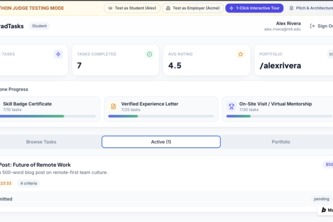
GradTasks is a self-reported two-sided marketplace platform that connects university students with companies for short-duration, on-demand micro-tasks (3–24 hours). The platform is described as AI-powered and includes features such as AI quality checks, escrow-based payment systems, gamified career tracking, and direct hiring pipelines.
What changed
The project was submitted to the OpenAI 2026 hackathon. It represents an early-stage prototype built in a short timeframe using modern web technologies and AI integration.
Single most important open question
Is there any evidence of real traction, revenue, or customer adoption beyond the author’s own description?
Note: This analysis is based entirely on the self-reported, unverified project description provided by the caller. No external verification or historical data are available. All claims are attributed to the author and labeled as such.
What The Product Actually Is
The description states that GradTasks is an AI-powered micro-internship platform designed to connect companies with verified college talent for short-term, high-impact tasks. Key features include:
- Instant claim and countdown timers
- AI pre-submission quality checker
- Automated escrow system
- Asynchronous judge/demo mode
- Gamified career track with experience letters and skill badges
It is described as a two-sided marketplace where students complete micro-tasks that convert into verified experience letters and full-time hiring pipelines.
Claim: The platform is built using React, Tailwind CSS, Node.js, OpenAI integration, and other modern web tools.
Evidence: Author’s own write-up.
Inference: Based on the features described, it appears to be a marketplace with task lifecycle management, AI-assisted quality control, and escrow-based payment systems.
Not evidenced: No actual product functionality or live user data is provided.
Positioning & Claim Evolution
The author positions GradTasks as a solution to broken traditional internships—long commitments, high friction, and low-impact work. The platform aims to offer fast, bite-sized help for companies while providing students with verified experience and direct hiring pipelines.
Key claims:
- “Bite-sized company projects for university talent”
- “AI quality checks, escrow, and direct hiring pipelines”
- “Converts task completions into verified experience letters and full-time career offers”
Claim: The platform bridges a gap between companies needing quick help and students wanting relevant experience.
Evidence: Author’s own write-up.
Inference: This is a positioning statement aimed at solving inefficiencies in the internship ecosystem.
Not evidenced: No market validation, customer feedback, or competitive differentiation beyond self-description.
Target Customer & ICP
The description identifies two main user types:
- Students: University talent seeking short-term, high-impact work that leads to verified experience and potential full-time offers.
- Companies: Early-stage teams needing fast, low-friction help with real-world projects without managing intern onboarding.
Claim: The platform targets early-stage companies and university students.
Evidence: Author’s own write-up.
Inference: The ICP likely includes startups or small teams looking for rapid execution and students in tech-related fields.
Not evidenced: No segmentation data, customer personas, or specific industry targeting.
Business Model & Pricing Evidence
The description does not provide any information about pricing models, revenue streams, or monetization strategies. It only mentions the use of escrow systems and AI quality checks as part of the platform’s architecture.
Claim: There is no explicit mention of how the platform makes money.
Evidence: Author’s own write-up.
Inference: The business model may involve fees from companies for task posting or commissions on completed tasks, but this is not stated.
Not evidenced: No pricing, fee structure, or monetization details.
Technical & Delivery Signals
The platform was built using:
- Frontend: React, Tailwind CSS, Lucide icons
- Backend: Node.js
- AI integration: OpenAI LLMs for quality checks
- Deployment stack: Vercel/Netlify hosting, modern component architectures
Claim: The tech stack reflects a modern, rapid-development approach.
Evidence: Author’s own write-up.
Inference: The use of modern tools suggests agility and scalability potential.
Not evidenced: No performance metrics, scalability data, or production deployment details.
Traction & Maturity Signals
The project is described as a hackathon submission (OpenAI 2026), built in a short timeframe. It includes:
- End-to-end functional marketplace
- Polished UX
- AI integration with real utility
However, there is no evidence of:
- Real users or customers
- Revenue or monetization
- Live product usage or adoption
- Any traction beyond the prototype phase
Claim: The platform is a working prototype.
Evidence: Author’s own write-up.
Inference: It has been developed and tested in a hackathon setting, but no real-world deployment or user base is evident.
Not evidenced: No customer data, usage statistics, or product maturity indicators.
Competitive Context
The description does not mention any competitors or existing solutions in the marketplace space. The author focuses on the problem of traditional internships and how their solution addresses it.
Claim: No competitive landscape is described.
Evidence: Author’s own write-up.
Inference: This may be a new or niche idea, but without reference to existing platforms, it's unclear where GradTasks sits in the market.
Not evidenced: No competitor analysis or market positioning data.
Open Questions & Risks
Several risks and open questions are evident from the self-reported description:
- No traction or revenue: The platform is described as a hackathon project with no real-world usage.
- Unproven AI utility: While AI is integrated, it’s unclear whether it delivers meaningful value beyond basic rubric checks.
- Trust and escrow complexity: Escrow systems are complex to implement and manage, especially for early-stage startups.
- Gamification may not scale: The gamified career track could be difficult to maintain without a large user base or clear incentives.
- Limited team size: Only one team member is listed, which raises concerns about execution capacity.
Claim: These are inherent risks in an unproven, early-stage product.
Evidence: Author’s own write-up.
Inference: The lack of team, traction, and monetization suggests a high-risk, speculative investment or partnership opportunity.
Not evidenced: No risk mitigation strategies or proven business models.
Questions the description leaves open
- What is the actual problem you're solving, and how do you know it exists?
- Have you validated your idea with real students or companies?
- How does the AI quality checker actually work, and what are its limitations?
- Is there any evidence of demand for this type of platform from employers or students?
- What is the path to monetization, and how do you plan to scale beyond a hackathon prototype?
- Are there any legal or compliance issues with escrow systems or student data handling?
- How do you plan to attract and retain users on both sides of the marketplace?
Overall Assessment
This is an early-stage, self-reported idea submitted as a hackathon project. It shows ambition and technical execution but lacks any evidence of traction, revenue, or real-world adoption.
Claim: This is a speculative opportunity with high uncertainty.
Evidence: Author’s own write-up.
Inference: The platform may have potential if it can prove its value proposition and gain early traction. However, at this stage, it is more of an idea than a product.
Not evidenced: No investment-ready metrics, customer validation, or business model clarity.
User Stories BotA demo video on every pull request
Get a demo video on every new feature
GitHub App that watches your pull requests and records a narrated, captioned demo.
Save time on demo prep and make informed decisions faster with a video walkthrough of every new feature.
Source
Submitted to the OpenAI 2026 hackathon on Devpost. Project home on Devpost. Back to the full gallery on Devpost.
This competitive analysis was produced by top-founders.com (opens in a new tab)
Generated by a language model from this project's public Devpost page — its tagline, the author's own write-up and any built-with tags listed there — as captured in August 2026. Short quotations are the author's words. It is an opinion on the idea as a business, not on the people behind it, and it reflects the description as published then. If the project has moved on, request a correction below. The analysis is not independent research and contains no verified traction, revenue or customer data.
An independent guide by KFG International LLC — not affiliated with, endorsed by, or connected to Devpost or OpenAI.