

Archive position — measured, not model output
2 likes on Devpost
221 of the 7,850 archived projects have more likes, and 284 share exactly 2 — so this project's #454 place in the like-ranked listing is a tie-break inside that group, not a ranking.
Projects (log scale)
Likes on Devpost. ▲ marks this project's group.
Show the figures
| Likes | Projects | Share of archive |
|---|---|---|
| 0 | 5,587 | 71.2% |
| 1 | 1,758 | 22.4% |
| 2 | 284 | 3.6% |
| 3–4 | 132 | 1.7% |
| 5–9 | 75 | 1.0% |
| 10+ | 14 | 0.2% |
 User Stories BotA demo video on every pull request
Get a demo video on every new feature
GitHub App that watches your pull requests and records a narrated, captioned demo.
Save time on demo prep and make informed decisions faster with a video walkthrough of every new feature.
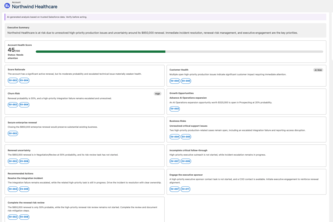
Executive Summary
The description states that SBC is a Salesforce-native AI platform built for enterprise use, designed to deliver reusable, evidence-backed business capabilities using GPT-5.6. The author claims it augments Salesforce by reasoning over trusted CRM data without modifying it, and implements strict structured outputs and validation. It currently provides an Account Intelligence capability with features like churn risk, growth opportunities, and customer health scores.
The project is self-reported as a hackathon submission, built entirely on Salesforce technologies including Apex, LWC, and OpenAI APIs. The author describes a layered architecture that keeps Salesforce as the system of record while using GPT-5.6 for reasoning. No revenue, customers or traction data are provided.
Most Important Open Question
Is there evidence that this platform can be scaled beyond a single developer's hackathon effort to deliver real business value in production environments?
What The Product Actually Is
The description states that SBC is a Salesforce-native AI Business Capability Platform. It implements an Account Intelligence capability that:
- Collects CRM context from Salesforce
- Builds a bounded and sanitized business snapshot
- Sends only permitted business data to GPT-5.6
- Generates structured customer intelligence
- Validates every AI response
- Maps evidence back to Salesforce records
- Returns read-only results to Lightning Web Components
The platform is described as using GPT-5.6 exclusively as a reasoning engine, never querying or modifying Salesforce directly.
Positioning & Claim Evolution
The description states that SBC was created to demonstrate how GPT-5.6 can safely augment Salesforce by reasoning only over trusted, bounded CRM data while Salesforce remains authoritative. The author positions it as an enterprise AI solution that avoids the risks of hallucination and data integrity issues associated with direct LLM access to CRM systems.
The claim evolution shows a progression from addressing manual review inefficiencies in customer-facing teams to building a reusable platform for business capabilities. The author states this is not just a one-off feature but a platform designed to deliver multiple AI capabilities over time.
Target Customer & ICP
The description states that SBC targets Salesforce customer-facing teams who spend significant time manually reviewing Accounts, Opportunities, Cases, Contacts, and Tasks before making decisions. These are described as the primary users who would benefit from automated business intelligence.
The target is positioned as enterprise Salesforce users who need evidence-backed insights without compromising data integrity or security boundaries.
Business Model & Pricing Evidence
Not evidenced. The description does not contain any information about pricing models, monetization strategies, customer acquisition costs, or revenue streams.
Technical & Delivery Signals
The description states that SBC was built entirely on Salesforce using technologies including:
- Salesforce Apex
- Lightning Web Components (LWC)
- Salesforce Named Credentials
- OpenAI Responses API
- GPT-5.6
- Structured Outputs
- JSON Schema
- Salesforce Design System (SLDS)
The solution follows a layered architecture:
Salesforce UI → Apex Controller → Context Services → OpenAI Client → GPT-5.6 → Validation → Presentation DTO → Lightning Web Components
Key technical claims include:
- Zero-DML architecture
- Strict structured outputs
- Evidence identifiers verification
- Read-only result delivery
- Preventing hallucinated evidence
- Maintaining strict response schema
Traction & Maturity Signals
Not evidenced. The description states that this is a hackathon submission and provides no information about customer adoption, usage metrics, revenue, or product maturity beyond the single developer's implementation.
Competitive Context
Not evidenced. The description does not mention any competitors, market positioning relative to existing solutions, or competitive advantages in the marketplace.
Open Questions & Risks
- Single developer team (1 person) with no evidence of additional contributors or support
- No traction data, customers, or revenue information
- Self-reported hackathon submission with no independent verification
- GPT-5.6 is not a real model (the description states "GPT-5.6" but this is not an actual released model)
- No evidence of production deployment or scalability beyond the single developer's environment
- No mention of security, compliance, or enterprise readiness beyond stated design principles
- No information about data governance, audit trails, or explainability in production use
Questions the description leaves open
- What is the actual technical architecture for handling large volumes of data and concurrent users?
- How does the validation process scale to handle real-world data complexity?
- What are the actual performance characteristics and latency expectations?
- How will this be maintained beyond the single developer's involvement?
- What specific enterprise security or compliance requirements has this addressed?
- How is the structured output validation implemented in practice?
- What are the actual costs of running this solution at scale?
- How does it handle edge cases or unexpected data patterns?
- What is the roadmap for additional capabilities beyond Account Intelligence?
- How does it integrate with existing Salesforce security and governance frameworks?
Overall Assessment
Not evidenced. The description provides no information about financial performance, market opportunity, team experience, or strategic fit that would inform an investment or partnership decision. This appears to be a single-person hackathon project with no demonstrated traction or commercial viability beyond the author's own implementation.
User Stories BotA demo video on every pull request
Get a demo video on every new feature
GitHub App that watches your pull requests and records a narrated, captioned demo.
Save time on demo prep and make informed decisions faster with a video walkthrough of every new feature.
Source
Submitted to the OpenAI 2026 hackathon on Devpost. Project home on Devpost. Back to the full gallery on Devpost.
This competitive analysis was produced by top-founders.com (opens in a new tab)
Generated by a language model from this project's public Devpost page — its tagline, the author's own write-up and any built-with tags listed there — as captured in August 2026. Short quotations are the author's words. It is an opinion on the idea as a business, not on the people behind it, and it reflects the description as published then. If the project has moved on, request a correction below. The analysis is not independent research and contains no verified traction, revenue or customer data.
An independent guide by KFG International LLC — not affiliated with, endorsed by, or connected to Devpost or OpenAI.