

Archive position — measured, not model output
0 likes on Devpost
2,263 of the 7,850 archived projects have more likes, and 5,587 share exactly 0 — so this project's #4,379 place in the like-ranked listing is a tie-break inside that group, not a ranking.
Projects (log scale)
Likes on Devpost. ▲ marks this project's group.
Show the figures
| Likes | Projects | Share of archive |
|---|---|---|
| 0 | 5,587 | 71.2% |
| 1 | 1,758 | 22.4% |
| 2 | 284 | 3.6% |
| 3–4 | 132 | 1.7% |
| 5–9 | 75 | 1.0% |
| 10+ | 14 | 0.2% |
 User Stories BotA demo video on every pull request
Get a demo video on every new feature
GitHub App that watches your pull requests and records a narrated, captioned demo.
Save time on demo prep and make informed decisions faster with a video walkthrough of every new feature.
Executive Summary
What the company appears to be
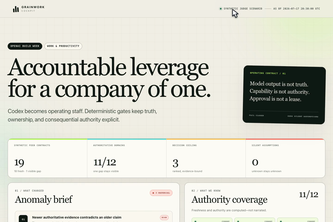
Grainwork Cockpit is a self-reported project by one founder (rkatzman83 Katzman) submitted to the OpenAI 2026 hackathon. The description states it is a "safety-gated operating system" that enables one person to work with AI at scale while maintaining explicit truth, ownership, and authority. It is described as part of a larger mission to help homeowners understand and care for their homes, with an eventual vision of supporting skilled tradespeople.
What changed
The project description indicates this was built during a "Build Week" hackathon event using Codex and GPT-5.6. It represents an evolution from earlier work on a homeowner utility app (Grainwork) to a control plane that governs AI interactions with explicit authority boundaries.
The single most important open question
Is there evidence of actual product-market fit or traction beyond the founder's own use, or is this purely a proof-of-concept for a future vision?
Note: This analysis is based entirely on self-reported information from the project description. No independent verification, revenue data, customer base, or traction metrics are available.
What The Product Actually Is
The description states that Grainwork Cockpit is:
- A "safety-gated operating system"
- Designed to let one founder work with AI at company scale
- A control plane that prevents model output from being confused with truth or capability with permission
- Built using Python, JSON Schema, HTML, CSS, JavaScript, and OpenAI tools (specifically Codex and GPT-5.6)
- Includes features like:
- Explicit coverage contracts and authority checks
- Anomaly-only briefs
- Typed human/system action lanes
- Structural receipts
- Exact approval scope
- A single-writer lease
- A bounded GPT-5.6 staff view
Inference: The product appears to be a governance layer for AI use, designed to maintain accountability and control in a single-founder operation.
Positioning & Claim Evolution
The description states:
- Grainwork is positioned as a homeowner utility app focused on helping homeowners understand and care for their homes
- It aims to address an "information imbalance" where homeowners can film damage, get independent repair estimates, compare quotes, and preserve records
- The long-term vision includes supporting skilled tradespeople and treating them as knowledge workers in the physical world
- Cockpit is described as a "Build Week project" that emerged from operating Grainwork and serves as an operating system for one founder to work with AI at scale
Inference: The positioning has evolved from a simple utility app to a broader ecosystem vision, with Cockpit being a technical enabler for the founder's mission.
Target Customer & ICP
The description states:
- Primary users are homeowners who need to understand and care for their homes
- The product is designed to help homeowners notice problems before they become crises
- Long-term, it aims to support skilled tradespeople who want to stay independent and learn new skills
Inference: The target customer is primarily homeowners, with a longer-term focus on small tradespeople. No specific ICP data or segmentation is provided.
Business Model & Pricing Evidence
The description states:
- Grainwork takes no money from contractors and sells no leads
- It is designed as someone in the homeowner's corner, not another lead marketplace
- The business model is not explicitly detailed beyond this
Inference: There is no clear evidence of a monetization strategy or pricing structure. The description only mentions that the product does not take money from contractors.
Technical & Delivery Signals
The description states:
- Built with: CSS3, GitHub, GPT-5, HTML5, JavaScript, JSON, OpenAI, productivity, Python
- Uses Python's standard library, JSON, JSON Schema, HTML, CSS, and JavaScript
- No third-party runtime dependencies
- Web boundary binds only to loopback, requires same-origin POSTs
- Enforces file allowlist, rejects symlinks, internal identifiers, private paths, and secret-shaped content
- Pins reviewed image by SHA-256
- Includes independent test suite covering authority hydration, action scope, risk derivation, etc.
- Uses deterministic Python to compile freshness, authority, contradictions, action lanes, and stable evidence IDs
Inference: The technical implementation shows a strong focus on security, determinism, and control. However, there is no evidence of production deployment or scalability beyond the hackathon context.
Traction & Maturity Signals
The description states:
- The working homeowner loop exists before Build Week
- Cockpit was built during Build Week as part of a hackathon submission
- A sanitized evaluator models the same operating problem with 19 synthetic feed contracts across 12 domains
- Includes a private owner system that recorded 193 passing Cockpit tests
- The project includes no customer data and has no production connection
Inference: There is no evidence of actual traction, revenue, or customer adoption. This appears to be a proof-of-concept or prototype.
Competitive Context
The description does not provide any information about competitors or market positioning beyond the founder's own claims.
Inference: No competitive landscape or differentiation strategy is evident from the provided text.
Open Questions & Risks
- The project is described as a hackathon submission with no production connection
- No evidence of revenue, customers, or traction
- The founder is the only team member (1 person)
- The product is described as a "safety-gated operating system" but lacks real-world testing or deployment
- There is no indication of how the vision will be scaled beyond one founder's use
Inference: The main risk is that this is a prototype with no commercial viability or traction, and the long-term vision may not materialize.
Questions the description leaves open
- What specific problems are homeowners currently facing in managing their homes?
- How does the founder plan to scale beyond one person working with AI?
- Are there any real-world users or early adopters of Grainwork?
- What is the path from this prototype to a viable product?
- How will the business model evolve beyond the current non-commercial approach?
Overall Assessment
The description indicates that this is a hackathon submission with no evidence of traction, revenue, or customer adoption. The project appears to be a proof-of-concept for a future vision rather than an operational product.
Assessment: Not evidenced as a viable investment opportunity or partnership at this stage. The founder's intent and technical execution are clear, but there is no commercial foundation to support further diligence or investment.
User Stories BotA demo video on every pull request
Get a demo video on every new feature
GitHub App that watches your pull requests and records a narrated, captioned demo.
Save time on demo prep and make informed decisions faster with a video walkthrough of every new feature.
Source
Submitted to the OpenAI 2026 hackathon on Devpost. Project home on Devpost. Back to the full gallery on Devpost.
This competitive analysis was produced by top-founders.com (opens in a new tab)
Generated by a language model from this project's public Devpost page — its tagline, the author's own write-up and any built-with tags listed there — as captured in August 2026. Short quotations are the author's words. It is an opinion on the idea as a business, not on the people behind it, and it reflects the description as published then. If the project has moved on, request a correction below. The analysis is not independent research and contains no verified traction, revenue or customer data.
An independent guide by KFG International LLC — not affiliated with, endorsed by, or connected to Devpost or OpenAI.