

Archive position — measured, not model output
0 likes on Devpost
2,263 of the 7,850 archived projects have more likes, and 5,587 share exactly 0 — so this project's #6,342 place in the like-ranked listing is a tie-break inside that group, not a ranking.
Projects (log scale)
Likes on Devpost. ▲ marks this project's group.
Show the figures
| Likes | Projects | Share of archive |
|---|---|---|
| 0 | 5,587 | 71.2% |
| 1 | 1,758 | 22.4% |
| 2 | 284 | 3.6% |
| 3–4 | 132 | 1.7% |
| 5–9 | 75 | 1.0% |
| 10+ | 14 | 0.2% |
 User Stories BotA demo video on every pull request
Get a demo video on every new feature
GitHub App that watches your pull requests and records a narrated, captioned demo.
Save time on demo prep and make informed decisions faster with a video walkthrough of every new feature.
Executive Summary
What the company appears to be
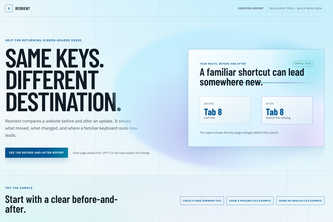
ReOrient is a tool that compares two versions of a web interface and generates structured reports on how the accessible structure changed — for example, how landmarks, headings, controls, and tab order shifted between releases. It aims to help developers produce release notes that are meaningful to users who navigate with screen readers or keyboard-only.
What changed
The author describes an idea rooted in personal experience: when apps are redesigned, returning users may struggle if changes aren’t explained in terms of familiar navigation paths. ReOrient attempts to bridge this gap by creating a “trustworthy map” from the old interface to the new one, using deterministic logic and model interpretation.
Single most important open question
Does ReOrient actually solve a problem that developers or accessibility teams encounter in practice — or is it a conceptual solution that has not yet been validated through real-world use?
Note: This analysis is based entirely on the self-reported description provided by the author. No external verification, traction data, revenue figures, or customer feedback are available.
What The Product Actually Is
The description states that ReOrient:
- Compares two releases of a web interface.
- Captures changes in landmarks, headings, controls, accessible names, roles, and tab order.
- Emits “stable receipts” for each change (e.g., move, rename, role change).
- Provides tools to replay keyboard routes against the new release.
- Enables CI failure when breaking changes are introduced.
- Publishes before-and-after reports for returning users.
- Exposes evidence to coding agents via an MCP server.
It uses:
- TypeScript and React
- Codex CLI
- GPT-5.6 (for interpretation only)
- npm packages: @reorient/core, @reorient/browser, @reorient/react, @reorient/cli, @reorient/mcp
Inference: The tool is built as a platform with multiple SDKs and CLI components, intended for integration into development workflows.
Positioning & Claim Evolution
The description states:
- ReOrient was inspired by a mismatch between familiar UI navigation and accessibility expectations.
- It aims to fill a gap in release notes — particularly those that do not explain how the structure changed for users who rely on landmarks or tab order.
- The tool is positioned as a way to generate “trustworthy maps” from old to new interfaces, enabling better communication with returning users.
Claim: ReOrient addresses a lack of accessible release documentation.
Inference: It positions itself as an accessibility tool that improves developer workflows and user experience for people using assistive technologies.
Target Customer & ICP
The description does not name specific customers or personas. However, it implies:
- Developers working on web applications.
- Teams concerned with accessibility compliance.
- Product teams who want to improve communication around UI changes.
- Users navigating via screen readers or keyboard-only.
Inference: The target is likely B2B SaaS or product development teams that care about inclusive design and user experience.
Not evidenced: No explicit ICP, customer segments, or buyer personas are described.
Business Model & Pricing Evidence
The description does not mention:
- Revenue model
- Pricing strategy
- Monetization approach
- Paid features or tiers
Not evidenced: There is no indication of how ReOrient would be sold or monetized.
Technical & Delivery Signals
The description states:
- Built with TypeScript, React, Next.js, Codex CLI.
- Uses npm packages split into five modules: core, browser, React, CLI, MCP.
- Implements a deterministic three-pass matcher to handle identity issues.
- Uses GPT-5.6 in a narrow, schema-validated way — after deterministic logic.
- Includes Playwright-based testing and security boundaries.
- Delivers a hosted demo at https://reorient-nine.vercel.app/demo/storefront
Inference: The tool is technically sophisticated, modular, and built with developer experience in mind.
Traction & Maturity Signals
The description states:
- Five npm packages published at 1.0.0.
- Live product walkthrough hosted on Vercel.
- Open-sourced project.
- Submitted to the OpenAI 2026 hackathon.
Not evidenced: No evidence of revenue, customers, adoption, or usage metrics beyond the demo and open-source release.
Competitive Context
The description does not reference:
- Competitors
- Existing tools in the space
- Market positioning relative to others
Not evidenced: No competitive analysis or market context is provided.
Open Questions & Risks
Key concerns based on the self-reported description:
- The tool is described as a hackathon submission, suggesting it may not be production-ready.
- It relies heavily on deterministic logic and model interpretation — but no validation of model outputs in real-world use.
- No mention of user research or testing with actual screen-reader or keyboard users.
- The author is a single person (team size = 1), raising questions about scalability and long-term maintenance.
- The demo is hosted, but there’s no indication of how it would scale for enterprise use.
Inference: ReOrient may be an early-stage concept with limited real-world validation or commercial viability.
Questions the description leaves open
- What specific accessibility challenges do you observe in your own development workflow?
- Have you conducted any user research with screen-reader or keyboard users to validate the need for this tool?
- How does ReOrient handle cases where UI elements are removed or restructured without clear identity markers?
- Is there a plan to integrate with CI/CD pipelines, and how would that work in practice?
- What is your roadmap for monetization or commercialization?
- Can you demonstrate how the tool integrates into an existing development workflow?
- How do you plan to ensure accuracy of model interpretations when the underlying data is ambiguous?
Overall Assessment
The description indicates ReOrient is a conceptual prototype built during a hackathon, with no evidence of traction, revenue, or customer validation.
Assessment: Not ready for investment or partnership at this stage.
Confidence level: Low — based on minimal evidence and lack of commercialization signals.
Next steps: If the team intends to move forward, user research, product-market fit validation, and integration into real workflows are essential before any serious consideration.
User Stories BotA demo video on every pull request
Get a demo video on every new feature
GitHub App that watches your pull requests and records a narrated, captioned demo.
Save time on demo prep and make informed decisions faster with a video walkthrough of every new feature.
Source
Submitted to the OpenAI 2026 hackathon on Devpost. Project home on Devpost. Back to the full gallery on Devpost.
This competitive analysis was produced by top-founders.com (opens in a new tab)
Generated by a language model from this project's public Devpost page — its tagline, the author's own write-up and any built-with tags listed there — as captured in August 2026. Short quotations are the author's words. It is an opinion on the idea as a business, not on the people behind it, and it reflects the description as published then. If the project has moved on, request a correction below. The analysis is not independent research and contains no verified traction, revenue or customer data.
An independent guide by KFG International LLC — not affiliated with, endorsed by, or connected to Devpost or OpenAI.