

Archive position — measured, not model output
0 likes on Devpost
2,263 of the 7,850 archived projects have more likes, and 5,587 share exactly 0 — so this project's #4,269 place in the like-ranked listing is a tie-break inside that group, not a ranking.
Projects (log scale)
Likes on Devpost. ▲ marks this project's group.
Show the figures
| Likes | Projects | Share of archive |
|---|---|---|
| 0 | 5,587 | 71.2% |
| 1 | 1,758 | 22.4% |
| 2 | 284 | 3.6% |
| 3–4 | 132 | 1.7% |
| 5–9 | 75 | 1.0% |
| 10+ | 14 | 0.2% |
 User Stories BotA demo video on every pull request
Get a demo video on every new feature
GitHub App that watches your pull requests and records a narrated, captioned demo.
Save time on demo prep and make informed decisions faster with a video walkthrough of every new feature.
Executive Summary
What the company appears to be
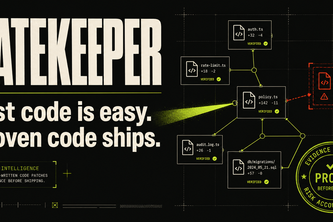
Gatekeeper is a self-reported local-first tool for AI-written code review. The author describes it as a release intelligence tool that parses unified diffs, identifies trust-boundary changes, and produces deterministic assessments with evidence and adversarial verification commands.
What changed
The project was built in one concentrated Codex session, according to the author. It is described as a browser-based application with no external dependencies or accounts required. The core functionality includes parsing diffs, calculating blast radius, generating risk maps, and producing Markdown receipts for code changes.
Single most important open question
Is there any evidence of real-world usage, customer feedback, or product-market fit beyond the author’s own demonstration? The description states no revenue, customers, or traction data exist beyond the hackathon submission.
What The Product Actually Is
The description states that Gatekeeper is a local-first release intelligence tool for AI-written patches. It parses unified diffs and identifies trust-boundary changes such as those in authorization, data, money, failure handling, secrets, and tests. It calculates blast radius, converts risky claims into adversarial verification commands, and produces a clear release assessment along with a deterministic Markdown receipt.
It is described as a Cloudflare-compatible Next.js/vinext application built using Codex and GPT-5.6. The analysis core is said to be a typed deterministic engine that evaluates evidence rules, calculates severity-weighted scores, and derives hostile probes. The interface presents the same analysis as a file risk map, annotated diff, proof console, and exportable receipt.
It was built in one session using Codex and deployed fully locally, with no keys or accounts required.
Evidence
- The author states it is a local-first tool for AI-written patches.
- It parses unified diffs and identifies trust-boundary changes.
- It produces deterministic assessments and Markdown receipts.
- Built as a Cloudflare-compatible Next.js app using Codex and GPT-5.6.
- No external dependencies or accounts required.
Not evidenced
- The actual functionality beyond the demo.
- Whether it has been used by others or integrated into workflows.
- Any real-world performance or scalability data.
Positioning & Claim Evolution
The author positions Gatekeeper as a solution to the scaling problem in AI code review, where traditional tools offer only opaque “AI confidence scores.” It is framed as a tool that provides visible, reproducible evidence for changes that should ship.
It claims to move beyond static analysis dashboards and opaque AI reviewers by offering explainable trust-boundary findings, deterministic case IDs, and hostile probe simulations. The author suggests that the product makes assumptions, risks, and remaining work explicit through its receipts.
The claim evolution shows a shift from general AI code tools to a specific, structured review primitive—a portable evidence receipt instead of a score.
Evidence
- The author states it addresses scaling issues in AI-generated code review.
- It is positioned as offering visible, reproducible evidence.
- It claims to be more useful than an AI confidence score.
Not evidenced
- No comparison with existing tools or market positioning.
- No stated differentiation from other AI code review tools.
- No evidence of prior product-market fit or user feedback.
Target Customer & ICP
The author states that Gatekeeper is for teams working with AI-generated code, particularly those who need to scale beyond human attention in code review. It targets users who want visible, reproducible evidence that a change deserves to ship.
It is described as useful for developers or engineering teams using AI tools like Codex and GPT-5.6, especially in environments where trust-boundary changes are critical (e.g., auth, data, money).
Evidence
- The tool is aimed at teams working with AI-generated code.
- It targets users who want to scale beyond human attention in review.
Not evidenced
- No stated customer personas or segments.
- No evidence of specific use cases or adoption by engineering teams.
- No mention of enterprise or developer tooling ecosystems.
Business Model & Pricing Evidence
The description does not state any business model, pricing, or monetization strategy. It is a self-reported hackathon project with no indication of revenue streams or pricing plans.
Evidence
- No mention of pricing, subscriptions, or monetization.
Not evidenced
- No evidence of any commercial structure.
- No indication of whether it will be offered as SaaS, open-source, or freemium.
Technical & Delivery Signals
The author describes Gatekeeper as a Cloudflare-compatible Next.js/vinext application, built with Codex and GPT-5.6. It is said to include:
- A typed deterministic engine for parsing diffs.
- Evidence rules and severity-weighted scores.
- Hostile probe derivation.
- File risk maps, annotated diffs, and proof console.
- Markdown export of receipts.
- Fully local browser analysis with no external dependencies.
It was built in one session, deployed, and tested by the author alone.
Evidence
- Built using Next.js, Codex, GPT-5.6, Cloudflare.
- Includes deterministic engine for parsing diffs.
- Produces risk maps, annotated diffs, proof console, and Markdown receipts.
- Fully local browser-based with no external dependencies.
Not evidenced
- No evidence of scalability or performance under load.
- No information on how it handles large codebases or CI/CD pipelines.
- No mention of API access or extensibility for integration.
Traction & Maturity Signals
The project is described as a single-person hackathon submission. It was built in one session, deployed, and demonstrated with three realistic case files plus arbitrary input. There is no evidence of:
- Revenue
- Customers
- Product-market fit
- Usage beyond the demo
- Iteration or feedback loops
It is described as a fully local browser-based tool, but no evidence of adoption or user engagement.
Evidence
- Built in one session.
- Demonstrated with three realistic case files and arbitrary input.
- Fully local, no accounts or keys required.
Not evidenced
- No traction data, usage metrics, or customer feedback.
- No indication of product maturity beyond the demo.
- No evidence of real-world adoption or integration.
Competitive Context
The description does not mention any competitors or how Gatekeeper compares to existing tools in AI code review or release intelligence. It is described as a local-first tool that avoids opaque AI confidence scores, but no comparison with other tools is made.
Evidence
- No mention of competitors.
- No stated differentiation from existing AI code review tools.
Not evidenced
- No competitive analysis.
- No evidence of market positioning or competitive advantage.
Open Questions & Risks
- No commercial traction or revenue: The project is described as a hackathon submission with no evidence of real-world usage or monetization.
- Single-person development: The entire product was built by one person, raising questions about scalability and long-term maintenance.
- Limited scope: It only handles local browser-based diffs and lacks integration with CI/CD pipelines or enterprise tools.
- Unproven trust-boundary logic: The author claims to identify trust-boundary changes, but no evidence of how accurate or reliable this logic is.
- No feedback loop or iteration: No indication that the tool has been tested or refined by users beyond the demo.
Evidence
- Built in one session by a single person.
- No revenue, customers, or usage data.
- Only local browser-based functionality.
Inferred risks
- Lack of integration with CI/CD pipelines.
- Limited adoption or feedback from real users.
Questions the description leaves open
- What specific trust-boundary changes does it detect, and how accurate are those detections?
- Has the tool been tested on real codebases or workflows beyond the demo?
- How does it handle edge cases in diff parsing or large-scale code changes?
- Are there plans to integrate with CI/CD pipelines or GitHub Checks?
- What is the long-term vision for monetization or product evolution?
- How does it compare to existing tools in AI code review or release intelligence?
Overall Assessment
The project is described as a single-person hackathon submission with no evidence of traction, revenue, or real-world adoption. It is a local-first tool for AI-written patches, but lacks any indication of commercial viability or scalability.
It is not evidenced that the product has been used beyond its own demo or tested in production environments. The author’s claims about trust-boundary detection and deterministic assessments are self-reported and unverified.
Confidence Low
Assessment Not ready for investment or partnership without further evidence of traction, usage, or commercial viability.
Evidence
- Self-reported, unverified.
- No revenue, customers, or adoption data.
- Single-person development with no iteration or feedback loops.
Inference
- The tool may have potential but lacks demonstrated utility or market fit.
User Stories BotA demo video on every pull request
Get a demo video on every new feature
GitHub App that watches your pull requests and records a narrated, captioned demo.
Save time on demo prep and make informed decisions faster with a video walkthrough of every new feature.
Source
Submitted to the OpenAI 2026 hackathon on Devpost. Project home on Devpost. Back to the full gallery on Devpost.
This competitive analysis was produced by top-founders.com (opens in a new tab)
Generated by a language model from this project's public Devpost page — its tagline, the author's own write-up and any built-with tags listed there — as captured in August 2026. Short quotations are the author's words. It is an opinion on the idea as a business, not on the people behind it, and it reflects the description as published then. If the project has moved on, request a correction below. The analysis is not independent research and contains no verified traction, revenue or customer data.
An independent guide by KFG International LLC — not affiliated with, endorsed by, or connected to Devpost or OpenAI.