

Archive position — measured, not model output
0 likes on Devpost
2,263 of the 7,850 archived projects have more likes, and 5,587 share exactly 0 — so this project's #4,270 place in the like-ranked listing is a tie-break inside that group, not a ranking.
Projects (log scale)
Likes on Devpost. ▲ marks this project's group.
Show the figures
| Likes | Projects | Share of archive |
|---|---|---|
| 0 | 5,587 | 71.2% |
| 1 | 1,758 | 22.4% |
| 2 | 284 | 3.6% |
| 3–4 | 132 | 1.7% |
| 5–9 | 75 | 1.0% |
| 10+ | 14 | 0.2% |
 User Stories BotA demo video on every pull request
Get a demo video on every new feature
GitHub App that watches your pull requests and records a narrated, captioned demo.
Save time on demo prep and make informed decisions faster with a video walkthrough of every new feature.
Executive Summary
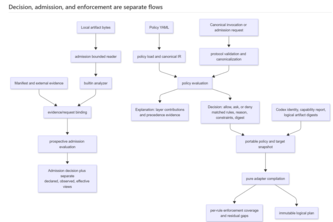
Gateweave, as described by its author, is a policy control plane for AI coding agents that aims to provide deterministic governance over agent actions and their supply chains. It is positioned as a tool for teams seeking to understand what an agent was allowed to do, why decisions were made, and which tools or artifacts were trusted — particularly in the context of agent-driven development workflows.
The project is self-reported, unverified, and lacks any evidence of revenue, customers, or traction. The author states that Gateweave provides a portable policy engine with deterministic deny > ask > allow precedence, and offers agent supply-chain security through bounded static inspection and local verification. It includes a local React/Next.js console, and is built primarily in Go.
The most important open question is:
What real-world use cases or adoption exists for Gateweave, and how does it differ from existing sandboxing or governance tools?
This analysis is based entirely on the self-reported description provided by the author. No external corroboration or historical data are available.
What The Product Actually Is
The description states that Gateweave is:
- A policy control plane for AI coding agents.
- A portable policy engine with deterministic deny > ask > allow precedence.
- A system that provides:
- Agent supply-chain security, including bounded static inspection of artifacts (MCP servers, skills, plugins).
- Local detached Ed25519 signature verification against a trust bundle.
- Redacted, after-the-fact observation of Codex JSON event streams.
- A local React/Next.js Console for workspace configuration, supply-chain inventory, evidence, admission, locks, drift, and recorded activity.
- Built in Go, with components including:
- Policy kernel
- Admission layer (inspect, admit, lock, monitor)
- Codex adapter and observer
- Console UI
It is described as a local, offline-first system that does not execute or mutate artifacts during inspection.
Inference: The product appears to be a governance and auditing tool, not a runtime enforcement engine. It focuses on policy compilation, evidence collection, and post-hoc observation rather than real-time control.
Positioning & Claim Evolution
The author claims that Gateweave is designed to:
- Make answers to key questions deterministic, local, inspectable, and honest:
- What was this agent allowed to do?
- Why was that decision made?
- Which tools or artifacts were trusted?
- Address agent supply-chain security, where dependencies can expand an agent’s capabilities or drift after review.
- Provide a policy layer that answers what the agent can enforce versus what it did.
The positioning evolves from:
- A sandboxing tool to:
- A policy and evidence control plane that allows teams to inspect, audit, and understand agent behavior.
- A trustworthy governance system that makes known limitations visible rather than hiding them.
Claim: Gateweave is positioned as a transparent, evidence-backed governance solution, not a fully autonomous enforcement layer.
Target Customer & ICP
The description states that Gateweave targets:
- Teams working with AI coding agents.
- Developers and DevOps teams who need to understand agent behavior, especially in production or high-risk environments.
- Organizations concerned with agent supply-chain security and policy compliance.
It is implied that the product is aimed at enterprise or advanced development teams using AI agents for tasks like:
- Installing dependencies
- Editing production files
- Invoking shell commands
Inference: The ICP likely includes DevOps engineers, platform teams, and security practitioners in organizations using or evaluating AI coding agents.
Business Model & Pricing Evidence
There is no evidence of a business model or pricing structure in the description. The author does not state whether Gateweave will be offered as:
- A SaaS product
- An open-source tool
- A paid license
- A freemium offering
Not evidenced: No information on monetization, pricing tiers, or customer acquisition.
Technical & Delivery Signals
The project is built with the following technologies:
- Go (core engine)
- React/Next.js (console UI)
- Node.js, TypeScript, MCP, policyengine, devsecops, agents, agenticsecurity
It includes:
- A policy kernel with strict ownership boundaries
- An admission layer that inspects artifacts without executing them
- A Codex adapter and observer
- A local console UI
- Inert fixtures, conformance tests, Playwright flows, and a demo video
Claim: The system is designed for offline-first, deterministic inspection, not dynamic execution or enforcement.
Traction & Maturity Signals
The description states that:
- Gateweave was built for the OpenAI 2026 hackathon.
- It includes:
- A three-minute demo
- Real local UI captures
- Playwright flows
- End-to-end payment-platform scenarios
- The team has dogfooded it with Codex CLI and found limitations, which were surfaced in the product.
Not evidenced: No evidence of revenue, customers, or adoption beyond the hackathon submission. No data on usage, retention, or user feedback.
Competitive Context
The description does not mention any direct competitors. However, based on the stated goals — policy control, agent supply-chain security, and evidence-based governance — Gateweave likely competes with:
- Tools focused on AI agent sandboxing
- DevSecOps platforms
- Policy engines for AI agents or LLMs
- Agent runtime monitoring or governance tools
Inference: The product is positioned in a nascent or emerging space, where few direct competitors are evident.
Open Questions & Risks
Key risks and open questions based on the description:
- The system is offline-first and inspection-only, not an enforcement engine.
- It does not execute or mutate artifacts during inspection, which may limit its utility in real-time control scenarios.
- The author explicitly states that enforcement gaps are surfaced honestly, which may be a limitation for teams seeking full control.
- The project is self-reported and unverified, with no evidence of traction, revenue, or customer feedback.
- It is built by a single founder (Rohit Bajaj), suggesting limited team capacity.
Inference: Gateweave may be underdeveloped for production use or not aligned with teams seeking active enforcement, and lacks validation in real-world settings.
Questions the description leaves open
- What is the real-world adoption of Gateweave beyond the hackathon?
- How does it integrate with existing AI agent platforms like Codex or others?
- Is there a plan to move beyond inspection into enforcement, or is it strictly a governance tool?
- What are the limitations in real-world usage that were not surfaced during dogfooding?
- Are there any customers or pilot programs currently using Gateweave?
- How does it handle scalability and multi-agent workflows?
- What is the long-term roadmap for monetization or product evolution?
Overall Assessment
Gateweave is a self-reported, unverified project submitted to a hackathon. It presents a conceptual approach to AI agent governance, emphasizing transparency and evidence-based control, but lacks any traction, revenue, or customer data.
Not evidenced: No commercial viability, market fit, or competitive positioning can be confirmed from the description alone.
The product is technically ambitious for an early-stage project, but its offline-first, inspection-only model may not meet the needs of teams seeking active enforcement or integration into production workflows.
Assessment: Not suitable for investment or partnership without further evidence of traction, customer validation, or a clear path to commercialization.
User Stories BotA demo video on every pull request
Get a demo video on every new feature
GitHub App that watches your pull requests and records a narrated, captioned demo.
Save time on demo prep and make informed decisions faster with a video walkthrough of every new feature.
Source
Submitted to the OpenAI 2026 hackathon on Devpost. Project home on Devpost. Back to the full gallery on Devpost.
This competitive analysis was produced by top-founders.com (opens in a new tab)
Generated by a language model from this project's public Devpost page — its tagline, the author's own write-up and any built-with tags listed there — as captured in August 2026. Short quotations are the author's words. It is an opinion on the idea as a business, not on the people behind it, and it reflects the description as published then. If the project has moved on, request a correction below. The analysis is not independent research and contains no verified traction, revenue or customer data.
An independent guide by KFG International LLC — not affiliated with, endorsed by, or connected to Devpost or OpenAI.