

Archive position — measured, not model output
2 likes on Devpost
221 of the 7,850 archived projects have more likes, and 284 share exactly 2 — so this project's #345 place in the like-ranked listing is a tie-break inside that group, not a ranking.
Projects (log scale)
Likes on Devpost. ▲ marks this project's group.
Show the figures
| Likes | Projects | Share of archive |
|---|---|---|
| 0 | 5,587 | 71.2% |
| 1 | 1,758 | 22.4% |
| 2 | 284 | 3.6% |
| 3–4 | 132 | 1.7% |
| 5–9 | 75 | 1.0% |
| 10+ | 14 | 0.2% |
 User Stories BotA demo video on every pull request
Get a demo video on every new feature
GitHub App that watches your pull requests and records a narrated, captioned demo.
Save time on demo prep and make informed decisions faster with a video walkthrough of every new feature.
Executive Summary
What the company appears to be
Homeroom is a self-reported AI workspace for K-12 students, built as a hackathon project by two founders (Matt Wheeler, Joanna Wheeler). It integrates school information from sources like Google Classroom and iCalendar into a single interface, with AI-assisted planning and guardian oversight. The product is described as designed to help students manage scattered academic and personal logistics, especially those with executive function challenges.
What changed
The project was submitted to the OpenAI 2026 hackathon on Devpost. It is presented as a proof-of-concept built in a short timeframe using AI tools like GPT-5.6 and engineering assistance from Codex. The description emphasizes its focus on student agency, safety, and consent-driven workflows.
Single most important open question
Is there any evidence of real-world usage or traction beyond the fictional test data described by the authors?
What The Product Actually Is
The description states that Homeroom is a guardian-connected AI workspace designed specifically for K-12 students, built as a Next.js application running through Vinext on Cloudflare Workers. It integrates school information from sources like Google Classroom, iCalendar, and official school pages into a single interface.
It includes features such as:
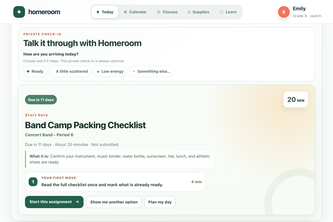
- A “Today” view that aggregates assignments, calendar events, and supply lists
- A focus room for breaking down tasks into steps with timeboxing
- Class-scoped learning rooms that provide hints without giving answers
- A student-controlled way to ask guardians for help
- Role-scoped access for guardians, with only approved summaries shared
The AI (GPT-5.6) is used to propose actions but not to authorize them. The system enforces boundaries through code, not model authority.
Evidence
- The project description states this.
- It lists technical stack including Next.js, Cloudflare Workers, GPT-5.6, and React.
- It describes how the AI is used in a controlled way, with no direct authorization or data sharing without approval.
Inference The product is built as a student-facing application with guardian oversight, using AI to assist rather than replace human decision-making.
Positioning & Claim Evolution
The description states that Homeroom was built to help students like Emily — a 14-year-old who struggles with executive function — manage scattered school information and activities. The core positioning is:
- For students with executive function challenges (ADHD, 504 plans, IEPs)
- To turn scattered information into one manageable day
- To teach students to answer “what should I do next?” themselves
It positions itself as a calm, consent-driven workflow that supports student agency and safety.
Evidence
- The inspiration section describes Emily’s problem.
- The “Golden Experience” section outlines the intended user journey.
- The “Student safety and agency” section details how the system enforces boundaries.
Inference The positioning evolved from a hackathon idea to a product focused on student empowerment, with a strong emphasis on privacy and guardian involvement.
Target Customer & ICP
The description states that Homeroom is built first for students who feel this problem most acutely: those with ADHD, a 504 plan, or an IEP. These students are described as having executive function challenges, not ability issues.
It also mentions that the nearest path to real users does not wait on district-level integration — instead, it uses guardian-forwarded assignment summaries, public iCalendar feeds, and district calendars.
Evidence
- The description explicitly names the target user group.
- It says the product is designed for students who struggle with “executive function, not ability.”
Inference The ICP is narrow: K-12 students with specific learning needs, particularly those needing support in organizing schoolwork and managing time.
Business Model & Pricing Evidence
Not evidenced.
The description does not mention any pricing model, monetization strategy, or business model. It only describes the product’s features and architecture.
Evidence
- No mention of revenue, pricing, or commercialization.
Inference No evidence of a business model or pricing structure exists in the provided description.
Technical & Delivery Signals
The project is built using:
- Next.js, React, TypeScript
- Cloudflare Workers, Cloudflare D1
- GPT-5.6 via OpenAI Responses API
- Codex for engineering collaboration and test-first development
- Playwright, Vitest, Zod, Resend, Vinext, Vite
It includes:
- 430 automated tests with 88% statement coverage
- Six Playwright journeys across desktop and mobile
- End-to-end deployment on Cloudflare with role-scoped access
- Strict session cookies, CSRF protections, SSRF guards, and D1-backed rate limiting
Evidence
- The “How we built it” section lists the tech stack.
- It mentions automated tests, CI/CD, and security features.
Inference The technical architecture is robust for a hackathon product, with strong emphasis on safety, testing, and role-scoped access.
Traction & Maturity Signals
Not evidenced.
There is no mention of real users, customers, or adoption. The only data mentioned is from fictional test cases (e.g., “seven Google Classroom classes,” “fourteen coursework items”).
Evidence
- The demo uses fictional student data.
- No real-world usage or customer feedback is reported.
Inference No traction or maturity signals are evident beyond the hackathon prototype.
Competitive Context
Not evidenced.
The description does not mention any competitors, market size, or competitive positioning in the broader educational or AI workspace space.
Evidence
- No reference to existing products or markets.
Inference No competitive context is provided.
Open Questions & Risks
- No real-world usage or traction: The project is described only as a hackathon prototype.
- Unverified claims about safety and agency: The system’s design is self-reported, not independently validated.
- Limited scope of integration: It relies on public data sources and does not yet support full school district integrations.
- No commercial model or monetization strategy: No evidence of how the product would be sold or funded.
Evidence
- The project is described as a hackathon submission.
- No mention of real users, revenue, or business model.
Inference The project lacks any evidence of traction, commercial viability, or independent validation.
Questions the description leaves open
- What is the actual user base beyond fictional test data?
- How does the product plan to scale beyond a single family setup?
- Are there any real partnerships with schools, districts, or educational institutions?
- What are the plans for monetization and long-term sustainability?
- How do you intend to validate the safety and agency claims in real-world usage?
- What is the roadmap for integrating with actual school systems beyond public feeds?
Overall Assessment
Not evidenced.
There is no evidence of any investment, funding, or partnership activity. The project is described as a hackathon submission with no indication of commercial interest or traction.
Evidence
- No mention of funding rounds, investors, or partnerships.
- No revenue or customer data provided.
Inference No basis for investment or partnership consideration exists in the provided description.
User Stories BotA demo video on every pull request
Get a demo video on every new feature
GitHub App that watches your pull requests and records a narrated, captioned demo.
Save time on demo prep and make informed decisions faster with a video walkthrough of every new feature.
Source
Submitted to the OpenAI 2026 hackathon on Devpost. Project home on Devpost. Back to the full gallery on Devpost.
This competitive analysis was produced by top-founders.com (opens in a new tab)
Generated by a language model from this project's public Devpost page — its tagline, the author's own write-up and any built-with tags listed there — as captured in August 2026. Short quotations are the author's words. It is an opinion on the idea as a business, not on the people behind it, and it reflects the description as published then. If the project has moved on, request a correction below. The analysis is not independent research and contains no verified traction, revenue or customer data.
An independent guide by KFG International LLC — not affiliated with, endorsed by, or connected to Devpost or OpenAI.