

Archive position — measured, not model output
0 likes on Devpost
2,263 of the 7,850 archived projects have more likes, and 5,587 share exactly 0 — so this project's #6,232 place in the like-ranked listing is a tie-break inside that group, not a ranking.
Projects (log scale)
Likes on Devpost. ▲ marks this project's group.
Show the figures
| Likes | Projects | Share of archive |
|---|---|---|
| 0 | 5,587 | 71.2% |
| 1 | 1,758 | 22.4% |
| 2 | 284 | 3.6% |
| 3–4 | 132 | 1.7% |
| 5–9 | 75 | 1.0% |
| 10+ | 14 | 0.2% |
 User Stories BotA demo video on every pull request
Get a demo video on every new feature
GitHub App that watches your pull requests and records a narrated, captioned demo.
Save time on demo prep and make informed decisions faster with a video walkthrough of every new feature.
Executive Summary
Company: RAGdoll
Self-reported basis: The description is entirely self-reported and unverified, based on a Devpost submission for the OpenAI 2026 hackathon. No external corroboration or historical data are available.
What it appears to be: A tool that processes ambiguous research questions into structured literature dossiers with human-approved search results and passage-level citations.
What changed: The project was submitted as a hackathon entry; no evidence of prior development, traction or commercialization is provided.
Most important open question: Is there any evidence of user adoption, revenue, or product-market fit beyond the initial hackathon submission?
What The Product Actually Is
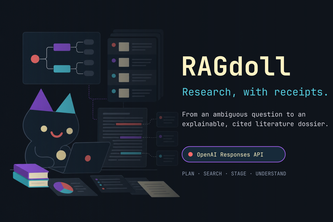
The description states that RAGdoll "turns ambiguous research questions into auditable literature dossiers—with human-approved search and passage-level citations."
- Claimed functionality: Converts vague or unclear research queries into structured academic literature summaries.
- Key feature: Human-approved search results with citation at the passage level.
- Not evidenced: The actual interface, user experience, or whether this is a web app, CLI, API, or desktop tool.
Inference: Based on the tech stack and description, it likely involves LLMs (e.g., GPT-5.6), academic APIs (arXiv, Crossref, OpenAlex), and possibly PDF parsing and database storage (SQLite).
- Inferred delivery mechanism: Likely a command-line or web-based tool, given the use of textual UI libraries and Python stack.
Positioning & Claim Evolution
The tagline positions RAGdoll as a solution for ambiguous research questions. It implies:
- A focus on academic or scientific research.
- A need to produce structured, auditable outputs from unclear prompts.
- A human-in-the-loop approach to validation of AI-generated content.
Not evidenced:
- No prior positioning or branding history.
- No evidence of how this differs from existing tools like Semantic Scholar, Zotero, or academic search engines.
- No indication of whether the tool is intended for individual researchers, institutions, or publishers.
Inference: The project likely emerged from a hackathon context, suggesting it was not yet a mature product but rather an experimental prototype.
Target Customer & ICP
The description does not name specific customer segments or personas.
- Claimed audience: Researchers, academics, or professionals working with literature reviews and research synthesis.
- Not evidenced: No evidence of target user types, usage patterns, or customer interviews.
Inference: Given the tool’s focus on literature dossiers and human-approved citations, it may appeal to:
- Graduate students
- Academics
- Research teams
- Publishers or editors requiring structured literature reviews
Business Model & Pricing Evidence
The description provides no information about pricing, monetization, or business model.
- Not evidenced: No mention of subscriptions, usage fees, B2B vs B2C, or revenue streams.
Inference: If this is a commercial product, it likely would be priced for academic institutions or individual researchers. However, the hackathon context suggests it may not yet have a defined model.
Technical & Delivery Signals
The author lists a number of technologies used:
- Tools and libraries: arXiv API, Crossref API, OpenAlex API, GPT-5.6, Pydantic, SQLite, pytest, rich, textual, typer.
- Stack: Python-based with LLM integration, CLI or terminal UI, and database support.
Not evidenced:
- No evidence of scalability, performance, or production deployment.
- No information on data handling, privacy, or API limits.
Inference: The tool is likely a prototype built in Python, using open-source APIs and LLMs, possibly for research or academic use. It may be CLI-based or web-based, but the UI stack (textual, typer) suggests terminal or lightweight UI.
Traction & Maturity Signals
The project was submitted to a hackathon in 2026.
- Not evidenced: No evidence of user adoption, customer feedback, revenue, or product iteration history.
- Not evidenced: No mention of prior versions, testing, or deployment beyond the hackathon.
Inference: The tool is likely at an early stage — possibly a proof-of-concept or prototype — with no demonstrated traction or market validation.
Competitive Context
The description does not name competitors or describe how RAGdoll compares to existing tools.
- Not evidenced: No competitive analysis, feature comparison, or differentiation from similar tools like:
- Semantic Scholar
- Zotero
- Mendeley
- Google Scholar
- ResearchGate
Inference: The tool may compete with academic literature search and citation tools, but without evidence of market positioning or differentiation, this remains speculative.
Open Questions & Risks
- Risk: No evidence of product-market fit or user traction.
- Risk: The project is a hackathon submission; no indication of long-term development or commercial viability.
- Open question: The use of GPT-5.6 (a non-existent model) in the tech stack may be an error or placeholder, suggesting lack of clarity or accuracy in technical claims.
- Open question: No evidence of team size beyond one person; no indication of support for scaling or product development.
Questions the description leaves open
- What is the process for human approval of search results and citations?
- How does RAGdoll handle ambiguous queries differently from existing tools?
- Has there been any user testing or feedback beyond the hackathon?
- Is this intended to be a commercial product, and if so, what is the monetization strategy?
- What are the limitations of the current prototype in terms of scalability or accuracy?
- How does it integrate with existing academic workflows or tools?
Overall Assessment
Not evidenced: No evidence of revenue, traction, or commercial viability.
- Confidence level: Low — based on a single hackathon submission and no external validation.
Inference: This is likely an early-stage prototype with no demonstrated product-market fit or business model. It may be a promising idea but lacks the evidence to support investment or partnership at this stage.
User Stories BotA demo video on every pull request
Get a demo video on every new feature
GitHub App that watches your pull requests and records a narrated, captioned demo.
Save time on demo prep and make informed decisions faster with a video walkthrough of every new feature.
Source
Submitted to the OpenAI 2026 hackathon on Devpost. Project home on Devpost. Back to the full gallery on Devpost.
This competitive analysis was produced by top-founders.com (opens in a new tab)
Generated by a language model from this project's public Devpost page — its tagline and any built-with tags listed there, since the author published no write-up — as captured in August 2026. Short quotations are the author's words. It is an opinion on the idea as a business, not on the people behind it, and it reflects the description as published then. If the project has moved on, request a correction below. The analysis is not independent research and contains no verified traction, revenue or customer data.
An independent guide by KFG International LLC — not affiliated with, endorsed by, or connected to Devpost or OpenAI.