

Archive position — measured, not model output
0 likes on Devpost
2,263 of the 7,850 archived projects have more likes, and 5,587 share exactly 0 — so this project's #4,247 place in the like-ranked listing is a tie-break inside that group, not a ranking.
Projects (log scale)
Likes on Devpost. ▲ marks this project's group.
Show the figures
| Likes | Projects | Share of archive |
|---|---|---|
| 0 | 5,587 | 71.2% |
| 1 | 1,758 | 22.4% |
| 2 | 284 | 3.6% |
| 3–4 | 132 | 1.7% |
| 5–9 | 75 | 1.0% |
| 10+ | 14 | 0.2% |
 User Stories BotA demo video on every pull request
Get a demo video on every new feature
GitHub App that watches your pull requests and records a narrated, captioned demo.
Save time on demo prep and make informed decisions faster with a video walkthrough of every new feature.
Executive Summary
What the company appears to be: A self-reported learning-path simulator built through natural-language direction using AI tools, intended as both a functional tool for families and a demonstration of how non-programmers can create, review, and continue software with AI assistance.
What changed: The project evolved from a private family tool into a public prototype designed for reuse by others, including documentation and source code release to enable further customization via AI.
Single most important open question: Is the described method of using natural language to direct AI-generated software development reproducible beyond this single instance?
Analysis basis: This report is based entirely on the self-reported description provided by the author. No external verification, revenue data, customer feedback or traction metrics are available. All claims in the description are treated as stated by the author and not independently confirmed.
What The Product Actually Is
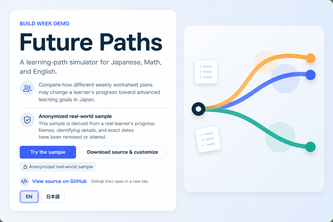
The description states that Future Paths is a bilingual, browser-only learning-path simulator. It turns dated progress records into visual forecasts across Japanese, Math, and English.
Key features include:
- Tracking current worksheet positions across three subjects
- Calculating an Observed Pace Baseline from anonymized progress history
- Adjusting weekly worksheet totals for each subject
- Comparing Lighter, Current, and Accelerated plans
- Projecting future worksheet positions toward a selected target date
- Comparing projected progress with learning benchmarks used in Japan
- Showing how much of the remaining distance toward a selected goal may be completed
- Visualizing anonymized progress history
- Importing updated progress records from CSV
- Switching between English and Japanese
- Storing settings locally in the browser
The system runs entirely client-side; no backend or server-side data transmission occurs.
Evidence: The author's own write-up describes these capabilities directly. No external validation or performance data is provided.
Positioning & Claim Evolution
The description states that Future Paths began as a private tool for one learner in one family, but evolved into a public, privacy-safe, bilingual, and reusable project.
It positions itself not merely as a forecasting tool, but as a method demonstration: the real project is the method of creating software through natural language and AI.
Key claims:
- A non-programmer can use lived experience, editorial judgment, testing, and natural-language direction to create working software.
- The tool demonstrates how to distribute and inherit software created this way.
- It is not a prediction of certainty but a planning and conversation tool.
- The application is released with source files and prompts so others can adapt it using AI.
Inference: The evolution from private to public, and the emphasis on method over product, suggests an experimental or educational positioning rather than a commercial one.
Target Customer & ICP
The description states that Future Paths was originally created for one learner in one family, suggesting a personal or niche use case.
It is described as intended for:
- Families managing children's learning paths
- Parents or educators who want to explore possible futures through study plans
- Individuals seeking a tool to visualize and discuss hypothetical learning scenarios
No explicit segmentation beyond this personal context is mentioned. The product is not positioned toward institutional users, schools, or broader commercial adoption.
Evidence: The author describes the origin as a family-specific need, with no indication of targeting other types of customers.
Business Model & Pricing Evidence
There is no evidence in the description of any business model, pricing structure, monetization strategy, or revenue streams.
The project is described as:
- Released under an MIT License
- Distributed as open-source with source files and prompts
- Designed to be inherited and customized by others
Absence of evidence: No mention of paid features, subscriptions, licensing fees, or commercial use restrictions.
Technical & Delivery Signals
The description indicates that the entire development process was directed through natural language, using:
- GPT-5.6 for turning ideas into implementation prompts
- Codex for generating and revising project files
- Other AI systems like Claude or Gemini for additional perspectives
Key technical details:
- Built with vanilla JavaScript, HTML5, CSS3, SVG
- Uses local storage for settings
- Supports CSV import/export
- Runs entirely in the browser (no backend)
- Bilingual interface (Japanese/English)
- Open-source and MIT licensed
Evidence: The author describes the development workflow and technical stack directly. No independent confirmation of these claims.
Traction & Maturity Signals
There is no evidence of traction, adoption, or user engagement beyond the author’s own description.
The project:
- Is described as a prototype
- Was submitted to an OpenAI hackathon (Devpost)
- Has no stated number of users, downloads, or usage statistics
- Does not mention any customer base, feedback loops, or iterative improvements based on external input
Absence of evidence: No data on user engagement, retention, or product maturity beyond the initial release.
Competitive Context
The description does not provide information about competitors or similar products in the market.
It is unclear whether there are existing tools for:
- Learning path simulation
- Educational planning
- AI-assisted software development
- Browser-based learning dashboards
Absence of evidence: No competitive landscape, market positioning, or comparison to other tools is provided.
Open Questions & Risks
Several potential risks and open questions are present based on the self-reported description:
- Reproducibility risk: The method described (using natural language to direct AI-generated code) may not be easily replicable by others.
- Scalability concerns: The tool is designed for individual or small family use; no indication of scalability to larger groups or institutions.
- Lack of commercial viability: No business model, pricing, or monetization strategy is evident.
- Dependency on AI tools: Reliance on specific AI models (e.g., GPT-5.6) raises questions about long-term sustainability if those tools change or become unavailable.
- Limited scope: The tool focuses only on worksheet-based tracking and does not appear to integrate with formal curricula or educational platforms.
Inference: These risks stem from the lack of evidence for scalability, commercialization, or widespread applicability.
Questions the description leaves open
- How consistently can this AI-driven development method be reproduced by others?
- What are the limitations of the current implementation that prevent broader adoption?
- Are there any plans to expand beyond family use cases or add features for institutional users?
- Has the tool been tested with actual families or educators, and what feedback was received?
- How would you adapt this approach if you wanted to build a more complex educational platform?
- What are the long-term implications of relying on specific AI models like GPT-5.6?
- Is there any intention to monetize or commercialize the tool in the future?
Note: These questions aim to probe beyond what is self-reported and uncover deeper insights into feasibility, scalability, and strategic direction.
Overall Assessment
There is no evidence of revenue, traction, or a clear path to profitability. The project is described as an experimental tool with educational value, not a commercial product.
It appears to be:
- A proof-of-concept
- An open-source demonstration
- A personal project with limited commercial intent
Assessment: Not suitable for investment or partnership at this stage due to lack of evidence of market demand, scalability, or business viability. The project may have value as a thought leadership tool or educational experiment, but it does not meet criteria for commercial due diligence.
User Stories BotA demo video on every pull request
Get a demo video on every new feature
GitHub App that watches your pull requests and records a narrated, captioned demo.
Save time on demo prep and make informed decisions faster with a video walkthrough of every new feature.
Source
Submitted to the OpenAI 2026 hackathon on Devpost. Project home on Devpost. Back to the full gallery on Devpost.
This competitive analysis was produced by top-founders.com (opens in a new tab)
Generated by a language model from this project's public Devpost page — its tagline, the author's own write-up and any built-with tags listed there — as captured in August 2026. Short quotations are the author's words. It is an opinion on the idea as a business, not on the people behind it, and it reflects the description as published then. If the project has moved on, request a correction below. The analysis is not independent research and contains no verified traction, revenue or customer data.
An independent guide by KFG International LLC — not affiliated with, endorsed by, or connected to Devpost or OpenAI.