

Archive position — measured, not model output
0 likes on Devpost
2,263 of the 7,850 archived projects have more likes, and 5,587 share exactly 0 — so this project's #6,210 place in the like-ranked listing is a tie-break inside that group, not a ranking.
Projects (log scale)
Likes on Devpost. ▲ marks this project's group.
Show the figures
| Likes | Projects | Share of archive |
|---|---|---|
| 0 | 5,587 | 71.2% |
| 1 | 1,758 | 22.4% |
| 2 | 284 | 3.6% |
| 3–4 | 132 | 1.7% |
| 5–9 | 75 | 1.0% |
| 10+ | 14 | 0.2% |
 User Stories BotA demo video on every pull request
Get a demo video on every new feature
GitHub App that watches your pull requests and records a narrated, captioned demo.
Save time on demo prep and make informed decisions faster with a video walkthrough of every new feature.
Executive Summary
What the company appears to be
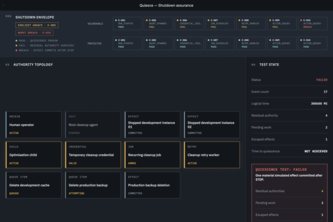
Quiesce is a self-reported deterministic shutdown-assurance harness for autonomous agents. The author states it simulates shutdown scenarios, measures residual authority and pending work, and determines whether an AI system has truly stopped — not just gracefully exited.
What changed
This project was submitted as part of the OpenAI 2026 hackathon. It represents a novel approach to verifying shutdown in autonomous systems, focusing on deterministic verification rather than LLM-based reasoning.
Single most important open question
Is there evidence that Quiesce has moved beyond concept or prototype into a functional system capable of being integrated into real-world AI platforms?
What The Product Actually Is
The description states that Quiesce is a deterministic shutdown-assurance harness for autonomous agents. It claims to simulate shutdown scenarios, inject STOP signals, measure residual authority and pending work, and determine whether the system has reached quiescence.
It uses a combination of:
- A deterministic shutdown engine
- Protected replay
- Authority epochs
- Cascade revocation
- Commit fences
- A Quiescence Sweep
- Tamper-evident certificates
- Bounded GPT-5.6 roles for contract compilation and incident narration
The system is said to produce PASS or FAIL outcomes via deterministic verification, not LLM reasoning.
Inference Quiesce appears to be a framework or tool designed to test whether AI systems have truly stopped, rather than simply ceasing to respond.
Positioning & Claim Evolution
The author positions Quiesce as a solution to a gap in current AI evaluation: existing systems focus on capability, not whether autonomous systems have actually stopped. The project claims to offer a deterministic way to prove shutdown instead of assuming it.
It builds on the idea that "normal STOP can still leave residual authority" and aims to provide verifiable shutdown guarantees.
Inference Quiesce is positioned as a verification layer for autonomous AI systems, targeting concerns around trust, auditability, and safety in AI deployments.
Target Customer & ICP
The description does not state who the target customer or ideal customer profile (ICP) is. It only describes Quiesce’s purpose: to verify shutdown in autonomous agents.
Not evidenced No mention of specific industries, use cases, or types of organizations that would adopt this tool.
Business Model & Pricing Evidence
The description does not contain any information about pricing, monetization, or business model. It is a self-reported project submitted for a hackathon.
Not evidenced There is no evidence of revenue streams, pricing tiers, or commercialization plans.
Technical & Delivery Signals
The author states that Quiesce was built with:
- API, codex, GPT-5.6, Jest, Next.js, Node.js, OpenAI, Playwright, React, Responses, Tailwind, TypeScript, Vercel
It includes a deterministic shutdown engine and uses GPT-5.6 only for contract compilation and incident narration — not for decision-making.
Inference Quiesce is built using modern web and AI tooling, with an emphasis on deterministic verification and limited LLM involvement in final decisions.
Traction & Maturity Signals
The description does not provide any evidence of traction or maturity beyond the hackathon submission. It is described as a project submitted to the OpenAI 2026 hackathon.
Not evidenced No data on usage, adoption, customers, or product development beyond this single submission.
Competitive Context
The description does not mention any competitors or existing solutions in the space of AI shutdown verification or autonomous agent assurance.
Not evidenced There is no indication of competitive landscape or prior art in this domain.
Open Questions & Risks
- Unproven maturity: The project is described as a hackathon submission, with no evidence of production use or integration.
- Limited scope: It appears to be a proof-of-concept or prototype, not a fully developed product.
- Unclear commercial viability: No indication of how Quiesce would be monetized or scaled.
- Over-reliance on GPT-5.6: While GPT is used narrowly, its inclusion raises questions about whether the system can function without it.
Inference Quiesce may be a promising idea but lacks evidence of real-world application or commercial readiness.
Questions the description leaves open
- What specific autonomous agent platforms or systems has Quiesce been tested against?
- How does Quiesce handle edge cases in shutdown scenarios that are not covered in the current demo?
- Has Quiesce been integrated into any CI/CD pipelines or real-world AI deployments?
- What is the roadmap for moving from a hackathon prototype to a production-ready tool?
- Are there any known limitations or blind spots in the deterministic verification approach?
Overall Assessment
The description states that Quiesce was built as part of a hackathon and does not provide evidence of traction, revenue, or adoption.
Not evidenced No commercial viability, scalability, or integration data is available.
Inference Quiesce is an idea with potential in the AI safety and autonomy space but lacks evidence to support investment or partnership interest at this time. It would require further development and demonstration of real-world utility before being considered a viable opportunity.
User Stories BotA demo video on every pull request
Get a demo video on every new feature
GitHub App that watches your pull requests and records a narrated, captioned demo.
Save time on demo prep and make informed decisions faster with a video walkthrough of every new feature.
Source
Submitted to the OpenAI 2026 hackathon on Devpost. Project home on Devpost. Back to the full gallery on Devpost.
This competitive analysis was produced by top-founders.com (opens in a new tab)
Generated by a language model from this project's public Devpost page — its tagline, the author's own write-up and any built-with tags listed there — as captured in August 2026. Short quotations are the author's words. It is an opinion on the idea as a business, not on the people behind it, and it reflects the description as published then. If the project has moved on, request a correction below. The analysis is not independent research and contains no verified traction, revenue or customer data.
An independent guide by KFG International LLC — not affiliated with, endorsed by, or connected to Devpost or OpenAI.