

Archive position — measured, not model output
0 likes on Devpost
2,263 of the 7,850 archived projects have more likes, and 5,587 share exactly 0 — so this project's #7,035 place in the like-ranked listing is a tie-break inside that group, not a ranking.
Projects (log scale)
Likes on Devpost. ▲ marks this project's group.
Show the figures
| Likes | Projects | Share of archive |
|---|---|---|
| 0 | 5,587 | 71.2% |
| 1 | 1,758 | 22.4% |
| 2 | 284 | 3.6% |
| 3–4 | 132 | 1.7% |
| 5–9 | 75 | 1.0% |
| 10+ | 14 | 0.2% |
 User Stories BotA demo video on every pull request
Get a demo video on every new feature
GitHub App that watches your pull requests and records a narrated, captioned demo.
Save time on demo prep and make informed decisions faster with a video walkthrough of every new feature.
Executive Summary
What the company appears to be
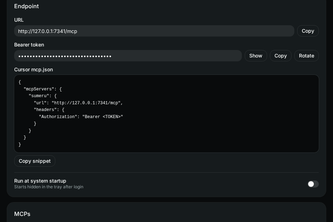
Sumeru is a self-reported local desktop application that aggregates multiple MCP (Model Control Protocol) endpoints into one authenticated gateway. It allows users to configure upstream tools (e.g., Notion, Linear, Stripe) once and then point hosts like Cursor at a single endpoint (http://127.0.0.1:7341/mcp) for tool access.
What changed
The project was submitted as part of the OpenAI 2026 hackathon. It is described as a functional prototype with desktop UI, CLI support, OAuth integration, and marketplace functionality for MCP providers.
Single most important open question
Is there any evidence of real-world usage or adoption beyond the author’s own development environment?
What The Product Actually Is
The description states that Sumeru is a local desktop MCP funnel/manager, designed to simplify how hosts interact with multiple upstream MCPs. It exposes a single authenticated endpoint (http://127.0.0.1:7341/mcp) and supports:
- Upstream servers via stdio commands or HTTP URLs.
- A system tray lifecycle (close window → keep serving; quit from tray to stop).
- Browser OAuth for HTTP MCPs using RFC 9728 / 8414 discovery, PKCE, and Dynamic Client Registration.
- Secrets stored in the OS keychain.
- A marketplace for one-click installation of curated DCR providers.
- CLI + npm launcher (
sumeru-mcp) for stdio hosts and GUI.
The product is built using Tauri (Rust), Svelte 5, Vite, shadcn-svelte, and Rust-based HTTP MCP server logic. It supports macOS/Linux via GitHub Releases and portable binaries.
Confidence Low — all details are self-reported and unverified.
Positioning & Claim Evolution
The author positions Sumeru as a solution to the fragmentation of MCP configurations across different tools (e.g., Linear, Notion, Stripe). The core claim is that users should be able to configure N upstream MCPs once and then point any host at one authenticated endpoint without reconfiguring.
This reflects an evolution from individual tool-specific setups toward a centralized local funnel. The author also notes that the product aims to reduce "babysitting server lists" and improve usability through quality-of-life features like tray lifecycle, pause/resume, and OAuth handling.
Confidence Low — this is a self-reported positioning statement with no external validation or traction data.
Target Customer & ICP
The description implies that Sumeru targets developers or users who work with MCP-compatible hosts, such as AI agents (e.g., Cursor), and those who manage multiple upstream tools using the MCP protocol. The product is intended for use in local development environments, where users want to avoid repetitive configuration steps.
There is no explicit mention of enterprise customers or end-users beyond developers working with AI tools.
Confidence Low — no evidence of customer segmentation or target personas beyond implied developer audience.
Business Model & Pricing Evidence
The description does not provide any information about pricing, monetization strategy, or business model. It only describes the technical architecture and functionality of the product.
Confidence Not evidenced — no indication of how Sumeru intends to generate revenue or whether it is commercialized.
Technical & Delivery Signals
Sumeru is built using:
- Desktop shell: Tauri (Rust) + Svelte 5 / Vite / shadcn-svelte
- Gateway engine: Rust Streamable HTTP MCP server on loopback, bearer-gated
- Transports: stdio commands and HTTPS HTTP MCPs (plain HTTP only on loopback)
- OAuth support: RFC 9728 / 8414 discovery, PKCE, Dynamic Client Registration, loopback callback on :7342
- Distribution method: GitHub Releases (macOS/Linux), portable CLI binaries, npm sumeru-mcp, in-app VitePress docs
It includes features like:
- Lazy connection to upstreams
- Reuse of connections until edit/delete/quit
- Browser OAuth for HTTP MCPs
- System tray lifecycle
- Pause/resume and optional launch at login
- Secrets stored in OS keychain
- Marketplace for one-click install of curated DCR providers
Confidence Medium — the technical details are described with sufficient granularity to suggest a functional prototype, but no independent verification exists.
Traction & Maturity Signals
There is no evidence of traction or user adoption beyond the author’s own development efforts. The project was submitted to a hackathon and lacks any data on:
- Number of users
- Customer feedback
- Revenue or monetization
- Usage metrics
- Product-market fit indicators
The product is described as a “real product loop” (install → Marketplace OAuth → paste one endpoint into Cursor), but this is self-reported and not independently confirmed.
Confidence Very low — no traction data provided.
Competitive Context
The description does not mention competitors or direct market comparisons. However, it references the MCP protocol, which is used by various tools like Linear, Notion, Stripe, Sentry, etc., suggesting a potential overlap with existing local tooling and agent frameworks.
It also implies that Sumeru addresses fragmentation in how hosts configure MCP endpoints — a problem likely shared across similar tools or platforms in the AI agent ecosystem.
Confidence Low — no competitive landscape or market positioning data provided.
Open Questions & Risks
- No traction or adoption: The project is described as a hackathon submission with no evidence of real-world usage.
- Single-person team: The team size is listed as one member, raising concerns about scalability and long-term maintenance.
- Limited platform support: macOS version is noted as untested; Windows packaging and cross-platform polish are mentioned as future work.
- Unverified claims: All descriptions are self-reported and lack independent corroboration.
- Unclear monetization path: No indication of how the product will be commercialized or generate revenue.
Confidence Medium — risks are inferred from lack of evidence rather than explicit data.
Questions the description leaves open
- Has Sumeru been tested in real-world usage beyond the author's own environment?
- Are there any early adopters or users who have provided feedback on usability or performance?
- What is the plan for expanding the marketplace catalog and improving non-DCR provider support?
- How does Sumeru intend to scale beyond a local desktop application, if at all?
- Is there any intention to pursue funding or commercial partnerships?
- What are the plans for cross-platform compatibility (especially Windows)?
- Are there any internal metrics or logs showing how often users interact with core features?
Overall Assessment
There is no evidence of traction, revenue, or customer adoption beyond the author’s own development efforts. The project appears to be a functional prototype built during a hackathon, with no indication of commercial viability or market demand.
The product addresses a real need in the MCP ecosystem but lacks any signal of progress toward a sustainable business model or user base.
Assessment Not ready for investment or partnership consideration based on available evidence. Further due diligence would require proof of usage, customer feedback, and clear monetization strategy.
User Stories BotA demo video on every pull request
Get a demo video on every new feature
GitHub App that watches your pull requests and records a narrated, captioned demo.
Save time on demo prep and make informed decisions faster with a video walkthrough of every new feature.
Source
Submitted to the OpenAI 2026 hackathon on Devpost. Project home on Devpost. Back to the full gallery on Devpost.
This competitive analysis was produced by top-founders.com (opens in a new tab)
Generated by a language model from this project's public Devpost page — its tagline, the author's own write-up and any built-with tags listed there — as captured in August 2026. Short quotations are the author's words. It is an opinion on the idea as a business, not on the people behind it, and it reflects the description as published then. If the project has moved on, request a correction below. The analysis is not independent research and contains no verified traction, revenue or customer data.
An independent guide by KFG International LLC — not affiliated with, endorsed by, or connected to Devpost or OpenAI.