

Archive position — measured, not model output
0 likes on Devpost
2,263 of the 7,850 archived projects have more likes, and 5,587 share exactly 0 — so this project's #3,111 place in the like-ranked listing is a tie-break inside that group, not a ranking.
Projects (log scale)
Likes on Devpost. ▲ marks this project's group.
Show the figures
| Likes | Projects | Share of archive |
|---|---|---|
| 0 | 5,587 | 71.2% |
| 1 | 1,758 | 22.4% |
| 2 | 284 | 3.6% |
| 3–4 | 132 | 1.7% |
| 5–9 | 75 | 1.0% |
| 10+ | 14 | 0.2% |
 User Stories BotA demo video on every pull request
Get a demo video on every new feature
GitHub App that watches your pull requests and records a narrated, captioned demo.
Save time on demo prep and make informed decisions faster with a video walkthrough of every new feature.
Executive Summary
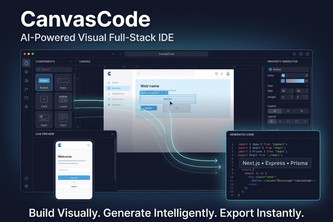
CanvasCode is described by its authors as an AI-powered visual IDE that enables developers to build full-stack web applications using drag-and-drop UI components. The tool is said to convert visual designs into code for technologies including Next.js, Express, and database systems.
The project was submitted to the OpenAI 2026 hackathon on Devpost by two team members, Owaif Aamir and Abdul Rehman. No revenue, customers, or traction are evidenced in the description.
Key open question
What is the actual technical architecture of CanvasCode? The description does not clarify whether it generates code from scratch, modifies existing projects, or integrates with a specific development workflow.
What The Product Actually Is
The description states that CanvasCode is an AI-powered visual IDE. It allows developers to build full-stack web applications by dragging and dropping UI components. The tool reportedly converts visual designs into code for technologies such as:
- Next.js
- Express
- Database systems (implied)
It is described as being built with a range of technologies including React, TypeScript, Node.js, and tools like OpenAI and Prisma.
Not evidenced The actual functionality or output of the tool beyond its self-description. There is no evidence of how it works technically or whether it generates code from scratch or modifies existing projects.
Positioning & Claim Evolution
The description states that CanvasCode is an AI-powered visual IDE for building full-stack web applications via drag-and-drop UI components, converting visual designs into code.
Not evidenced The evolution of the product's positioning over time. No evidence of prior versions, iterations, or changes in messaging.
Target Customer & ICP
The description states that CanvasCode is aimed at developers who want to build full-stack web applications using a visual interface.
Not evidenced Specific customer segments or ideal customer profiles (ICP). There is no indication of whether it targets beginners, experienced developers, startups, enterprises, or specific verticals.
Business Model & Pricing Evidence
The description does not provide any information on the business model or pricing structure of CanvasCode.
Not evidenced No evidence of revenue streams, pricing tiers, monetization strategy, or commercial arrangements.
Technical & Delivery Signals
The project is said to be built using technologies including:
- React
- TypeScript
- Node.js
- Next.js
- Express.js
- OpenAI
- Prisma
- SQLite
- Tailwind CSS
- Electron
- Vite
- Zustand
- Monaco Editor
- Shadcn
The description also mentions that it was submitted to the OpenAI 2026 hackathon.
Not evidenced The actual delivery mechanism or architecture of the tool. No evidence of how it integrates with development environments, whether it is a desktop app, browser-based tool, or cloud service.
Traction & Maturity Signals
The description does not provide any evidence of traction or maturity. It was submitted to a hackathon and has no mention of users, adoption, or product usage metrics.
Not evidenced No evidence of customers, revenue, user base, or product development milestones beyond its submission to a hackathon.
Competitive Context
The description does not provide any information about the competitive landscape or how CanvasCode compares to existing tools in the market.
Not evidenced No evidence of competitors, market positioning, or differentiation from other visual IDEs or no-code tools.
Open Questions & Risks
- Lack of product details: The description is sparse and does not provide enough information to assess the actual functionality or technical feasibility.
- No traction or commercialization: The project was submitted to a hackathon with no evidence of real-world usage or monetization.
- Unverified claims: All statements are self-reported and unverified, including its AI capabilities and code generation process.
Questions the description leaves open
- What is the actual technical architecture of CanvasCode? How does it generate code from visual components?
- Can you demonstrate a working prototype or provide screenshots of the tool in action?
- How does CanvasCode integrate with existing development workflows or IDEs?
- What are the limitations of the current version, and what features are planned for future releases?
- Are there any specific use cases or industries where CanvasCode is particularly suited?
Overall Assessment
The description provides no evidence to support a commercial due-diligence read. It is unclear whether CanvasCode has progressed beyond an idea or prototype stage, and there is no indication of traction, revenue, or customer adoption.
Not evidenced No basis for evaluating the commercial viability, scalability, or potential return on investment for CanvasCode. The project appears to be in a very early stage, with limited evidence of development or market readiness.
User Stories BotA demo video on every pull request
Get a demo video on every new feature
GitHub App that watches your pull requests and records a narrated, captioned demo.
Save time on demo prep and make informed decisions faster with a video walkthrough of every new feature.
Source
Submitted to the OpenAI 2026 hackathon on Devpost. Project home on Devpost. Back to the full gallery on Devpost.
This competitive analysis was produced by top-founders.com (opens in a new tab)
Generated by a language model from this project's public Devpost page — its tagline and any built-with tags listed there, since the author published no write-up — as captured in August 2026. Short quotations are the author's words. It is an opinion on the idea as a business, not on the people behind it, and it reflects the description as published then. If the project has moved on, request a correction below. The analysis is not independent research and contains no verified traction, revenue or customer data.
An independent guide by KFG International LLC — not affiliated with, endorsed by, or connected to Devpost or OpenAI.