

Archive position — measured, not model output
0 likes on Devpost
2,263 of the 7,850 archived projects have more likes, and 5,587 share exactly 0 — so this project's #7,037 place in the like-ranked listing is a tie-break inside that group, not a ranking.
Projects (log scale)
Likes on Devpost. ▲ marks this project's group.
Show the figures
| Likes | Projects | Share of archive |
|---|---|---|
| 0 | 5,587 | 71.2% |
| 1 | 1,758 | 22.4% |
| 2 | 284 | 3.6% |
| 3–4 | 132 | 1.7% |
| 5–9 | 75 | 1.0% |
| 10+ | 14 | 0.2% |
 User Stories BotA demo video on every pull request
Get a demo video on every new feature
GitHub App that watches your pull requests and records a narrated, captioned demo.
Save time on demo prep and make informed decisions faster with a video walkthrough of every new feature.
Executive Summary
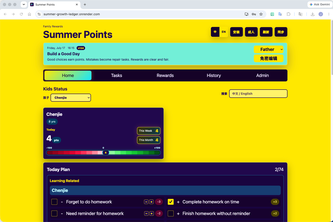
The description states that Summer Growth Ledger is a bilingual (English/Chinese) progressive web app built solo by LipTakChief Wu to track kids’ summer habits, chores, and growth milestones. It is described as a full-stack PWA with Supabase backend and Render deployment. The author reports building it from scratch without prior coding experience, iterating through version 115. No revenue, customers or traction data are evidenced.
The single most important open question is: What is the actual commercial intent behind this project? The description presents a personal tool built for family use, but does not clarify whether there is an intention to monetize or scale it beyond its current scope.
What The Product Actually Is
- The description states that Summer Growth Ledger is a "bilingual (English/Chinese) progressive web app"
- It is described as a tool for families to log daily habits, chores, and milestones for kids over the summer
- The app works offline as a PWA and syncs data to the cloud
- It presents progress in a way that's easy for both parents and kids to understand
Not evidenced: technical architecture beyond frontend calling Supabase backend; no details on features, UI/UX design, or functionality beyond logging and syncing.
Positioning & Claim Evolution
- The description states the author built it as a personal solution to track child development during summer
- It is positioned as "something more engaging than a paper chart, but not as heavy as a full parenting app"
- The author frames it as a learning project to sharpen full-stack skills
- No evidence of market positioning beyond personal use or skill-building
Inference: If this was intended for broader adoption, the author may have evolved the positioning from personal tool to commercial product. However, no such evolution is evidenced.
Target Customer & ICP
- The description states that it is designed for "families" and specifically for tracking "kids' summer habits, chores, and growth milestones"
- It is described as useful for both parents and kids
- No evidence of specific customer segments or personas beyond general family use
Not evidenced: no segmentation, targeting criteria, or detailed ICP beyond "families with children"
Business Model & Pricing Evidence
- The description does not state any pricing model or monetization strategy
- No evidence of paid features, subscriptions, or revenue streams
- The author states they built it solo from scratch without prior coding background
Inference: If the project is intended for commercial use, there is no indication of how it would generate revenue. It appears to be a personal tool at this stage.
Technical & Delivery Signals
- The app is described as a full-stack PWA
- It uses Supabase backend for authentication and data storage
- Deployment is on Render
- The author reports working through issues like Row Level Security (RLS) policies, conflicting event listeners, and dropdown bugs
- The app has reached version 115 over time
Not evidenced: no information about scalability, performance metrics, or technical robustness beyond bug fixes
Traction & Maturity Signals
- The project is described as being at version 115
- It was submitted to a hackathon (OpenAI 2026)
- The author built it solo from scratch with no prior coding background
- No evidence of user adoption, retention, or usage metrics beyond the author's personal use
Inference: The project appears to be in early development or prototype stage, with no clear signs of traction or market validation.
Competitive Context
- The description does not mention any direct competitors
- No evidence of existing solutions in this space (e.g., habit tracking apps for children)
- The author's framing suggests a niche gap between paper charts and full parenting apps
Not evidenced: no competitive landscape, market size, or differentiation analysis
Open Questions & Risks
- The project is described as built solo by one person with no prior coding background
- No evidence of revenue, customers, or traction
- The author's own write-up suggests this was a learning project rather than a commercial venture
- No indication of scalability or long-term viability beyond personal use
- The app is at version 115 but lacks any evidence of market validation
Inference: If the goal is to commercialize, there are significant risks related to lack of experience, no revenue model, and no clear path to growth.
Questions the description leaves open
- What is the actual commercial intent behind this project?
- Are you planning to monetize or scale this beyond personal use?
- How do you plan to validate demand for this product in the market?
- What are your plans for user acquisition and retention?
- Do you have any plans to add features or expand functionality beyond current scope?
Overall Assessment
Not evidenced: no financials, traction, or clear business case presented.
The description states that Summer Growth Ledger is a personal tool built by one developer with no prior coding experience. It is not evident whether the project has commercial intent or plans for scaling. There is no evidence of revenue, customers, or market traction to support an investment or partnership decision at this stage. The author's framing suggests it was primarily a learning exercise rather than a business venture.
The lack of any commercial strategy, pricing model, or user base makes it difficult to assess the potential for growth or return on investment. Without further evidence of market demand or monetization plans, the project appears to be in an early prototype phase with no clear path to commercial viability.
User Stories BotA demo video on every pull request
Get a demo video on every new feature
GitHub App that watches your pull requests and records a narrated, captioned demo.
Save time on demo prep and make informed decisions faster with a video walkthrough of every new feature.
Source
Submitted to the OpenAI 2026 hackathon on Devpost. Project home on Devpost. Back to the full gallery on Devpost.
This competitive analysis was produced by top-founders.com (opens in a new tab)
Generated by a language model from this project's public Devpost page — its tagline, the author's own write-up and any built-with tags listed there — as captured in August 2026. Short quotations are the author's words. It is an opinion on the idea as a business, not on the people behind it, and it reflects the description as published then. If the project has moved on, request a correction below. The analysis is not independent research and contains no verified traction, revenue or customer data.
An independent guide by KFG International LLC — not affiliated with, endorsed by, or connected to Devpost or OpenAI.