

Archive position — measured, not model output
0 likes on Devpost
2,263 of the 7,850 archived projects have more likes, and 5,587 share exactly 0 — so this project's #7,038 place in the like-ranked listing is a tie-break inside that group, not a ranking.
Projects (log scale)
Likes on Devpost. ▲ marks this project's group.
Show the figures
| Likes | Projects | Share of archive |
|---|---|---|
| 0 | 5,587 | 71.2% |
| 1 | 1,758 | 22.4% |
| 2 | 284 | 3.6% |
| 3–4 | 132 | 1.7% |
| 5–9 | 75 | 1.0% |
| 10+ | 14 | 0.2% |
 User Stories BotA demo video on every pull request
Get a demo video on every new feature
GitHub App that watches your pull requests and records a narrated, captioned demo.
Save time on demo prep and make informed decisions faster with a video walkthrough of every new feature.
Executive Summary
The company appears to be a solo developer project named Summer Sound Maker, built as part of an OpenAI 2026 hackathon submission. The product is described as a local-first app that allows users to compose summer soundscapes from a set of predefined sounds and export them as images, audio clips, or short videos.
What changed during Build Week
The project focused on improving product robustness by addressing real-world edge cases such as sound quality, layout stability, accessibility, and reliable media export. A key change involved aligning the app's behavior with native platform APIs for sharing/exporting, particularly on iPhone.
The single most important open question
Is there any evidence of user adoption or monetization strategy beyond the prototype?
This analysis is based entirely on the self-reported description provided by the author — no independent verification or traction data is available. The project appears to be in early-stage development with a focus on local-first design and cross-platform compatibility.
What The Product Actually Is
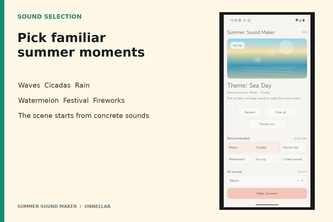
- The description states that Summer Sound Maker is an app allowing users to select summer sounds (e.g., waves, cicadas, rain) and generate a visual result with a title, local audio mix, and exportable media.
- It supports exporting results as images, audio clips, or short videos.
- The app uses Flutter for UI, JavaScript canvas rendering, Web Audio mixing, native Android share/save paths, and Apps in Toss WebView packaging.
- For iPhone AIT (App in Toss), video generation now uses a deterministic FFmpeg/WASM fallback instead of depending on WebView MediaRecorder support.
Note
This is a self-reported description. No evidence of actual product usage or revenue exists.
Positioning & Claim Evolution
- The author claims the app was built around the idea that "a season is easier to remember when it has a sound."
- It positions itself as a tool for composing and sharing summer scenes using recognizable sounds.
- During Build Week, the focus shifted from basic functionality to handling real-world product edges like export behavior and platform compatibility.
- The project evolved from a prototype into something more robust, particularly in how it handles iPhone AIT integration.
Inference The positioning seems to be centered on personalization and nostalgia through soundscapes, but there is no evidence of market research or user feedback influencing this direction.
Target Customer & ICP
- Not evidenced.
Finding
No explicit mention of target customer segments or ideal customer profile (ICP) in the description. The app appears aimed at general users interested in creating and sharing soundscapes, but no specific demographic or use case is defined.
Business Model & Pricing Evidence
- Not evidenced.
Finding
There is no indication of pricing structure, monetization strategy, or business model within the provided description. The project is described as a hackathon submission with no mention of revenue streams or paid features.
Technical & Delivery Signals
- Built using Flutter, JavaScript canvas, Web Audio API, native Android share/save paths, and Apps in Toss WebView packaging.
- For iPhone AIT, video generation now uses FFmpeg/WASM fallback to ensure deterministic output without relying on WebView MediaRecorder support.
- The app is designed to be local-first, meaning it does not require cloud connectivity for core functionality.
- Codex was used as a coding partner rather than content generator; it helped implement media export patches and updated packaging scripts.
Inference The technical stack suggests a focus on cross-platform compatibility and offline-first design. However, no evidence of scalability or infrastructure planning is present.
Traction & Maturity Signals
- Not evidenced.
Finding
No data on user engagement, downloads, retention, or any form of traction is provided. The project is described as a prototype submitted to a hackathon, with no indication of post-submission activity or growth metrics.
Competitive Context
- Not evidenced.
Finding
No mention of competitors or market positioning relative to existing tools for sound composition or media creation. The description does not reference similar products or services in the marketplace.
Open Questions & Risks
- Solo Developer Risk: With only one team member, there may be limited capacity for scaling or iterating quickly.
- Prototype Nature: The project is described as a hackathon submission, suggesting it has not yet reached a stable or scalable product state.
- Lack of Monetization Strategy: No evidence of how the app intends to generate revenue or sustain itself beyond its initial development phase.
- Limited Market Validation: There is no indication of user testing, feedback loops, or market demand validation.
Inference The lack of traction, monetization strategy, and competitive analysis raises concerns about long-term viability and commercial potential.
Questions the description leaves open
- What inspired the idea behind Summer Sound Maker? Was there any prior market research?
- How many users have interacted with the prototype so far?
- Are there plans to monetize the app, and if so, what model are you considering?
- Have you considered how the app will scale beyond a single developer?
- What is your roadmap for future features or integrations?
- How do you plan to validate demand for this type of product?
Overall Assessment
- Not evidenced.
Finding
No evidence of investment interest, partnership opportunities, or strategic alignment with potential investors or partners. The project remains in early-stage prototype form with no indication of commercial traction or scalability.
User Stories BotA demo video on every pull request
Get a demo video on every new feature
GitHub App that watches your pull requests and records a narrated, captioned demo.
Save time on demo prep and make informed decisions faster with a video walkthrough of every new feature.
Source
Submitted to the OpenAI 2026 hackathon on Devpost. Project home on Devpost. Back to the full gallery on Devpost.
This competitive analysis was produced by top-founders.com (opens in a new tab)
Generated by a language model from this project's public Devpost page — its tagline, the author's own write-up and any built-with tags listed there — as captured in August 2026. Short quotations are the author's words. It is an opinion on the idea as a business, not on the people behind it, and it reflects the description as published then. If the project has moved on, request a correction below. The analysis is not independent research and contains no verified traction, revenue or customer data.
An independent guide by KFG International LLC — not affiliated with, endorsed by, or connected to Devpost or OpenAI.