

Archive position — measured, not model output
1 like on Devpost
505 of the 7,850 archived projects have more likes, and 1,758 share exactly 1 — so this project's #1,151 place in the like-ranked listing is a tie-break inside that group, not a ranking.
Projects (log scale)
Likes on Devpost. ▲ marks this project's group.
Show the figures
| Likes | Projects | Share of archive |
|---|---|---|
| 0 | 5,587 | 71.2% |
| 1 | 1,758 | 22.4% |
| 2 | 284 | 3.6% |
| 3–4 | 132 | 1.7% |
| 5–9 | 75 | 1.0% |
| 10+ | 14 | 0.2% |
 User Stories BotA demo video on every pull request
Get a demo video on every new feature
GitHub App that watches your pull requests and records a narrated, captioned demo.
Save time on demo prep and make informed decisions faster with a video walkthrough of every new feature.
Executive Summary
Company: GridOne AI
Self-reported basis: The description is entirely self-reported and unverified; it contains no evidence of revenue, customers, traction or adoption.
What the company appears to be: A prototype for a distributed compute network that allows individuals to contribute idle device capacity to help build AI infrastructure, with an emphasis on transparency, control, and verifiability.
What changed: The project is described as a working prototype built in one week for a hackathon, demonstrating core components of a collaborative compute model.
Single most important open question: Is there a viable path from this prototype to a scalable, economically sustainable platform that can attract and retain users?
What The Product Actually Is
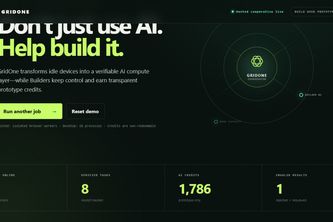
The description states that GridOne AI is a working prototype of a collaborative compute network. It allows people to become "Builders" by contributing idle device capacity through "Smart Contribution controls". The system divides supported jobs into microtasks, assigns them to available workers, and verifies results before issuing "AI Credits".
- The prototype uses Node.js 20 for the coordinator, scheduler, worker processes, verification, ledger, and tests.
- The dashboard is built with HTML, CSS, and JavaScript.
- Workers accept only versioned, allow-listed task types — not arbitrary remote code.
- Tasks are designed to be deterministic and independently verifiable (e.g., feature-hash vectors from text).
- Verification includes checks on digest, dimensions, token counts, and numerical output.
- Credits are issued only after verification and linked to auditable receipts.
Inference: The system is built around a model of distributed compute where trust is managed through verification rather than centralization.
Not evidenced: No information about actual performance metrics, scalability limits, or real-world usage.
Positioning & Claim Evolution
The project positions itself as an alternative to centralized AI infrastructure by enabling "a more participatory model: not AI built only for humanity, but AI infrastructure built with humanity."
- The tagline is: “Don’t just use AI. Help build it.”
- It emphasizes democratization, participation, and control over compute resources.
- The authors note that they used Codex and GPT-5.6 as a product/engineering collaborator to help define boundaries, avoid overclaiming, and keep the vision honest.
Inference: The positioning is rooted in cooperative computing and community-driven AI development, not commercial or profit-driven models.
Not evidenced: No evidence of prior positioning, marketing claims, or evolution of messaging beyond this single submission.
Target Customer & ICP
The description states that "people become Builders by opting in their idle device capacity."
- The primary user role is the Builder, who contributes compute resources.
- The system is designed for individuals with idle devices (e.g., personal computers, mobile phones).
- It targets users who are interested in contributing to AI infrastructure and value transparency and control.
Inference: The ICP is likely tech-savvy individuals or early adopters of distributed computing concepts.
Not evidenced: No data on user personas, segmentation, or customer acquisition strategy.
Business Model & Pricing Evidence
The description does not provide any information about:
- Revenue streams
- Pricing models
- Monetization strategies
- Customer lifetime value or unit economics
It only mentions that "AI Credits" are issued for verified work, and these credits are linked to audit receipts. However, it also states that "prototype credits are simulated and non-redeemable."
Inference: The system is currently in a prototype phase with no monetization or pricing structure described.
Not evidenced: No evidence of any business model beyond the prototype.
Technical & Delivery Signals
- Built using Node.js 20, HTML5, CSS3, JavaScript.
- No third-party runtime dependencies.
- Uses allow-listed task types to prevent arbitrary remote code execution.
- Implements deterministic verification for tasks.
- Includes a dashboard with task state, audit events, and credit receipts.
- Demonstrates multi-worker processes, task leasing, timeout, retry, reassignment, and rejection/requeueing of invalid work.
Inference: The prototype shows technical maturity in core components like scheduling, verification, and task management.
Not evidenced: No information on scalability, performance under load, or production readiness.
Traction & Maturity Signals
The project is described as a working prototype built in one week for a hackathon, with:
- A live demo available at https://cjreyrey.github.io/gridone-ai/
- Source code and desktop test instructions provided
- Five passing tests, including an end-to-end multi-worker run
- A reproducible public demo
Inference: The project has reached a functional prototype stage.
Not evidenced: No evidence of user adoption, retention, or real-world usage beyond the demo.
Competitive Context
The description does not mention any competitors directly. However, it implies a space that includes:
- Distributed computing platforms
- Collaborative AI infrastructure projects
- Community-driven compute networks (e.g., BOINC, Folding@home)
It also contrasts itself with centralized data centers and "hyperscale" models.
Inference: The project operates in a niche space of decentralized or community-based compute.
Not evidenced: No competitive analysis, market sizing, or positioning relative to existing platforms.
Open Questions & Risks
- Prototype-only status: The system is described as a one-week hackathon prototype with no real-world deployment.
- No monetization strategy: There is no indication of how the platform will generate revenue or sustain itself.
- Limited scope and simulation: Credits are simulated, not redeemable; the demo only shows a small-scale setup.
- Trust assumptions: Reliance on verification for trust may be insufficient at scale without stronger governance or economic incentives.
- No user base or feedback loop: No evidence of users or real-world testing beyond the demo.
Inference: The project is in an early exploratory phase with significant gaps in viability and scalability.
Not evidenced: No data on risk mitigation, user feedback, or long-term sustainability.
Questions the description leaves open
- What are your plans for transitioning from a prototype to a scalable platform?
- How do you intend to incentivize participation beyond altruism?
- What is the economic model for AI Credits and how will they be valued or exchanged?
- How do you plan to ensure security, privacy, and isolation in a distributed environment?
- Have you tested the system with more than one worker or under realistic workloads?
- What are the key technical challenges that remain unresolved before production deployment?
Overall Assessment
Self-reported basis only: This is an unverified, self-described prototype from a hackathon project.
- The project shows technical feasibility and conceptual clarity in building a distributed compute network.
- It has no evidence of traction, revenue, or customer adoption.
- It is not yet a commercial product, but rather a proof-of-concept with a clear vision.
- There is no indication of a viable path to monetization or scalability.
Assessment: Not ready for investment or partnership at this stage. A follow-up evaluation would require evidence of user engagement, prototype scaling, and business model development.
User Stories BotA demo video on every pull request
Get a demo video on every new feature
GitHub App that watches your pull requests and records a narrated, captioned demo.
Save time on demo prep and make informed decisions faster with a video walkthrough of every new feature.
Source
Submitted to the OpenAI 2026 hackathon on Devpost. Project home on Devpost. Back to the full gallery on Devpost.
This competitive analysis was produced by top-founders.com (opens in a new tab)
Generated by a language model from this project's public Devpost page — its tagline, the author's own write-up and any built-with tags listed there — as captured in August 2026. Short quotations are the author's words. It is an opinion on the idea as a business, not on the people behind it, and it reflects the description as published then. If the project has moved on, request a correction below. The analysis is not independent research and contains no verified traction, revenue or customer data.
An independent guide by KFG International LLC — not affiliated with, endorsed by, or connected to Devpost or OpenAI.