

Archive position — measured, not model output
1 like on Devpost
505 of the 7,850 archived projects have more likes, and 1,758 share exactly 1 — so this project's #1,148 place in the like-ranked listing is a tie-break inside that group, not a ranking.
Projects (log scale)
Likes on Devpost. ▲ marks this project's group.
Show the figures
| Likes | Projects | Share of archive |
|---|---|---|
| 0 | 5,587 | 71.2% |
| 1 | 1,758 | 22.4% |
| 2 | 284 | 3.6% |
| 3–4 | 132 | 1.7% |
| 5–9 | 75 | 1.0% |
| 10+ | 14 | 0.2% |
 User Stories BotA demo video on every pull request
Get a demo video on every new feature
GitHub App that watches your pull requests and records a narrated, captioned demo.
Save time on demo prep and make informed decisions faster with a video walkthrough of every new feature.
Executive Summary
What the company appears to be
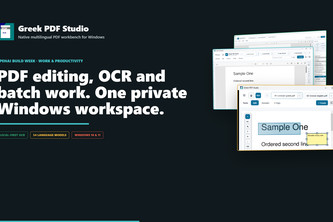
Greek PDF Studio is a desktop application for Windows that enables users to manipulate and process PDF documents locally, with a focus on multilingual support (especially Greek), privacy, and direct page interaction. It integrates OCR capabilities, batch processing, and document security features.
What changed
The project was built as part of the OpenAI 2026 hackathon, using .NET 8 WPF and AI tools like Codex and GPT-5.6 for development support. The author describes a validated native Windows release with offline installer, OCR functionality across multiple languages, and a structured workflow around document tabs.
The single most important open question
Is there any evidence of commercial traction or revenue generation beyond the hackathon submission? The description does not indicate whether this is a product in market, nor if it has moved past prototype or proof-of-concept stage.
What The Product Actually Is
The description states that Greek PDF Studio is:
- A private multilingual PDF and OCR workbench for Windows
- A desktop client built using .NET 8 WPF
- Designed to allow users to open multiple PDFs in tabs, perform direct page edits (annotations, shapes, text boxes), merge/split documents, run batch operations, and export to various formats (DOCX, XLSX, PPTX, TXT, images)
- Includes local OCR with 54 language models
- Offers security features such as password protection, redaction, digital signatures, and visual comparison
- Provides an offline installer, repair path, uninstall path, and embedded help
The product is described as a single executable application for Windows 10 x64 and Windows 11 x64.
Inference The software appears to be a desktop utility focused on local document processing, not cloud-based or SaaS.
Positioning & Claim Evolution
The author positions Greek PDF Studio as:
- A solution to fragmentation in document workflows, particularly for users working with Greek and mixed-language documents
- A tool that puts the document itself at the center of the workflow
- A private and local processing alternative to browser-based or cloud services
- A multilingual OCR workbench that supports both Greek and other languages
The claim evolution shows:
- Initial focus on solving a user pain point: fragmented document tools
- Expansion into privacy-sensitive use cases, especially for multilingual documents
- Emphasis on local processing, which implies no data leakage or reliance on external services
- Use of AI (Codex + GPT-5.6) to assist in development, but not as a core product feature
Inference The positioning is centered on privacy, local control, and multilingual OCR support, with an emphasis on usability for complex document workflows.
Target Customer & ICP
The description states:
- The primary use case involves users working with Greek and mixed-language documents
- Users may be professionals or individuals who need to process documents locally
- The tool supports batch operations, suggesting a potential audience of users handling large volumes of documents
- It is designed for Windows desktop environments
There is no explicit mention of:
- Specific industries (e.g., legal, academic, government)
- End-user roles (e.g., lawyers, researchers, librarians)
- Customer segments beyond general document processors
Inference The ICP likely includes document-heavy professionals or power users who value privacy and local processing, especially in multilingual contexts.
Business Model & Pricing Evidence
The description does not provide any evidence of:
- A pricing model
- Revenue streams
- Monetization strategy
- Subscription plans or one-time purchases
- Paid features or freemium offerings
It only mentions:
- An offline installer
- A single executable application
- No indication of monetization beyond the hackathon submission
Inference There is no evidence of a business model or pricing structure. The project appears to be a prototype or proof-of-concept, not yet commercialized.
Technical & Delivery Signals
The description provides:
- A desktop client built with .NET 8 WPF
- UI organized around a reader-first document canvas, direct-manipulation toolbars, and side panels
- Service boundaries for long-running jobs (PDF processing, OCR, export)
- Use of local tools like Tesseract, PDFSharp, OpenXML, FFmpeg, QPDF, Remotion, WebView2
- Release automation that verifies hashes, UI, dependency repair, uninstallation, and cleanup
- Integration with Codex and GPT-5.6 for engineering assistance during development
The author also notes:
- The application supports 100-file batch operations
- It includes embedded help, search, zoom, and task-based instructions
- A fail-closed release pipeline with evidence of application, installer, UI, repair, and uninstall behavior
Inference The technical architecture is robust for a desktop tool, with modular design, offline support, and automation in place. However, this is not yet a commercial product.
Traction & Maturity Signals
The description states:
- A validated native Windows release
- Exact recognition on controlled fixtures for Greek and English
- Tested scenarios including Greek-English automatic mode, Ancient Greek polytonic, German, Russian, and Simplified Chinese
- Verified merge, split, extract, protect, redaction, compare, signing, and editable exports
- Deterministic 100-file merge and 100-document batch edit/export tests
- Embedded help with real screenshots, search, zoom, and task-based instructions
However:
- No mention of:
- Customers or users
- Revenue or monetization
- Market adoption or usage data
- Post-hackathon development or commercialization
Inference The project shows technical maturity, but no evidence of commercial traction or user adoption beyond the hackathon.
Competitive Context
The description does not provide:
- Information on competitors
- Market positioning relative to existing PDF tools (e.g., Adobe Acrobat, PDFtk, LibreOffice)
- Pricing or feature comparisons
Inference The competitive context is unknown. The tool may be positioned as a niche utility for multilingual document processing, but no direct comparison or market analysis is provided.
Open Questions & Risks
Key risks and open questions based on the description:
- No commercial traction: The project was submitted to a hackathon, with no evidence of market adoption or revenue
- Limited scope: Only one developer (John Papadakis) involved
- No monetization strategy: No indication of how the product would be sold or funded
- Niche focus: Multilingual OCR and local processing may limit its appeal to a small user base
- Unverified claims: All features are self-reported, with no third-party validation or testing data
Inference The project is in an early stage (hackathon prototype), with no commercial viability demonstrated.
Questions the description leaves open
- What is the plan for monetization and go-to-market strategy?
- Has there been any user feedback or market testing beyond the hackathon?
- Are there plans to expand beyond Windows or support other platforms (e.g., macOS, Linux)?
- How does the OCR accuracy compare in real-world vs. controlled scenarios?
- What is the roadmap for future features and product development?
- Is there any intention to partner with or integrate into existing document workflows or enterprise systems?
Overall Assessment
Assessment Not evidenced.
The description provides no evidence of:
- Revenue
- Customers
- Traction
- Commercial viability
- Market demand
It describes a technical prototype built during a hackathon, with strong development and delivery signals but no indication of commercialization or product-market fit. The project is not yet a product in the market.
Confidence level Low — based entirely on self-reported information from one developer, with no external validation or evidence of adoption or monetization.
User Stories BotA demo video on every pull request
Get a demo video on every new feature
GitHub App that watches your pull requests and records a narrated, captioned demo.
Save time on demo prep and make informed decisions faster with a video walkthrough of every new feature.
Source
Submitted to the OpenAI 2026 hackathon on Devpost. Project home on Devpost. Back to the full gallery on Devpost.
This competitive analysis was produced by top-founders.com (opens in a new tab)
Generated by a language model from this project's public Devpost page — its tagline, the author's own write-up and any built-with tags listed there — as captured in August 2026. Short quotations are the author's words. It is an opinion on the idea as a business, not on the people behind it, and it reflects the description as published then. If the project has moved on, request a correction below. The analysis is not independent research and contains no verified traction, revenue or customer data.
An independent guide by KFG International LLC — not affiliated with, endorsed by, or connected to Devpost or OpenAI.