

Archive position — measured, not model output
0 likes on Devpost
2,263 of the 7,850 archived projects have more likes, and 5,587 share exactly 0 — so this project's #4,206 place in the like-ranked listing is a tie-break inside that group, not a ranking.
Projects (log scale)
Likes on Devpost. ▲ marks this project's group.
Show the figures
| Likes | Projects | Share of archive |
|---|---|---|
| 0 | 5,587 | 71.2% |
| 1 | 1,758 | 22.4% |
| 2 | 284 | 3.6% |
| 3–4 | 132 | 1.7% |
| 5–9 | 75 | 1.0% |
| 10+ | 14 | 0.2% |
 User Stories BotA demo video on every pull request
Get a demo video on every new feature
GitHub App that watches your pull requests and records a narrated, captioned demo.
Save time on demo prep and make informed decisions faster with a video walkthrough of every new feature.
Executive Summary
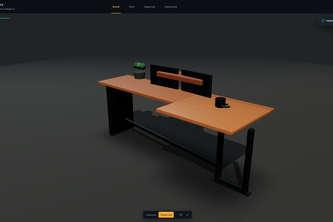
What the company appears to be: Form & Force is a self-reported AI-powered furniture construction simulator that allows users to describe furniture ideas, generate 3D designs, edit components, test stress and stability, and prepare fabrication-ready outputs. The tool is described as being built for desk construction but intended to expand to other furniture types.
What changed: This project was submitted as part of the OpenAI 2026 hackathon. It represents an early-stage prototype with no evidence of commercial traction or revenue.
The single most important open question: Is there any evidence that this tool has been used beyond the author's own development and testing, or whether it has attracted users who are not the founder?
What The Product Actually Is
- The description states that Form & Force is an AI-powered furniture construction simulator.
- It allows users to describe a desk or other furniture item, generate design ideas, edit 3D parts, test stress and stability, compare improvements, and prepare fabrication-ready outputs.
- Users can move or resize components such as worktops, legs, rails, braces, shelves, and storage.
- The app includes a Construction view for editing and a Finished Look view for seeing the desk as a product.
- AI is used to interpret natural language prompts (via GPT-5.6) but not to perform structural calculations or invent geometry.
- Deterministic code handles the actual construction, testing, and fabrication preparation.
- The AI Construction Coach helps explain results in simpler terms.
- Not evidenced: whether this tool produces professional engineering-grade outputs or is used by makers, learners, or vocational instructors.
Positioning & Claim Evolution
- The author claims Form & Force turns furniture ideas into editable 3D designs, tests stress and stability, recommends fixes, and prepares fabrication-ready outputs.
- It is positioned as a tool that helps users understand structural problems before starting to build.
- The product is described as educational and preliminary, not professional engineering certification.
- The author states it supports a complete workflow: Describe → Generate → Edit → Test → Improve → Retest → Fabricate.
- Not evidenced: whether this is intended for hobbyists, students, makers, or professionals; how the positioning evolved from idea to prototype.
Target Customer & ICP
- The author states that Form & Force is intended for learners, makers, and vocational instructors.
- It is described as a tool to help people understand furniture construction problems before building.
- Not evidenced: specific customer segments, user personas, or whether the product has been tested with any of these groups.
Business Model & Pricing Evidence
- The description does not state anything about pricing, monetization, or business model.
- Not evidenced: whether Form & Force is free to use, subscription-based, or sold as a SaaS product; if there are plans for monetization.
Technical & Delivery Signals
- Built with React, TypeScript, Vite, Three.js, React Three Fiber, Zustand, Zod, the OpenAI API, and Vercel server functions.
- Codex with GPT-5.6 was used for development, testing, debugging, and improvement.
- The AI is used to interpret user intent but not to perform structural validation or invent geometry.
- Deterministic code handles design generation, structure checking, testing, and fabrication preparation.
- Not evidenced: whether the tool is production-ready, scalable, or deployed in a way that supports real users.
Traction & Maturity Signals
- The project was submitted as part of an OpenAI hackathon.
- It is described as a prototype with no evidence of revenue, customers, or adoption beyond the author’s own use.
- The current validated module is Desk.
- Not evidenced: any user base, customer feedback, usage metrics, or product maturity beyond the initial prototype.
Competitive Context
- Not evidenced: whether there are existing tools in this space (e.g., CAD software for furniture, educational construction simulators).
- No mention of competitors or market positioning relative to them.
- The author does not describe how Form & Force differentiates from other tools.
Open Questions & Risks
- The tool is described as a prototype with no commercial traction or revenue.
- There is no evidence that it has been used by anyone beyond the founder.
- The AI is used for interpretation but not for structural validation, which may limit its utility for real-world applications.
- The author states the results are educational and preliminary, not professional engineering certification — this could be a significant limitation for adoption.
- Not evidenced: whether the tool is scalable or suitable for commercial use.
Questions the description leaves open
- Has Form & Force been tested with any users outside of yourself?
- What specific feedback have you received from learners, makers, or vocational instructors?
- Are there plans to monetize the product? If so, what is the business model?
- How does the tool handle real-world constraints like material properties or manufacturing limitations?
- Have you considered how this would scale beyond desk construction?
Overall Assessment
- Not evidenced: whether Form & Force has commercial potential or traction.
- The project is described as a prototype with no revenue, customers, or adoption data.
- It is positioned for learners and makers but lacks evidence of market validation or user engagement.
- The tool’s utility may be limited by its educational nature and lack of professional engineering certification.
- No clear path to commercialization or scalability is evident from the description.
- This is an early-stage idea with no demonstrated traction, and thus not a viable investment or partnership opportunity at this time.
User Stories BotA demo video on every pull request
Get a demo video on every new feature
GitHub App that watches your pull requests and records a narrated, captioned demo.
Save time on demo prep and make informed decisions faster with a video walkthrough of every new feature.
Source
Submitted to the OpenAI 2026 hackathon on Devpost. Project home on Devpost. Back to the full gallery on Devpost.
This competitive analysis was produced by top-founders.com (opens in a new tab)
Generated by a language model from this project's public Devpost page — its tagline, the author's own write-up and any built-with tags listed there — as captured in August 2026. Short quotations are the author's words. It is an opinion on the idea as a business, not on the people behind it, and it reflects the description as published then. If the project has moved on, request a correction below. The analysis is not independent research and contains no verified traction, revenue or customer data.
An independent guide by KFG International LLC — not affiliated with, endorsed by, or connected to Devpost or OpenAI.