

Archive position — measured, not model output
0 likes on Devpost
2,263 of the 7,850 archived projects have more likes, and 5,587 share exactly 0 — so this project's #4,207 place in the like-ranked listing is a tie-break inside that group, not a ranking.
Projects (log scale)
Likes on Devpost. ▲ marks this project's group.
Show the figures
| Likes | Projects | Share of archive |
|---|---|---|
| 0 | 5,587 | 71.2% |
| 1 | 1,758 | 22.4% |
| 2 | 284 | 3.6% |
| 3–4 | 132 | 1.7% |
| 5–9 | 75 | 1.0% |
| 10+ | 14 | 0.2% |
 User Stories BotA demo video on every pull request
Get a demo video on every new feature
GitHub App that watches your pull requests and records a narrated, captioned demo.
Save time on demo prep and make informed decisions faster with a video walkthrough of every new feature.
Executive Summary
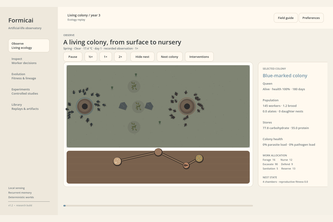
Formicai is a self-reported visual artificial-life simulation project that models ant colonies using neural networks. The author, Mehmet Dedeler, describes it as an "AI lab" where ants evolve, forage, build, fight and adapt—using only local information, without central control. It includes features like evolution, deterministic replays, individual neural-decision inspection, ecosystem simulation, and controlled experiments.
The project is presented as a research tool with educational potential, intended for experimentation in emergent intelligence and artificial life. It was submitted to the OpenAI 2026 hackathon.
Key open question
Is this a prototype or proof-of-concept that could evolve into a commercial product or platform, or is it purely an academic or personal exploration?
What The Product Actually Is
The description states that Formicai is a visual artificial-life laboratory. It simulates ant colonies using neural networks and includes:
- Neural ants that evolve
- Resource gathering and pheromone-based communication
- Nest building, fighting, and adaptation to weather/disease
- Reproduction and colony-level behavior emergence
- Deterministic simulation for repeatable experiments
- Individual neural decision inspection
- Ecosystem simulation capabilities
It is described as a research platform, not a commercial product. The author built it using Codex (a tool for code generation), and the project was submitted to the OpenAI 2026 hackathon.
Not evidenced What specific technology stack or architecture underpins the simulation, how many ants are simulated, or whether any real-time interaction is possible.
Positioning & Claim Evolution
The author positions Formicai as a visual AI lab for studying artificial life and emergent intelligence. The core claim is that it demonstrates how simple local decisions can create complex colony-level behavior—similar to real ant colonies.
It is framed as an educational and research tool, with potential for publication as open-source software. The author emphasizes the ability to inspect individual neural decisions, run controlled experiments, and simulate deterministic outcomes.
Not evidenced Whether this has been used in any formal academic or industry setting, or whether it has attracted interest beyond its creator.
Target Customer & ICP
The description does not identify specific target customers or personas. The author describes Formicai as a personal research tool, intended for experimentation and education.
It is presented as a platform for:
- Researchers studying artificial intelligence
- Educators teaching about emergent systems
- Developers exploring neural networks in simulation
Not evidenced Who has used it, whether there are users beyond the creator, or if any institutional adoption exists.
Business Model & Pricing Evidence
The description does not mention any business model or pricing. It is described as a personal project, with no indication of monetization or commercial intent.
Not evidenced Whether Formicai has any revenue streams, licensing plans, or paid features.
Technical & Delivery Signals
The author states that the simulation:
- Uses neural networks
- Includes evolution and deterministic replays
- Allows for inspection of individual neural decisions
- Simulates ecosystem behavior (forage, fight, build, etc.)
- Is built using Codex
It is described as a visual research platform, not a consumer-facing product.
Not evidenced Technical architecture, scalability, performance metrics, or whether it runs in real-time or batch mode.
Traction & Maturity Signals
The project is presented as a personal hackathon submission, with no evidence of traction beyond the author’s own description. It was submitted to the OpenAI 2026 hackathon and is described as an open-source educational tool under development.
Not evidenced Customer adoption, usage statistics, revenue, or any market validation.
Competitive Context
The description does not mention competitors or similar projects. It is framed as a unique personal exploration, not part of an existing product category.
Not evidenced Whether there are comparable tools in the AI simulation or artificial-life space, or how Formicai compares to them.
Open Questions & Risks
- No commercial traction or revenue: The project is described as a personal research tool with no evidence of monetization.
- Unproven market demand: No indication that there is a market for such a platform beyond the creator’s interest.
- Limited scope: It appears to be a prototype or proof-of-concept, not a scalable product.
- No external validation: The project has not been independently verified or tested by users or third parties.
Questions the description leaves open
- What is the intended use case for Formicai beyond personal research?
- Are there any plans to commercialize it, and if so, what would that look like?
- Has the project been used or tested by others (e.g., in academic or educational settings)?
- How does the simulation scale, and what are its performance limitations?
- What is the long-term vision for Formicai—research tool, open-source platform, or something else?
Overall Assessment
The project is described as a personal research effort, not a commercial venture. It has no evidence of traction, revenue, or customer adoption.
Not evidenced Whether this represents an opportunity for investment or partnership. The author’s intent appears to be educational and exploratory, not product-market fit-driven.
Confidence level: Low — based on the self-reported nature of all information and lack of external validation or commercial signals.
User Stories BotA demo video on every pull request
Get a demo video on every new feature
GitHub App that watches your pull requests and records a narrated, captioned demo.
Save time on demo prep and make informed decisions faster with a video walkthrough of every new feature.
Source
Submitted to the OpenAI 2026 hackathon on Devpost. Project home on Devpost. Back to the full gallery on Devpost.
This competitive analysis was produced by top-founders.com (opens in a new tab)
Generated by a language model from this project's public Devpost page — its tagline, the author's own write-up and any built-with tags listed there — as captured in August 2026. Short quotations are the author's words. It is an opinion on the idea as a business, not on the people behind it, and it reflects the description as published then. If the project has moved on, request a correction below. The analysis is not independent research and contains no verified traction, revenue or customer data.
An independent guide by KFG International LLC — not affiliated with, endorsed by, or connected to Devpost or OpenAI.