

Archive position — measured, not model output
2 likes on Devpost
221 of the 7,850 archived projects have more likes, and 284 share exactly 2 — so this project's #282 place in the like-ranked listing is a tie-break inside that group, not a ranking.
Projects (log scale)
Likes on Devpost. ▲ marks this project's group.
Show the figures
| Likes | Projects | Share of archive |
|---|---|---|
| 0 | 5,587 | 71.2% |
| 1 | 1,758 | 22.4% |
| 2 | 284 | 3.6% |
| 3–4 | 132 | 1.7% |
| 5–9 | 75 | 1.0% |
| 10+ | 14 | 0.2% |
 User Stories BotA demo video on every pull request
Get a demo video on every new feature
GitHub App that watches your pull requests and records a narrated, captioned demo.
Save time on demo prep and make informed decisions faster with a video walkthrough of every new feature.
Executive Summary
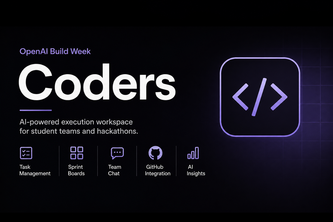
What the company appears to be: Coders is an AI-native execution workspace for hackathon and project teams, built as a self-contained product that combines task management, real-time collaboration, meetings, AI assistance, GitHub integration, document storage, analytics, billing, and administration into one platform. The authors state it was developed during OpenAI Build Week 2026.
What changed: The project evolved from a frontend-first prototype to a more complete product with end-to-end Super Admin system, organization-level controls, team isolation, secure collaboration features, AI improvements, billing flows, and security hardening — all within the context of a hackathon submission.
The single most important open question: Is there any evidence that this product has been adopted or used beyond the development environment, and if so, by whom?
Analysis basis: This report is based entirely on the self-reported project description provided by the authors. It contains no external verification or historical data. All claims are treated as stated by the author unless otherwise noted.
What The Product Actually Is
The description states that Coders is an AI-native execution workspace designed for hackathon and fast-moving project teams. It combines:
- Project planning
- Real-time collaboration
- Meetings
- AI assistance
- GitHub context
- Analytics
- Document storage
- Submission support
- Billing
- Administration
It supports two distinct product experiences:
- Global / personal workspace experience — for individual users who sign in globally, create personal workspaces, and manage tasks, chat, meetings, documents, GitHub, and personal billing.
- Organization workspace experience — for organizations with dedicated logins, administration flows, team leaders, capacity limits, and data isolation between teams.
The product is built using:
- React, TypeScript, Vite, Tailwind CSS, shadcn/Radix UI
- Supabase Auth, PostgreSQL, Realtime, Storage, Row-Level Security, RPCs, Edge Functions
- Groq runtime AI through protected Edge Functions
- Razorpay Standard Checkout for INR billing
- Vercel for deployment
Inference: The product appears to be a SaaS platform aimed at teams needing structured execution workflows, with emphasis on secure data handling and AI integration.
Positioning & Claim Evolution
The authors claim Coders addresses the problem of teams losing momentum due to fragmented tools — tasks in one app, discussions elsewhere, meetings in another, GitHub activity separate, and decisions forgotten after calls end.
They position it as:
- A single accountable workspace connecting people, work, meetings, and AI guidance.
- An execution tool that brings full workflow into one secure space.
- A solution for hackathon teams and fast-moving project teams under tight deadlines.
The evolution of the claim is from a general problem statement to a specific product offering with features like:
- Task creation with assignees, priority, due dates, sprint context, blockers, comments, attachments, dependencies, subtasks, recurring work, watchers, templates.
- Review-based workflow for task submission and approval.
- Sprint boards, calendar views, goals, retrospectives, completion signals, analytics.
- Team channels, direct messages, group messages, private channels, reactions, pins, replies, search, mentions, task references.
- Meeting intelligence with AI questions like “What was decided in the last meeting?”
- GitHub activity connection and AI-assisted project context.
- Document storage and AI assistant for various functions.
Claim vs Fact: These are claims made by the authors about what the product does and how it solves problems. No evidence of actual usage or adoption is provided.
Target Customer & ICP
The description states Coders is built for:
- Hackathon teams
- Student project teams
- Startup teams
- Organization-led programs
It explicitly targets teams that:
- Work under short deadlines
- Need clear ownership
- Cannot afford to spend time asking: “Who is doing this?”, “What was decided in the meeting?”, “Which task is blocked?”, “Is this work actually ready?”
The authors also note it supports both independent teams and organizations, with separate product experiences tailored for each.
Inference: The ICP likely includes small to mid-sized teams working on time-sensitive projects where coordination across tools is a pain point. However, no evidence of actual customer segments or personas is provided.
Business Model & Pricing Evidence
The description mentions:
- Billing support via Razorpay Standard Checkout for INR
- Personal billing versus workspace/organization billing separation
- Plan quota enforcement
- Organization-level billing controls
There is no mention of pricing tiers, subscription models, freemium offerings, or monetization strategy beyond the use of Razorpay.
Not evidenced: No information on revenue model, pricing structure, or monetization approach.
Technical & Delivery Signals
The product is built with:
- Frontend: React, TypeScript, Vite, Tailwind CSS, shadcn/Radix UI
- Backend: Supabase Auth, PostgreSQL, Realtime, Storage, Row-Level Security, RPCs, Edge Functions
- AI: Groq runtime AI through protected Edge Functions
- Payment: Razorpay Standard Checkout for INR billing
- Deployment: Vercel
Key technical signals include:
- Use of Supabase Row-Level Security for private data
- Server-side GitHub credential handling
- Rate limits for sensitive actions (AI, chat, invitations, uploads, meeting-code access)
- Secure notifications with workspace-aware destinations
- Role-based task review and deletion permissions
- Support tickets, data export/deletion workflows, audit-aware admin controls
Inference: The technical stack suggests a modern, scalable SaaS architecture with strong focus on security and user isolation.
Traction & Maturity Signals
The authors state:
- The project was submitted to the OpenAI 2026 hackathon.
- It started as a frontend-first project and was extended significantly during Build Week.
- Features were implemented in a short timeframe (a week-long hackathon).
- No mention of user adoption, customer base, or revenue.
Not evidenced: There is no evidence of traction, users, customers, or any form of market validation beyond the development phase.
Competitive Context
The description does not reference specific competitors. However, based on its features, Coders appears to compete with:
- Project management tools (e.g., Notion, Asana, Monday.com)
- Collaboration platforms (e.g., Slack, Microsoft Teams)
- Developer tooling integrations (e.g., GitHub, GitLab)
- AI productivity assistants (e.g., ChatGPT, Cursor, GitHub Copilot)
Inference: The competitive landscape includes a broad set of tools that address similar needs but may not fully integrate all aspects of Coders’ functionality.
Open Questions & Risks
Key risks and open questions identified:
- No evidence of actual users or customers.
- No revenue or monetization model described.
- Product is described as a hackathon submission — no indication of post-hackathon traction or commercial viability.
- Heavy reliance on AI features without clarity on how they scale or are integrated into workflows.
- Security and access controls are emphasized, but there’s no evidence of real-world testing or audits.
- The product is built for both individuals and organizations, which could complicate UX design and scalability.
Inference: Without any evidence of adoption or revenue, the commercial viability remains unproven.
Questions the description leaves open
- What is the current status of the product beyond the hackathon? Is it being used by anyone outside the development team?
- How many users are currently active on the platform, if any?
- What is the monetization strategy and how do you plan to generate revenue?
- Can you provide evidence of user feedback or early adopter engagement?
- Are there any plans for scaling beyond the current architecture?
- How do you ensure data privacy and compliance in a multi-tenant environment?
- What are the key challenges in transitioning from prototype to full product?
Overall Assessment
Assessment: Not evidenced.
The description provides no information on revenue, customers, traction, or commercial viability beyond the hackathon submission. The authors describe a comprehensive feature set and technical architecture, but there is no indication that this has been validated in the market.
Confidence Level: Low — based entirely on self-reported claims with no external validation or evidence of adoption or performance.
User Stories BotA demo video on every pull request
Get a demo video on every new feature
GitHub App that watches your pull requests and records a narrated, captioned demo.
Save time on demo prep and make informed decisions faster with a video walkthrough of every new feature.
Source
Submitted to the OpenAI 2026 hackathon on Devpost. Project home on Devpost. Back to the full gallery on Devpost.
This competitive analysis was produced by top-founders.com (opens in a new tab)
Generated by a language model from this project's public Devpost page — its tagline, the author's own write-up and any built-with tags listed there — as captured in August 2026. Short quotations are the author's words. It is an opinion on the idea as a business, not on the people behind it, and it reflects the description as published then. If the project has moved on, request a correction below. The analysis is not independent research and contains no verified traction, revenue or customer data.
An independent guide by KFG International LLC — not affiliated with, endorsed by, or connected to Devpost or OpenAI.