

Archive position — measured, not model output
3 likes on Devpost
128 of the 7,850 archived projects have more likes, and 93 share exactly 3 — so this project's #160 place in the like-ranked listing is a tie-break inside that group, not a ranking.
Projects (log scale)
Likes on Devpost. ▲ marks this project's group.
Show the figures
| Likes | Projects | Share of archive |
|---|---|---|
| 0 | 5,587 | 71.2% |
| 1 | 1,758 | 22.4% |
| 2 | 284 | 3.6% |
| 3–4 | 132 | 1.7% |
| 5–9 | 75 | 1.0% |
| 10+ | 14 | 0.2% |
 User Stories BotA demo video on every pull request
Get a demo video on every new feature
GitHub App that watches your pull requests and records a narrated, captioned demo.
Save time on demo prep and make informed decisions faster with a video walkthrough of every new feature.
Executive Summary
What the company appears to be
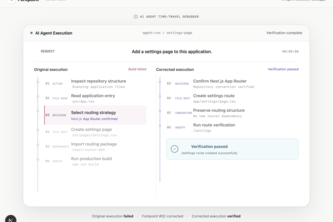
Forkpoint is a self-reported causal debugger for AI agents. The author describes it as a tool that imports normalized JSON execution traces and visualizes them into an interactive timeline and decision graph, identifying the earliest unsupported assumption in an agent’s execution and showing how errors propagated.
What changed
This is a hackathon submission (submitted to OpenAI 2026). It was built over a short time period with a single team member. The author states it includes a public demo, documentation, automated tests, and an end-to-end workflow for debugging AI agents.
The single most important open question
Is there any evidence of traction, revenue, or real-world adoption beyond the hackathon submission? The description does not indicate any commercial activity or customer base beyond the demo.
What The Product Actually Is
The description states that Forkpoint is a causal debugger for AI agents. It imports normalized JSON execution traces and transforms them into an interactive timeline and decision graph. It identifies the first unsupported assumption, shows evidence contradicting it, and visualizes how the error propagated through tool calls, file changes, and test failures.
It allows developers to edit the context at a "fork point" and generate a corrected alternative execution plan. The system includes a constrained replay demo that verifies a corrected branch and demonstrates a result changing from Failed to Passed.
Evidence
- The author states: “Forkpoint is a causal debugger for AI agents.”
- It imports normalized JSON execution traces.
- It visualizes execution as an interactive timeline and decision graph.
- It identifies the first unsupported assumption and shows propagation.
- It allows editing context at fork points and generating corrected branches.
- A constrained replay demo verifies corrected branches.
Inference The product is described as a debugging tool for AI agents, not a general-purpose development tool or platform. It is built to support debugging workflows in agent-based systems.
Positioning & Claim Evolution
The author positions Forkpoint as a causal debugger, inspired by Git branches and game save points. The core claim is that traditional logs fail to show where the agent first went wrong, whereas Forkpoint locates the earliest unsupported assumption and traces its impact.
Evidence
- “Traditional logs show what happened, but they rarely reveal where the agent first went wrong.”
- “Forkpoint was inspired by Git branches and game save points.”
- “Identifies the earliest unsupported assumption, highlights the evidence that contradicted it, and shows how the mistake propagated.”
Inference The positioning is focused on solving a specific problem in AI agent debugging — identifying root causes rather than just symptoms. It is not positioned as a general-purpose tool or platform.
Target Customer & ICP
The description states that Forkpoint is for developers working with AI agents, particularly those who need to debug agent behavior and trace execution errors.
Evidence
- “A developer can then edit the context at that Forkpoint and generate a corrected alternative execution plan.”
- The tool is built for debugging AI agents, not end-users or general consumers.
- It supports editing context and generating corrected plans — actions typically taken by developers.
Inference The target customer is likely technical users, such as software engineers or AI researchers working with agent-based systems. No specific ICP (Ideal Customer Profile) is defined beyond this.
Business Model & Pricing Evidence
There is no evidence of a business model or pricing structure in the description.
Evidence
- The description does not mention any pricing, subscriptions, or monetization strategy.
- The demo is publicly available and uses built-in traces to avoid API costs.
- No mention of paid features or access levels.
Inference The product is currently a hackathon submission with no commercial model evident. It may be intended for future monetization, but that is not stated.
Technical & Delivery Signals
Forkpoint is built using Next.js, React, TypeScript, Zod, Vitest, and integrates with the OpenAI API (specifically GPT-5.6). The author mentions that Codex was used during development.
Evidence
- Built with: Next.js, React, TypeScript, Zod, Vitest, OpenAI API
- Uses GPT-5.6 for structured causal analysis
- Codex was used for implementation and testing
- Public demo uses deterministic built-in trace to avoid API consumption
Inference The tool is technically feasible and built with modern web stack components. It integrates with AI APIs for causal reasoning, but no production deployment or scalability details are provided.
Traction & Maturity Signals
There is no evidence of traction, customers, or real-world adoption beyond the hackathon submission.
Evidence
- The project was submitted to a hackathon (OpenAI 2026)
- Includes a public demo and documentation
- No mention of revenue, users, or customer data
- No indication of product-market fit or usage beyond the demo
Inference The product is in early-stage development. It has not been validated with real users or commercial use cases.
Competitive Context
No competitive landscape or direct competitors are mentioned in the description.
Evidence
- The author does not reference any existing tools for AI agent debugging or causal analysis
- No mention of similar products, platforms, or market players
Inference It is unclear whether there are existing solutions in this space. The product may be novel or niche, but no competitive positioning is evident.
Open Questions & Risks
- No commercial traction or revenue evidence: The project is a hackathon submission with no indication of real-world adoption.
- Single-person team: The entire project was built by one person (zhi liscope), raising questions about scalability and long-term maintenance.
- Limited scope: The demo uses deterministic traces, not live agent behavior — this may limit its practical utility.
- No pricing or monetization strategy: No indication of how the product would be monetized or sold.
Evidence
- Only one team member listed
- Public demo uses built-in trace, not real-time agent execution
- No mention of monetization or business model
- No evidence of customer base or usage
Inference The project is experimental and lacks commercial viability or traction. It may be a proof-of-concept rather than a scalable product.
Questions the description leaves open
- What is the intended use case for Forkpoint beyond the demo? Is it meant to be integrated into agent frameworks or used standalone?
- How does Forkpoint handle trace data from different AI agent systems or frameworks (e.g., LangChain, AutoGen)?
- Are there any plans to support real-time tracing or integration with live agent sessions?
- What is the roadmap for monetization or commercial deployment?
- How does the tool ensure that causal reasoning from GPT-5.6 is reliable and repeatable across different traces?
Overall Assessment
Not evidenced.
The description provides no evidence of revenue, customers, traction, or commercial viability. It is a hackathon submission with a demo and limited functionality.
Confidence Low This is a self-reported, unverified project with no independent validation. The author states what the product does, but there is no evidence of real-world adoption, monetization, or scalability.
Inference If this were to be considered for investment or partnership, it would require further due diligence into its potential for commercial use, market demand, and technical feasibility beyond the demo. As a standalone hackathon project, it lacks the signals typically required for investment decisions.
User Stories BotA demo video on every pull request
Get a demo video on every new feature
GitHub App that watches your pull requests and records a narrated, captioned demo.
Save time on demo prep and make informed decisions faster with a video walkthrough of every new feature.
Source
Submitted to the OpenAI 2026 hackathon on Devpost. Project home on Devpost. Back to the full gallery on Devpost.
This competitive analysis was produced by top-founders.com (opens in a new tab)
Generated by a language model from this project's public Devpost page — its tagline, the author's own write-up and any built-with tags listed there — as captured in August 2026. Short quotations are the author's words. It is an opinion on the idea as a business, not on the people behind it, and it reflects the description as published then. If the project has moved on, request a correction below. The analysis is not independent research and contains no verified traction, revenue or customer data.
An independent guide by KFG International LLC — not affiliated with, endorsed by, or connected to Devpost or OpenAI.