

Archive position — measured, not model output
3 likes on Devpost
128 of the 7,850 archived projects have more likes, and 93 share exactly 3 — so this project's #162 place in the like-ranked listing is a tie-break inside that group, not a ranking.
Projects (log scale)
Likes on Devpost. ▲ marks this project's group.
Show the figures
| Likes | Projects | Share of archive |
|---|---|---|
| 0 | 5,587 | 71.2% |
| 1 | 1,758 | 22.4% |
| 2 | 284 | 3.6% |
| 3–4 | 132 | 1.7% |
| 5–9 | 75 | 1.0% |
| 10+ | 14 | 0.2% |
 User Stories BotA demo video on every pull request
Get a demo video on every new feature
GitHub App that watches your pull requests and records a narrated, captioned demo.
Save time on demo prep and make informed decisions faster with a video walkthrough of every new feature.
Executive Summary
What the company appears to be
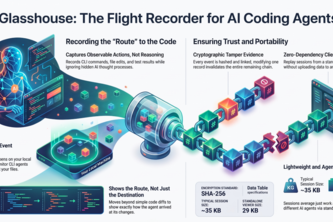
GlassHouse is a self-reported tool that records and replays AI coding agent sessions with cryptographic verification. The author states it captures observable actions (file reads/writes, terminal commands, test execution) using SHA-256 hash chaining to make sessions tamper-evident. It operates as a local recorder and browser-based replay viewer.
What changed
The project was submitted to the OpenAI 2026 hackathon. No evidence of prior development or product release exists beyond this submission.
Single most important open question
Is there any evidence of actual usage, adoption, or traction by developers working with AI coding agents?
What The Product Actually Is
The description states that GlassHouse is a "flight recorder for AI coding agents" that records observable actions performed by AI coding agents. It captures events such as:
- File reads
- File writes
- Terminal commands
- Test execution
- Command output
- Session metadata
These events are linked using SHA-256 hash chaining to create a tamper-evident session log.
The system consists of two components:
- A local recorder that wraps an AI coding agent and captures observable events.
- A standalone replay viewer that visualizes sessions and verifies integrity entirely in the browser.
Sessions can be stored as portable JSON files or exported as self-contained HTML replay files that work offline with no server required.
Evidence Self-reported by author.
Inference The tool appears to be a developer-facing observability tool focused on transparency and debugging for AI coding agents, not content generation.
Positioning & Claim Evolution
The description states that GlassHouse was inspired by flight recorders for airplanes. It aims to make AI coding sessions as transparent as flight data is for aviation safety.
The author claims:
- "We wanted to make AI coding sessions as transparent as flight recorders are for airplanes."
- "Glasshouse-lite records observable actions performed by AI coding agents."
- "Every event is linked using a SHA-256 hash chain, making the session tamper-evident."
- "Developers can replay an entire coding session through an interactive timeline."
Evidence Self-reported.
Inference The positioning is centered on trust, transparency, and debugging for AI agents in development workflows. It's positioned as a tool for developers who want to understand how AI agents work, not as a generative AI product itself.
Target Customer & ICP
The description states that GlassHouse is designed for developers working with AI coding agents. It captures observable actions during agent sessions and allows replay and inspection of those sessions.
Evidence Self-reported.
Inference The primary customer is likely software developers or engineering teams using AI coding tools (e.g., GitHub Copilot, Claude, Gemini) who want to audit or debug their AI-assisted workflows.
Business Model & Pricing Evidence
The description makes no mention of pricing, business model, monetization strategy, or any commercial aspects. It only describes the technical architecture and functionality.
Evidence Not evidenced.
Inference No evidence of a defined business model or pricing structure exists in the provided description.
Technical & Delivery Signals
The project was built using:
- Frontend: React, Next.js, TypeScript, JavaScript, HTML, Tailwind CSS (via Lucide icons)
- Backend: Node.js, Python
- Tools: Vercel, NPM, Codex
- Cryptography: SHA-256 hash chaining for verification
- Architecture: Adapter-based system to support different AI coding agents
Key technical features include:
- Agent-agnostic architecture
- Self-contained HTML replay files (no server required)
- SHA-256 verification implemented in JavaScript without relying on browser Web Crypto APIs
- Portable JSON storage format
Evidence Self-reported.
Inference The tool shows some engineering sophistication, particularly around cryptographic integrity and cross-platform compatibility. However, no evidence of production deployment or scalability is provided.
Traction & Maturity Signals
The project was submitted to the OpenAI 2026 hackathon on Devpost. It has a team size of two members: Arveend Phraseart and Mazrini Bot.
There is no evidence of:
- Revenue
- Customers
- Product usage
- Market traction
- Deployment in production environments
Evidence Self-reported.
Inference This is an early-stage hackathon project with no demonstrated traction or commercial maturity. It's not evident whether it has moved beyond prototype status.
Competitive Context
The description does not mention any competitors or existing tools in the space of AI agent observability or debugging.
Evidence Not evidenced.
Inference Without a competitive analysis, it is unclear how GlassHouse fits into the broader market for AI coding agent transparency tools. It may be an early entrant or niche solution.
Open Questions & Risks
- No revenue or customer data: The project has no evidence of monetization or user adoption.
- Early-stage prototype: Submitted to a hackathon, with no indication of further development or product release.
- Limited team size: Only two members are listed, which may limit execution capacity.
- Unproven market demand: No evidence that developers actually need this type of tool for AI agent sessions.
- No scalability claims: The tool works offline and in browsers but lacks information on handling large-scale or enterprise use cases.
Evidence Self-reported.
Inference The risk of failure is high due to lack of traction, unclear commercial viability, and absence of real-world validation.
Questions the description leaves open
- What specific AI coding agents does GlassHouse currently support?
- Has anyone outside the team used or tested GlassHouse in practice?
- Are there any plans for monetization or commercial product development beyond this hackathon submission?
- How do you plan to scale the tool if it gains adoption?
- What are the limitations of the current architecture that would prevent enterprise use?
Overall Assessment
Not evidenced.
There is no evidence of:
- Revenue
- Customers
- Product-market fit
- Traction or usage metrics
- Commercial strategy or business model
The project appears to be a hackathon submission with no demonstrated commercial viability, user adoption, or product maturity.
Confidence level Low — based on minimal self-reported information and absence of any traction data.
User Stories BotA demo video on every pull request
Get a demo video on every new feature
GitHub App that watches your pull requests and records a narrated, captioned demo.
Save time on demo prep and make informed decisions faster with a video walkthrough of every new feature.
Source
Submitted to the OpenAI 2026 hackathon on Devpost. Project home on Devpost. Back to the full gallery on Devpost.
This competitive analysis was produced by top-founders.com (opens in a new tab)
Generated by a language model from this project's public Devpost page — its tagline, the author's own write-up and any built-with tags listed there — as captured in August 2026. Short quotations are the author's words. It is an opinion on the idea as a business, not on the people behind it, and it reflects the description as published then. If the project has moved on, request a correction below. The analysis is not independent research and contains no verified traction, revenue or customer data.
An independent guide by KFG International LLC — not affiliated with, endorsed by, or connected to Devpost or OpenAI.