

Archive position — measured, not model output
3 likes on Devpost
128 of the 7,850 archived projects have more likes, and 93 share exactly 3 — so this project's #161 place in the like-ranked listing is a tie-break inside that group, not a ranking.
Projects (log scale)
Likes on Devpost. ▲ marks this project's group.
Show the figures
| Likes | Projects | Share of archive |
|---|---|---|
| 0 | 5,587 | 71.2% |
| 1 | 1,758 | 22.4% |
| 2 | 284 | 3.6% |
| 3–4 | 132 | 1.7% |
| 5–9 | 75 | 1.0% |
| 10+ | 14 | 0.2% |
 User Stories BotA demo video on every pull request
Get a demo video on every new feature
GitHub App that watches your pull requests and records a narrated, captioned demo.
Save time on demo prep and make informed decisions faster with a video walkthrough of every new feature.
Executive Summary
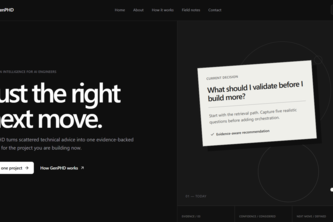
What the company appears to be: GenPHD is a self-reported decision intelligence tool for AI engineers. It claims to help users navigate conflicting AI advice by offering evidence-backed next actions, learning from outcomes, and updating roadmaps over time.
What changed: The project description indicates this is an MVP built for the OpenAI 2026 hackathon. It presents a closed-loop system designed to reduce decision fatigue in AI engineering workflows through structured reasoning and feedback.
The single most important open question: Is there evidence of real-world usage or traction beyond the hackathon MVP? The description states no revenue, customers or adoption data exist outside of its own claims.
What The Product Actually Is
The description states that GenPHD is a decision intelligence layer for AI engineers. It builds a concise roadmap with next three milestones based on user input (goal, project, stack, time budget, blocker). When stuck, users ask a decision question and receive a Decision Brief containing:
- Source-backed evidence
- Tradeoffs
- Recommendation
- Explicit confidence level
- Counterfactual ("choose the alternative if…")
- One next action
This action becomes a Build Mission with target outcome and acceptance criteria. After completion, GenPHD records the outcome, updates skill evidence, and adjusts the roadmap.
It is described as not being a generic chatbot, course platform, or multi-agent dashboard — instead, it's a closed decision loop: evidence in, action out, learning compounding over time.
Inference: The system appears to be built around an iterative workflow of deciding → acting → reflecting → improving. It uses AI orchestration (OpenAI) and structured data handling (PostgreSQL, Supabase).
Positioning & Claim Evolution
The description states GenPHD was inspired by the problem of AI engineers losing hours asking the same question in multiple tabs — where conflicting advice leads to inefficiency rather than lack of answers.
It positions itself as a tool that remembers projects, weighs evidence over opinion, and turns decisions into actual next steps. The tagline says: “Turn conflicting AI advice into an evidence-backed next build action — then learn from what happens when you act on it.”
The claim evolution shows a shift from generic AI tools to a structured decision-making system focused on actionable outcomes and continuous learning.
Inference: This is a product built with the intent to solve inefficiencies in AI engineering workflows, particularly around decision fatigue and lack of structured guidance.
Target Customer & ICP
The description states GenPHD is for AI engineers. It targets users who are working on AI projects and face conflicting advice from various sources (tutorials, docs, social media).
It does not specify a细分 customer segment beyond “AI engineers” or provide any indication of whether it's aimed at individuals, teams, or enterprises.
Inference: The ICP is likely individual AI engineers or small engineering teams working on AI-related projects. No evidence suggests targeting enterprise clients or specific verticals.
Business Model & Pricing Evidence
The description does not contain any information about pricing, monetization strategy, or business model.
Not evidenced
Technical & Delivery Signals
The project was built with:
- Frontend: Next.js (App Router), TypeScript strict mode, Tailwind CSS, shadcn/ui, Lucide icons
- Backend: Supabase (PostgreSQL, Auth, RLS, Storage), typed server routes, Zod schema validation
- AI workflow: OpenAI as primary reasoning layer, orchestrated via a controlled pipeline:
- Context Builder → Evidence Retriever → Parallel Deliberation → Claim Adjudicator → Action Composer → Reflection Evaluator
- Architecture: Deliberate modular monolith for MVP; services split only when there's a measured reason
- Design system: Monochrome UI with restraint-first approach, no gradients or gamification
Inference: The technical stack suggests a modern SaaS architecture with strong emphasis on type safety and data integrity. The AI workflow is structured as a pipeline rather than an autonomous agent.
Traction & Maturity Signals
The description states this was built for the OpenAI 2026 hackathon, and no revenue, customer or traction data is available beyond what the authors state.
There is no evidence of:
- Revenue
- Customers
- Adoption metrics
- Product usage data
- Market validation
Not evidenced
Competitive Context
The description does not mention any competitors. It does not describe how GenPHD differs from existing tools in the AI engineering space, such as documentation platforms, AI assistants, or decision frameworks.
Not evidenced
Open Questions & Risks
- No traction or validation: The product is described only as an MVP for a hackathon — no evidence of real-world usage.
- Unproven value proposition: While the author claims to solve decision fatigue, there’s no data showing whether users actually benefit from this approach.
- Limited scope: The MVP excludes features like gamification, social feeds, and admin dashboards — but it's unclear if these were cut for good reasons or due to time constraints.
- Self-reported nature: All claims are unverified; there is no third-party corroboration of the product’s functionality or effectiveness.
Inference: Without real-world usage or feedback, the risk that GenPHD fails to deliver on its promise is high.
Questions the description leaves open
- What specific problems do AI engineers face in practice that this tool addresses?
- How does GenPHD determine the trustworthiness of sources used in a Decision Brief?
- Has there been any user testing or feedback beyond the hackathon MVP?
- What are the key assumptions behind the closed-loop decision-making model, and how have they been validated?
- Are there plans to integrate with existing AI development tools or platforms?
Overall Assessment
The description states that GenPHD is an MVP built for a hackathon. There is no evidence of revenue, customers, traction, or product-market fit beyond the authors' own claims.
Assessment: Not ready for investment or partnership at this stage. The project shows potential in addressing a real pain point but lacks validation and evidence of adoption or impact.
User Stories BotA demo video on every pull request
Get a demo video on every new feature
GitHub App that watches your pull requests and records a narrated, captioned demo.
Save time on demo prep and make informed decisions faster with a video walkthrough of every new feature.
Source
Submitted to the OpenAI 2026 hackathon on Devpost. Project home on Devpost. Back to the full gallery on Devpost.
This competitive analysis was produced by top-founders.com (opens in a new tab)
Generated by a language model from this project's public Devpost page — its tagline, the author's own write-up and any built-with tags listed there — as captured in August 2026. Short quotations are the author's words. It is an opinion on the idea as a business, not on the people behind it, and it reflects the description as published then. If the project has moved on, request a correction below. The analysis is not independent research and contains no verified traction, revenue or customer data.
An independent guide by KFG International LLC — not affiliated with, endorsed by, or connected to Devpost or OpenAI.