

Archive position — measured, not model output
1 like on Devpost
505 of the 7,850 archived projects have more likes, and 1,758 share exactly 1 — so this project's #1,087 place in the like-ranked listing is a tie-break inside that group, not a ranking.
Projects (log scale)
Likes on Devpost. ▲ marks this project's group.
Show the figures
| Likes | Projects | Share of archive |
|---|---|---|
| 0 | 5,587 | 71.2% |
| 1 | 1,758 | 22.4% |
| 2 | 284 | 3.6% |
| 3–4 | 132 | 1.7% |
| 5–9 | 75 | 1.0% |
| 10+ | 14 | 0.2% |
 User Stories BotA demo video on every pull request
Get a demo video on every new feature
GitHub App that watches your pull requests and records a narrated, captioned demo.
Save time on demo prep and make informed decisions faster with a video walkthrough of every new feature.
Executive Summary
What the company appears to be
Focused is a browser extension built by one developer (Prithvi Bharadwaj) that organizes, understands, and searches open browser tabs using an agentic layer — likely powered by AI tools like GPT-5.6 Codex and Claude. The product aims to reduce tab management friction by grouping tabs based on intent, enabling users to search or talk to the extension about specific content, and offering features such as tab merging, undo, and local processing.
What changed
The project was developed over a hackathon period (as noted in the Devpost submission), with significant use of AI agents for development and testing. It is now being prepared for release on the Chrome Web Store, with plans to add session memory and subscription-based access.
Single most important open question
Is there evidence of early user traction or adoption beyond the author’s own experience and feedback from a small group of testers?
What The Product Actually Is
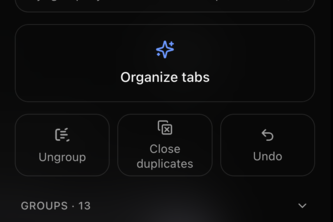
The description states that Focused is a browser extension with an agentic layer. It reads open tabs, groups them by intent, allows users to search or talk to it about specific content, and supports local processing (no server data transfer). Features include tab merging, undo functionality, stashing, duplicate cleanup, and export capabilities.
- The product is built using React 19, TypeScript, Tailwind v4, Vite.
- It uses a Manifest V3 service worker and integrates with AI tools like GPT-5.6 Codex and Claude for development.
- It runs on either a user’s own API key or fully locally, ensuring no data touches any server.
Inference The extension appears to be designed around personal productivity and tab organization, leveraging AI to interpret tab content and group it semantically.
Positioning & Claim Evolution
The author positions Focused as a personal productivity tool that solves the problem of tab overload by offering intelligent grouping and search capabilities. It is framed as an agentic solution, where users can interact with the extension via natural language queries to locate specific tabs or content.
- The product was built to scratch the author’s own itch — managing 20–40 open tabs daily.
- It evolved from a simple tab manager into something more sophisticated, incorporating AI for intent recognition and user interaction.
- The author claims that users who tested it said they needed it and that it would save them hours.
Inference The positioning has shifted from a basic utility to an AI-enhanced personal assistant for browser navigation. However, no external validation or market positioning beyond the author’s own description is provided.
Target Customer & ICP
The target customer appears to be individuals who frequently use multiple browser tabs, especially those engaged in research, content curation, or knowledge work. The extension is tailored toward users who are frustrated by tab overload and want better control over their browsing experience.
- The author notes that the tool was built for personal use — managing 20–40 tabs at once.
- Users may include professionals working with large volumes of information, such as researchers, writers, or investors.
Inference The ICP is likely a knowledge worker or researcher, but no explicit segmentation or persona data is provided in the description.
Business Model & Pricing Evidence
The author mentions that the extension will be released on the Chrome Web Store and plans to make API keys optional while turning it into a subscription-based service.
- No pricing model, subscription tiers, or monetization strategy are detailed.
- The product currently supports local processing, which may imply a freemium or self-hosted option before introducing paid features.
Inference A potential business model could involve a freemium tier with basic features and premium subscriptions for advanced functionality like session memory or enhanced AI tools. However, no concrete evidence of pricing exists.
Technical & Delivery Signals
The extension is built using modern web technologies:
- Frontend: React 19, TypeScript, Tailwind v4, Vite
- Backend/Service Worker: Manifest V3, dependency-free
- Development Process: Used AI agents (GPT-5.6 Codex, Claude) extensively for coding and testing.
- Testing & Quality Assurance: 124 tests across 17 files; used parallel agent workspaces for development and auditing.
Inference The technical stack suggests a high-quality, modern frontend with strong tooling support. The use of AI agents in development indicates a focus on automation and rapid iteration, though this does not imply scalability or product maturity.
Traction & Maturity Signals
The author claims:
- “I already got 30 users”
- “Every single person I showed this to said they needed it and that it would save them hours”
- “I haven’t even posted about it online yet”
There is no mention of revenue, customer acquisition metrics, or user retention data.
Inference While the author reports early interest and feedback from a small group, there is no verifiable traction beyond self-reported numbers. No evidence of organic growth, marketing activity, or real-world usage beyond the developer’s own use case.
Competitive Context
The description does not provide any information about competitors or existing solutions in the browser tab management space.
Inference The competitive landscape is unknown. Focused may compete with tools like Tab Manager extensions, browser-based AI assistants, or note-taking apps that integrate with browsers. However, no direct comparison or differentiation strategy is evident from the description.
Open Questions & Risks
- Single-person team: Only one developer (Prithvi Bharadwaj) is involved.
- No revenue or monetization data: No evidence of paid users or sales.
- Unverified traction claims: The author states 30 users but provides no way to validate this.
- Limited external validation: No third-party reviews, testimonials, or press coverage.
- Unclear scalability: The extension is described as a hackathon project, with no indication of long-term product development plans or infrastructure support.
Inference The lack of verified traction and limited team size raise concerns about execution risk and ability to scale beyond the initial concept.
Questions the description leaves open
- How many actual users have installed the extension, and how are you tracking usage?
- What is your plan for monetization beyond a potential subscription model?
- Can you provide more details on how the AI grouping works — what prompts or models are used?
- Are there any known technical limitations or bugs that prevent broader adoption?
- How do you intend to grow awareness and attract users beyond personal networks?
Overall Assessment
The description presents a conceptual product with strong initial design and development execution, but lacks evidence of traction, revenue, or customer validation.
- The author is clearly passionate and technically capable.
- However, there is no verified user base, no financials, and no clear path to monetization beyond speculative future plans.
- The project appears to be in an early stage — a prototype or MVP with potential for growth, but not yet a proven commercial entity.
Assessment Not ready for investment or partnership at this time. Requires further validation of user demand, product-market fit, and scalability before serious consideration.
User Stories BotA demo video on every pull request
Get a demo video on every new feature
GitHub App that watches your pull requests and records a narrated, captioned demo.
Save time on demo prep and make informed decisions faster with a video walkthrough of every new feature.
Source
Submitted to the OpenAI 2026 hackathon on Devpost. Project home on Devpost. Back to the full gallery on Devpost.
This competitive analysis was produced by top-founders.com (opens in a new tab)
Generated by a language model from this project's public Devpost page — its tagline, the author's own write-up and any built-with tags listed there — as captured in August 2026. Short quotations are the author's words. It is an opinion on the idea as a business, not on the people behind it, and it reflects the description as published then. If the project has moved on, request a correction below. The analysis is not independent research and contains no verified traction, revenue or customer data.
An independent guide by KFG International LLC — not affiliated with, endorsed by, or connected to Devpost or OpenAI.