

Archive position — measured, not model output
0 likes on Devpost
2,263 of the 7,850 archived projects have more likes, and 5,587 share exactly 0 — so this project's #5,013 place in the like-ranked listing is a tie-break inside that group, not a ranking.
Projects (log scale)
Likes on Devpost. ▲ marks this project's group.
Show the figures
| Likes | Projects | Share of archive |
|---|---|---|
| 0 | 5,587 | 71.2% |
| 1 | 1,758 | 22.4% |
| 2 | 284 | 3.6% |
| 3–4 | 132 | 1.7% |
| 5–9 | 75 | 1.0% |
| 10+ | 14 | 0.2% |
 User Stories BotA demo video on every pull request
Get a demo video on every new feature
GitHub App that watches your pull requests and records a narrated, captioned demo.
Save time on demo prep and make informed decisions faster with a video walkthrough of every new feature.
Executive Summary
What the company appears to be
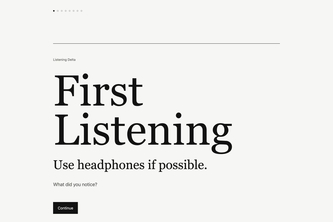
Listening Delta is a self-reported web application that uses AI to support deeper listening through a two-pass experience. The author describes it as an experimental tool designed to cultivate attention rather than generate content or provide answers.
What changed
The project was submitted to the OpenAI 2026 hackathon, indicating a development phase focused on experimentation and prototyping. It is described as a lightweight web app built with Next.js, TypeScript, and GPT-5.6, deployed via Vercel.
Single most important open question
Is there evidence of traction, revenue, or customer adoption beyond the author's self-description?
Note: This analysis is based entirely on the self-reported description provided by the author. No external verification, archived data, or third-party sources are available. All claims are attributed to the project description and labeled as such.
What The Product Actually Is
The description states that Listening Delta is a "short, two-pass listening experience." It involves:
- A user listening to a brief sound and writing what they noticed.
- GPT-5.6 generating a personalized follow-up question based on that observation.
- The user observing the sound through a real-time stereo X-Y vectorscope (visual representation of audio channels).
- The user listening again and recording what changed.
- Both observations presented together as a "Listening Delta."
The system integrates:
- Next.js
- TypeScript
- OpenAI Responses API with GPT-5.6
- Web Audio API for the vectorscope
- Vercel for deployment
It is described as an open-source project under MIT License.
Claim: The product is a web-based tool using AI to guide attention during listening.
Evidence: Author's own write-up.
Positioning & Claim Evolution
The author positions Listening Delta as an experiment in "cultivating attention" rather than generating content or answering questions. Key claims include:
- AI is used not to interpret sounds but to help listeners notice more for themselves.
- The system avoids evaluation, grading, or replacement of human judgment.
- It aims to create conditions for perception rather than replace it.
The project reflects a broader interest in "creating the conditions for perception" and explores how AI can introduce a "productive pause" or new perspective without producing final artifacts.
Claim: Listening Delta is positioned as an experimental tool focused on attention cultivation.
Evidence: Author's own write-up.
Target Customer & ICP
The description does not identify specific target customers or personas. It mentions possible future directions such as:
- Facilitators, educators, artists, and listening workshops
- Supporting different kinds of sounds and listening exercises
- Allowing users to revisit past Listening Deltas
However, no explicit customer segments are named.
Claim: No defined ICP or target customer identified.
Evidence: Not evidenced.
Business Model & Pricing Evidence
There is no evidence of a business model or pricing structure in the description. The project is described as open-source and deployed to production, but there is no mention of monetization, subscriptions, or fees.
Claim: No business model or pricing information provided.
Evidence: Not evidenced.
Technical & Delivery Signals
The product was built using:
- Next.js
- TypeScript
- OpenAI Responses API with GPT-5.6
- Web Audio API for vectorscope visualization
- Vercel for deployment
It is described as a lightweight web application, deployed to production and released under MIT License.
Claim: The technical stack includes modern web technologies and AI integration.
Evidence: Author's own write-up.
Traction & Maturity Signals
There is no evidence of traction, revenue, or customer adoption. The project is described as a hackathon submission and an open-source tool with no mention of users, customers, or usage metrics.
Claim: No traction or maturity signals.
Evidence: Not evidenced.
Competitive Context
The description does not reference competitors or similar products in the market. It focuses on the unique positioning of AI as a facilitator of attention rather than an interpreter or generator.
Claim: No competitive context provided.
Evidence: Not evidenced.
Open Questions & Risks
- The project is described as a hackathon submission, suggesting it may be in early development or experimental phase.
- There is no evidence of revenue, customers, or product-market fit.
- The use of GPT-5.6 raises questions about scalability and cost if the system were to expand beyond prototype status.
- The lack of defined target users or business model suggests a high degree of uncertainty around commercial viability.
Claim: Risks include lack of traction, unclear monetization, and experimental nature.
Inference: Based on absence of evidence for key commercial signals.
Questions the description leaves open
- What is the intended user base or market for this tool?
- Are there plans to monetize the product or expand beyond the current prototype?
- How would you scale the AI integration (e.g., GPT-5.6) if usage increased?
- What are your long-term goals for Listening Delta beyond the hackathon submission?
- Have you considered how this tool might be used in educational, therapeutic, or artistic contexts?
Note: These questions are based on the lack of evidence around commercial strategy and user adoption.
Overall Assessment
There is insufficient evidence to assess whether Listening Delta has investment or partnership potential. The project appears to be an experimental prototype submitted for a hackathon, with no demonstrated traction, revenue, or defined customer base.
Claim: No clear investment or partnership opportunity based on available information.
Evidence: Not evidenced.
User Stories BotA demo video on every pull request
Get a demo video on every new feature
GitHub App that watches your pull requests and records a narrated, captioned demo.
Save time on demo prep and make informed decisions faster with a video walkthrough of every new feature.
Source
Submitted to the OpenAI 2026 hackathon on Devpost. Project home on Devpost. Back to the full gallery on Devpost.
This competitive analysis was produced by top-founders.com (opens in a new tab)
Generated by a language model from this project's public Devpost page — its tagline, the author's own write-up and any built-with tags listed there — as captured in August 2026. Short quotations are the author's words. It is an opinion on the idea as a business, not on the people behind it, and it reflects the description as published then. If the project has moved on, request a correction below. The analysis is not independent research and contains no verified traction, revenue or customer data.
An independent guide by KFG International LLC — not affiliated with, endorsed by, or connected to Devpost or OpenAI.