

Archive position — measured, not model output
1 like on Devpost
505 of the 7,850 archived projects have more likes, and 1,758 share exactly 1 — so this project's #1,088 place in the like-ranked listing is a tie-break inside that group, not a ranking.
Projects (log scale)
Likes on Devpost. ▲ marks this project's group.
Show the figures
| Likes | Projects | Share of archive |
|---|---|---|
| 0 | 5,587 | 71.2% |
| 1 | 1,758 | 22.4% |
| 2 | 284 | 3.6% |
| 3–4 | 132 | 1.7% |
| 5–9 | 75 | 1.0% |
| 10+ | 14 | 0.2% |
 User Stories BotA demo video on every pull request
Get a demo video on every new feature
GitHub App that watches your pull requests and records a narrated, captioned demo.
Save time on demo prep and make informed decisions faster with a video walkthrough of every new feature.
Executive Summary
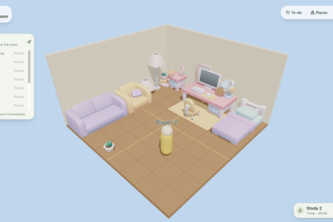
Focuspia is a self-reported 3D social focus application built in 20–30 hours using Codex 5.6 as the primary development tool. The author states it allows users to create and decorate personal rooms, invite friends, and engage in shared focus sessions with real-time interaction. It includes features like focus timers, speech bubbles, and a public cafe space. The product is described as an experiment from a hackathon submission, not yet a commercial service.
The single most important open question is: What is the actual commercial viability of this concept, and how does it differ from existing focus tools or social platforms?
This analysis is based entirely on self-reported information from the author. No evidence exists for revenue, customers, traction, or product-market fit beyond what is stated in the description.
What The Product Actually Is
The description states that Focuspia is a "3D social focus space" where users can:
- Sign in with email
- Create and decorate personal rooms
- Add friends and visit each other’s rooms
- Move around the room and send short speech bubbles in real time
- Use either an elapsed-time stopwatch or countdown timer for todos
- See focus state and elapsed time above avatars
- Access a public cafe space for structured shared-focus environments
The client uses React, Vite, Electron, React Three Fiber, Three.js, Tailwind CSS, and Supabase Auth. The backend uses Phoenix Channels, Phoenix Presence, and PostgreSQL.
This is an experiment built in 20–30 hours using Codex 5.6 as the main development tool, not a commercial product.
Positioning & Claim Evolution
The author describes Focuspia as:
- A "3D social focus space"
- An experiment combining focus timers with gamification and social features
- A way to turn focus from a "lonely timer" into a "quiet shared place"
- Built using Codex 5.6 in a hackathon context
The positioning evolved from a personal project to a potential commercial service, but the description does not indicate any prior market testing or product-market fit.
Target Customer & ICP
Not evidenced.
The description does not specify:
- Who the target customers are
- What their needs or pain points are
- How they would use the product in practice
- Whether there is an identified ICP or persona
Business Model & Pricing Evidence
Not evidenced.
The description does not include any information about:
- Revenue model
- Pricing structure
- Monetization strategy
- Customer acquisition costs
- Unit economics
Technical & Delivery Signals
The description states:
- Built in 20–30 hours using Codex 5.6 as the primary development tool
- Uses React, Vite, Electron, React Three Fiber, Three.js, Tailwind CSS, Supabase Auth for client
- Uses Phoenix Channels, Phoenix Presence, PostgreSQL for backend
- Includes email authentication, 3D room rendering, furniture placement, friend relationships, room visits, real-time avatars, speech bubbles, focus timers, focus status, persisted focus records, and a public cafe scene
The author notes that Codex 5.6 was used to implement the entire codebase from scratch, including backend and frontend, with no direct code writing by the author.
Traction & Maturity Signals
Not evidenced.
There is no evidence of:
- Users or customer base
- Revenue or monetization
- Product usage metrics
- Customer feedback or retention
- Product iteration history
- Market traction or adoption
Competitive Context
Not evidenced.
The description does not mention:
- Competitors in the focus timer or social productivity space
- How Focuspia differentiates from existing solutions
- Market size or competitive landscape
- Any prior market research or competitive analysis
Open Questions & Risks
Inferences based on self-reported information:
- Unproven commercial viability: The product is described as an experiment, not a commercial service.
- Lack of user data: No evidence of customer feedback, usage metrics, or adoption.
- AI-assisted development uncertainty: While Codex was used to build the app, it's unclear how this affects long-term maintainability or scalability.
- Limited scope and maturity: The product is described as a hackathon experiment with no indication of ongoing development beyond that.
- No clear monetization path: No evidence of pricing, revenue model, or business strategy.
Questions the description leaves open
- What specific user problems are you solving, and how do you know?
- How does Focuspia differ from existing focus tools (e.g., Forest, Focus To-Do)?
- What is your plan for monetization and customer acquisition?
- Have you conducted any market research or user interviews to validate demand?
- What are the technical challenges in scaling this product beyond a prototype?
- How do you plan to maintain and iterate on the product post-hackathon?
Overall Assessment
Not evidenced.
The description does not provide sufficient information to assess:
- Commercial potential
- Market opportunity
- Product-market fit
- Team capability or traction
- Financial viability or return expectations
This is a self-reported hackathon experiment with no evidence of commercial readiness, revenue, customers, or product-market validation.
User Stories BotA demo video on every pull request
Get a demo video on every new feature
GitHub App that watches your pull requests and records a narrated, captioned demo.
Save time on demo prep and make informed decisions faster with a video walkthrough of every new feature.
Source
Submitted to the OpenAI 2026 hackathon on Devpost. Project home on Devpost. Back to the full gallery on Devpost.
This competitive analysis was produced by top-founders.com (opens in a new tab)
Generated by a language model from this project's public Devpost page — its tagline, the author's own write-up and any built-with tags listed there — as captured in August 2026. Short quotations are the author's words. It is an opinion on the idea as a business, not on the people behind it, and it reflects the description as published then. If the project has moved on, request a correction below. The analysis is not independent research and contains no verified traction, revenue or customer data.
An independent guide by KFG International LLC — not affiliated with, endorsed by, or connected to Devpost or OpenAI.