

Archive position — measured, not model output
1 like on Devpost
505 of the 7,850 archived projects have more likes, and 1,758 share exactly 1 — so this project's #1,090 place in the like-ranked listing is a tie-break inside that group, not a ranking.
Projects (log scale)
Likes on Devpost. ▲ marks this project's group.
Show the figures
| Likes | Projects | Share of archive |
|---|---|---|
| 0 | 5,587 | 71.2% |
| 1 | 1,758 | 22.4% |
| 2 | 284 | 3.6% |
| 3–4 | 132 | 1.7% |
| 5–9 | 75 | 1.0% |
| 10+ | 14 | 0.2% |
 User Stories BotA demo video on every pull request
Get a demo video on every new feature
GitHub App that watches your pull requests and records a narrated, captioned demo.
Save time on demo prep and make informed decisions faster with a video walkthrough of every new feature.
Executive Summary
FoldForge is a self-reported AI-assisted design system for generating fabrication-ready flat-sheet paper or cardstock objects from plain-language descriptions. The author states it uses GPT-5.6 Sol to interpret user intent and deterministic code to generate, verify and export designs. It is presented as a bounded system focused on specific types of foldable structures, not a general-purpose text-to-CAD tool.
The key commercial due-diligence question is whether FoldForge's approach — separating AI interpretation from deterministic geometry generation — can scale beyond a single-person prototype into a viable product or service with real users and revenue. There is no evidence of traction, customers, pricing, or business model beyond the author’s own description.
What The Product Actually Is
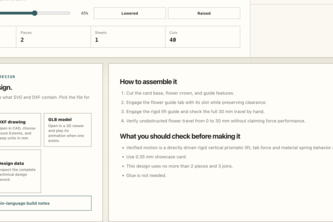
The description states that FoldForge is an AI-assisted cut-and-fold design system for paper and thin cardstock. It takes a plain-language brief and produces a verified, printable flat-sheet design.
It generates:
- Panels, folds, joints, tabs, and slots
- 3D and cut-pattern previews
- Exports in SVG, DXF, GLB, and JSON formats
The system is described as intentionally bounded — not an unrestricted text-to-CAD system. It focuses on flat-sheet objects that can be cut, folded, assembled, and checked computationally.
It uses:
- GPT-5.6 Sol for interpreting user intent into structured fabrication briefs
- Deterministic TypeScript synthesis engine for generating physical structures
- A verification pipeline checking schema validity, geometry, motion paths, collisions, clearances
The system is built with Next.js, React, Three.js, and other technologies listed in the author's tags.
Positioning & Claim Evolution
The author states that FoldForge was built to explore whether someone can describe a physical object in plain English and receive a fabrication-ready paper design that has been checked before they build it.
It positions itself as:
- AI-assisted design for paper/cardstock objects
- A system that checks designs before assembly
- Not a general-purpose text-to-CAD tool, but a bounded one focused on flat-sheet structures
The claim evolution shows a shift from an exploratory hackathon project to a more structured approach where AI interprets intent and deterministic code handles physical validity.
Target Customer & ICP
Not evidenced. The description does not state who the intended users are or what their specific needs are beyond general "people who want to design foldable objects."
Business Model & Pricing Evidence
Not evidenced. There is no mention of pricing, monetization strategy, revenue model, or customer acquisition in the description.
Technical & Delivery Signals
The system uses:
- GPT-5.6 Sol for interpretation
- Deterministic TypeScript engine for geometry generation
- Verification pipeline including schema checks, motion simulation, collision detection
- Frontend built with Next.js and React
- 3D visualization using Three.js and React Three Fiber
- Strict typing via Zod
- Automated testing with Vitest, Fast-check, Playwright, GitHub Actions
The system is described as having:
- More than 550 automated tests
- Property testing, browser tests, compiler mutation tests, export validation
- Source-equivalent exports across formats
- Typed failure reporting for invalid designs
Traction & Maturity Signals
Not evidenced. There is no evidence of customers, revenue, usage metrics, or product adoption beyond the author's own account.
Competitive Context
Not evidenced. The description does not mention existing competitors or market positioning relative to other design tools or AI systems.
Open Questions & Risks
- The system is described as a single-person hackathon project with no evidence of traction or commercial viability
- It uses GPT-5.6 Sol, which may not be available for commercial use or scaling
- No evidence of business model, pricing, or monetization strategy
- The author states that AI should not be responsible for every layer — suggesting a complex architecture that may be difficult to maintain or scale
- The system is described as bounded and focused on specific types of structures, which may limit its market appeal
Questions the description leaves open
- What is the actual business model? How do you plan to monetize this?
- Are there any existing customers or users beyond the author's own use case?
- What are the technical limitations that prevent scaling beyond a single-person prototype?
- How does the system handle edge cases or unusual requests?
- What are the plans for expanding beyond paper/cardstock objects?
- Is there a plan to integrate with existing design software or platforms?
- How do you intend to validate the accuracy of AI interpretations at scale?
Overall Assessment
Not evidenced. There is no evidence of financials, traction, or commercial viability to support an investment or partnership decision. The project appears to be a single-person hackathon prototype with no demonstrated market need, revenue, or customer base. The author's own account indicates that the system was built for exploration rather than commercial deployment.
User Stories BotA demo video on every pull request
Get a demo video on every new feature
GitHub App that watches your pull requests and records a narrated, captioned demo.
Save time on demo prep and make informed decisions faster with a video walkthrough of every new feature.
Source
Submitted to the OpenAI 2026 hackathon on Devpost. Project home on Devpost. Back to the full gallery on Devpost.
This competitive analysis was produced by top-founders.com (opens in a new tab)
Generated by a language model from this project's public Devpost page — its tagline, the author's own write-up and any built-with tags listed there — as captured in August 2026. Short quotations are the author's words. It is an opinion on the idea as a business, not on the people behind it, and it reflects the description as published then. If the project has moved on, request a correction below. The analysis is not independent research and contains no verified traction, revenue or customer data.
An independent guide by KFG International LLC — not affiliated with, endorsed by, or connected to Devpost or OpenAI.