

Archive position — measured, not model output
1 like on Devpost
505 of the 7,850 archived projects have more likes, and 1,758 share exactly 1 — so this project's #1,091 place in the like-ranked listing is a tie-break inside that group, not a ranking.
Projects (log scale)
Likes on Devpost. ▲ marks this project's group.
Show the figures
| Likes | Projects | Share of archive |
|---|---|---|
| 0 | 5,587 | 71.2% |
| 1 | 1,758 | 22.4% |
| 2 | 284 | 3.6% |
| 3–4 | 132 | 1.7% |
| 5–9 | 75 | 1.0% |
| 10+ | 14 | 0.2% |
 User Stories BotA demo video on every pull request
Get a demo video on every new feature
GitHub App that watches your pull requests and records a narrated, captioned demo.
Save time on demo prep and make informed decisions faster with a video walkthrough of every new feature.
Executive Summary
FoldLens is a browser-based tool designed to streamline the review of AlphaFold 3 structural biology outputs. The author describes it as a local-first workspace that links molecular structures, confidence metrics (like pTM, ipTM), PAE heatmaps, and GPT-5.6-generated interpretations. It allows users to inspect models, compare rankings, and explore evidence without uploading raw data to servers.
The project is self-reported as a hackathon submission with no verified revenue, customers or traction. The author states that the tool uses React, TypeScript, 3Dmol.js, and GPT-5.6, and includes local file parsing, PAE interaction, and schema-validated AI outputs. It supports a no-account public demo and is built for desktop and mobile.
Key open question
Is there any evidence of real-world usage or adoption beyond the hackathon submission?
What The Product Actually Is
The description states that FoldLens:
- Opens AlphaFold 3 ZIP, result folders, .cif/.mmcif files, or confidence JSONs directly in the browser.
- Matches prediction samples with their confidence data automatically.
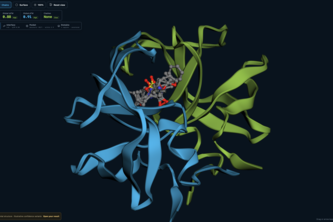
- Renders molecular structures and allows users to compare ranking scores, ipTM, pTM, and clash status across models.
- Enables interaction with PAE heatmaps that link to 3D structure selections.
- Uses GPT-5.6 for schema-validated interpretations grounded in visible evidence.
- Operates locally in the browser; raw files are not uploaded to servers.
- Provides a deterministic fallback when live GPT-5.6 is unavailable.
It is described as a local-first, evidence-linked workspace for structural biology data and AI interpretation.
Inference The tool appears to be a prototype or proof-of-concept rather than a production-ready product, based on its hackathon origin and lack of customer or revenue data.
Positioning & Claim Evolution
The author positions FoldLens as:
- A solution to the fragmented workflow of reviewing AlphaFold 3 outputs.
- A way to tie interpretations back to specific predictions, chains, and confidence metrics.
- A tool that keeps raw scientific files local while enabling AI analysis.
- An interface that makes AI-generated insights traceable to visible evidence.
It claims to be a "local-first" solution with no account required for the public demo. It also emphasizes:
- Deterministic fact sets derived from user selections.
- Schema-validated GPT responses.
- Honest scientific limitations over unsupported conclusions.
Inference The positioning reflects an attempt to address a niche but high-value problem in structural biology research, using AI and visualization tools in a privacy-conscious way.
Target Customer & ICP
The description states that FoldLens is intended for:
- Researchers reviewing AlphaFold 3 outputs.
- Users who need to keep interpretations tied to specific prediction models, chain pairs, residue ranges, and confidence metrics.
It is not clear whether the tool targets academic researchers, biotech companies, or computational biology teams. The author does not name any specific customer segments.
Inference The ICP likely includes structural biologists, computational researchers, or bioinformatics teams working with AlphaFold data. However, no evidence of actual users or customer personas is provided.
Business Model & Pricing Evidence
The description states:
- No account or installation is required to try the public demo.
- GPT-5.6 analysis is available via a server-side API key.
- The tool uses Vercel for frontend and Render for backend, suggesting a cloud-based hosting model.
- The project was submitted to an OpenAI hackathon.
There is no mention of pricing, monetization strategy, or commercial use cases beyond the demo.
Inference No evidence of a business model or pricing structure exists. The tool appears to be a prototype with a public demo and no stated revenue path.
Technical & Delivery Signals
The description states:
- Built with React, TypeScript, Vite, Express, 3Dmol.js, fflate, Zod, and OpenAI API.
- File parsing, visualization, and PAE interaction run locally in the browser.
- The backend (Express) keeps the OpenAI API key server-side.
- Uses Zod Structured Outputs to validate GPT responses.
- Includes 40 automated tests covering core functionality and safety.
- Supports desktop and mobile layouts.
Inference Technical implementation suggests a modern, secure, and testable stack. However, no evidence of scalability or production deployment is provided.
Traction & Maturity Signals
The description states:
- The project was submitted to the OpenAI 2026 hackathon.
- It includes a public demo with live GPT-5.6 analysis.
- It has 40 automated tests.
- The bundled sample uses experimental PDB structure 1NVV.
There is no evidence of:
- Revenue
- Customers or users
- Product adoption
- Market traction
Inference No traction or maturity signals are evident beyond the hackathon submission and demo.
Competitive Context
The description does not mention any competitors. It focuses on the unique value of linking AlphaFold outputs with AI interpretation in a local-first way, but does not compare to existing tools for molecular visualization or structural biology analysis.
Inference No competitive landscape is described. The tool may be addressing an underserved niche, but no evidence of existing alternatives or market positioning is provided.
Open Questions & Risks
- No verified users or traction: The project is a hackathon submission with no evidence of real-world adoption.
- Unproven AI utility: While GPT-5.6 is used, there is no evidence that the AI output is widely valued or trusted by users.
- Limited commercial viability: No pricing model, monetization strategy, or customer base are evident.
- Highly niche use case: The tool targets a narrow audience (AlphaFold 3 users), which may limit scalability.
- Dependency on experimental tools: GPT-5.6 is described as experimental; its availability and reliability are uncertain.
Inference The project lacks commercial viability or traction, and the AI integration is unproven in practice.
Questions the description leaves open
- What is the actual use case for researchers? Is there a specific workflow that this tool solves?
- How many users have tried the public demo, and what feedback have you received?
- Are there any plans to monetize or scale beyond the hackathon prototype?
- How do you plan to integrate with existing molecular biology tools or platforms?
- What is the long-term vision for FoldLens beyond a proof-of-concept?
Overall Assessment
The description states that FoldLens is a hackathon submission and does not provide evidence of:
- Revenue
- Customers
- Product-market fit
- Commercial traction
It is described as a local-first, evidence-linked tool for AlphaFold 3 outputs, with GPT-5.6 integration and schema-validated AI responses.
Inference The project is in an early prototype phase with no demonstrated commercial viability or market traction. It may be a promising idea but lacks the evidence to support investment or partnership decisions at this stage.
User Stories BotA demo video on every pull request
Get a demo video on every new feature
GitHub App that watches your pull requests and records a narrated, captioned demo.
Save time on demo prep and make informed decisions faster with a video walkthrough of every new feature.
Source
Submitted to the OpenAI 2026 hackathon on Devpost. Project home on Devpost. Back to the full gallery on Devpost.
This competitive analysis was produced by top-founders.com (opens in a new tab)
Generated by a language model from this project's public Devpost page — its tagline, the author's own write-up and any built-with tags listed there — as captured in August 2026. Short quotations are the author's words. It is an opinion on the idea as a business, not on the people behind it, and it reflects the description as published then. If the project has moved on, request a correction below. The analysis is not independent research and contains no verified traction, revenue or customer data.
An independent guide by KFG International LLC — not affiliated with, endorsed by, or connected to Devpost or OpenAI.