

Archive position — measured, not model output
0 likes on Devpost
2,263 of the 7,850 archived projects have more likes, and 5,587 share exactly 0 — so this project's #4,058 place in the like-ranked listing is a tie-break inside that group, not a ranking.
Projects (log scale)
Likes on Devpost. ▲ marks this project's group.
Show the figures
| Likes | Projects | Share of archive |
|---|---|---|
| 0 | 5,587 | 71.2% |
| 1 | 1,758 | 22.4% |
| 2 | 284 | 3.6% |
| 3–4 | 132 | 1.7% |
| 5–9 | 75 | 1.0% |
| 10+ | 14 | 0.2% |
 User Stories BotA demo video on every pull request
Get a demo video on every new feature
GitHub App that watches your pull requests and records a narrated, captioned demo.
Save time on demo prep and make informed decisions faster with a video walkthrough of every new feature.
Executive Summary
Project: FareClaim
Self-reported basis: The entire analysis is based on the project description supplied by the caller — its name, tagline, the author's own write-up, and technology tags. No external verification or historical data are available.
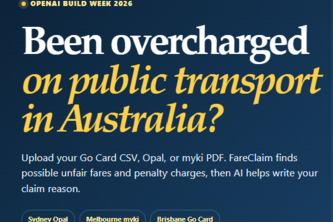
What it appears to be: A tool for Australian commuters to upload transit history, identify overcharges, and generate claims for reimbursement using AI assistance.
What changed: The project was submitted as a hackathon entry (OpenAI 2026) by a team of three volunteers with no funding. It is described as a free service targeting public transport users in Sydney, Melbourne, and SE Queensland.
Most important open question: Is there any evidence that the tool has been adopted or used beyond the initial development phase?
What The Product Actually Is
The description states that FareClaim is a platform that allows commuters to upload transit history (PDFs or CSVs), identifies missing touch-offs, and formats claims for reimbursement. It uses a TypeScript rules engine and OpenAI models to draft the claim content. The system supports one-click submission to legacy government portals.
Evidence:
- “Commuters can just upload their transit history to Fare Claim. The system instantly identifies missing touch-offs and formats the exact claim for commuters.”
- “We built the front end using React and deployed it on Cloudflare.”
- “When a commuter uploads their transit history, a TypeScript rules engine processes the backend data pipeline to detect overcharges.”
- “We use OpenAI models to draft the exact reason for the overcharge claim.”
Inference: The product is described as a web-based tool with AI-assisted claim generation and automated detection of fare discrepancies.
Positioning & Claim Evolution
The project positions itself as a solution to a problem caused by glitchy public transport systems in Australia, where commuters are penalized for system failures. It frames its value proposition around helping people reclaim money they’ve lost due to these issues.
Evidence:
- “High gas/fuel prices push us to public transport, but glitchy systems penalise us with hidden public transport overcharges in Australia.”
- “Commuters can just upload their transit history to Fare Claim. The system instantly identifies missing touch-offs and formats the exact claim for commuters.”
Inference: The positioning evolved from a personal pain point (the author’s own experience) into a tool that aims to help many users reclaim lost money, with no mention of broader commercial ambitions.
Target Customer & ICP
The description states that FareClaim is intended for Australian commuters who use public transport and are affected by system glitches that result in overcharges. It specifically mentions targeting Sydney, Melbourne, and SE Queensland.
Evidence:
- “FareClaim helps commuters to track and recover unfair charges.”
- “We are proud to give FareClaim away for free to every commuter in Sydney, Melbourne and SE Queensland.”
Inference: The ICP is defined by geography (Australia) and user behavior (public transport users affected by system errors), but no segmentation beyond that is described.
Business Model & Pricing Evidence
The project is described as a free tool. There is no evidence of a monetization strategy, pricing model or revenue streams.
Evidence:
- “We are proud to give FareClaim away for free to every commuter in Sydney, Melbourne and SE Queensland.”
- “We did not receive a single dollar of government grants or corporate funding.”
Inference: The business model is not evident beyond being a free service. No commercial or subscription elements are described.
Technical & Delivery Signals
The project was built using Angular.js, Cloudflare Pages, Firebase, Firestore, Node.js, OpenAI, PrimeNG, SCSS, and TypeScript. It uses React for the frontend and a rules engine with AI to draft claims.
Evidence:
- “Built with (author-declared): angular.js, cloudflare-pages, codex, firebase, firestore, node.js, openai, primeng, scss, typescript”
- “We built the front end using React and deployed it on Cloudflare.”
- “We use OpenAI models to draft the exact reason for the overcharge claim.”
Inference: The tech stack suggests a modern web application with AI integration. However, no evidence of scalability or production deployment is provided.
Traction & Maturity Signals
There is no evidence of user adoption, customer base, or traction beyond the initial development and hackathon submission. The project is described as being built by volunteers with no funding.
Evidence:
- “We built this entire platform as a small team of volunteers.”
- “We did not receive a single dollar of government grants or corporate funding.”
Inference: No data on usage, retention, or growth is available. The tool appears to be in an early stage, possibly non-operational beyond the hackathon.
Competitive Context
The description does not mention any competitors or existing solutions in this space. It implies that current tools for reclaiming overcharges are outdated and difficult to use.
Evidence:
- “They can claim this money back, but the process requires logging into an outdated government portal, where manually auditing every line of transit history is painful.”
Inference: The competitive landscape is not described, but it is implied that current solutions are suboptimal. No direct competitors are named or referenced.
Open Questions & Risks
- No traction or adoption: The project is described as a hackathon submission with no evidence of real-world usage.
- Unverified claims: The description makes strong claims about user pain and impact, but no data supports these.
- Lack of monetization strategy: No indication of how the tool will be sustained beyond its initial free offering.
- No scalability or production deployment: The project is described as a prototype with no evidence of operational readiness.
Questions the description leaves open
- What is the current status of FareClaim? Is it live, and if so, how many users are using it?
- How does FareClaim handle data privacy and compliance with Australian transit data regulations?
- Have you received any feedback from commuters or government agencies about the tool?
- What is the plan for scaling beyond Sydney, Melbourne, and SE Queensland?
- Are there any legal or regulatory barriers to the tool’s operation in its current form?
Overall Assessment
Not evidenced: There is no evidence of revenue, customers, traction, or a clear path to monetization. The project is described as a hackathon submission by volunteers with no funding, and it is not clear whether it has moved beyond the prototype stage.
Confidence level: Low. The description is self-reported and unverified, and there are no signs of commercial viability or adoption. The tool appears to be an idea in early development, not a functioning product in the market.
Assessment: Not ready for investment or partnership at this time. Further evidence of traction, user engagement, or operational deployment is required to assess its potential.
User Stories BotA demo video on every pull request
Get a demo video on every new feature
GitHub App that watches your pull requests and records a narrated, captioned demo.
Save time on demo prep and make informed decisions faster with a video walkthrough of every new feature.
Source
Submitted to the OpenAI 2026 hackathon on Devpost. Project home on Devpost. Back to the full gallery on Devpost.
This competitive analysis was produced by top-founders.com (opens in a new tab)
Generated by a language model from this project's public Devpost page — its tagline, the author's own write-up and any built-with tags listed there — as captured in August 2026. Short quotations are the author's words. It is an opinion on the idea as a business, not on the people behind it, and it reflects the description as published then. If the project has moved on, request a correction below. The analysis is not independent research and contains no verified traction, revenue or customer data.
An independent guide by KFG International LLC — not affiliated with, endorsed by, or connected to Devpost or OpenAI.