

Archive position — measured, not model output
0 likes on Devpost
2,263 of the 7,850 archived projects have more likes, and 5,587 share exactly 0 — so this project's #4,060 place in the like-ranked listing is a tie-break inside that group, not a ranking.
Projects (log scale)
Likes on Devpost. ▲ marks this project's group.
Show the figures
| Likes | Projects | Share of archive |
|---|---|---|
| 0 | 5,587 | 71.2% |
| 1 | 1,758 | 22.4% |
| 2 | 284 | 3.6% |
| 3–4 | 132 | 1.7% |
| 5–9 | 75 | 1.0% |
| 10+ | 14 | 0.2% |
 User Stories BotA demo video on every pull request
Get a demo video on every new feature
GitHub App that watches your pull requests and records a narrated, captioned demo.
Save time on demo prep and make informed decisions faster with a video walkthrough of every new feature.
Executive Summary
What the company appears to be
The project described by the caller is Fargate Spot Autopilot, a self-reported tool that automates fallback from Fargate Spot to on-demand Fargate in Amazon ECS services, with gradual recovery back to Spot. It is presented as a minimal controller that integrates into existing autoscaling setups without taking over desiredCount.
What changed
The author states they built this tool in response to an unmet AWS feature request for automatic fallback and recovery behavior when Fargate Spot capacity becomes unavailable. The solution uses a deterministic state machine implemented via AWS CDK, Lambda, DynamoDB, and EventBridge.
Single most important open question — the commercial due-diligence read
Is there any evidence of real-world usage or adoption beyond the author’s own development and testing? The description contains no data on customers, revenue, traction, or product-market fit beyond a single developer's personal project.
What The Product Actually Is
The description states that Fargate Spot Autopilot is a controller that adds automatic fallback and gradual recovery to existing autoscaled ECS services. It operates by observing ECS events and scheduled ticks, then running a deterministic state machine with three modes:
- NORMAL: uses configured mix of Spot and on-demand tasks
- FALLBACK: moves partially or fully to on-demand Fargate when Spot becomes unstable
- RECOVERY: introduces real application Spot tasks as canaries and gradually restores target mix
It does not modify desiredCount, instead changing only the ECS capacity provider strategy. The system is implemented in TypeScript using AWS CDK, Lambda, DynamoDB, EventBridge, and the AWS SDK v3.
Evidence
- Author describes how it works: “runs a deterministic state machine”
- It uses AWS infrastructure components (CDK, Lambda, DynamoDB, EventBridge)
- It implements a local simulator and real AWS adapter
- The author claims to have built it with Codex using GPT-5.6
Inference The tool is described as a minimal, plug-in solution that integrates into existing autoscaling workflows rather than replacing them.
Positioning & Claim Evolution
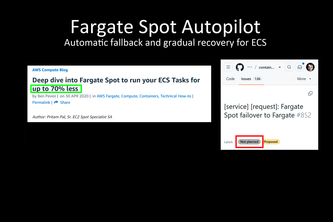
The author positions Fargate Spot Autopilot as a solution to an AWS gap: the lack of automatic fallback and recovery behavior in ECS when Fargate Spot capacity becomes unavailable. The tool is described as a small controller that plugs into existing autoscaling instead of competing with it.
Claims made
- “Fargate Spot can reduce compute cost significantly, but an ECS service does not automatically fall back to regular Fargate when Spot capacity becomes unavailable.”
- “I wanted to build the smallest possible controller that closes this gap.”
- “The controller never writes desiredCount. Service Auto Scaling remains its only owner.”
Inference This is a niche tool aimed at developers or DevOps teams managing ECS services on AWS, particularly those using Fargate Spot for cost savings but facing instability issues.
Target Customer & ICP
The description does not explicitly name target customers or define an ideal customer profile (ICP). However, the author implies that this is a developer or DevOps team working with ECS services on AWS, especially those using Fargate Spot and experiencing capacity instability.
Evidence
- The tool is built for ECS services
- It addresses issues around Fargate Spot availability
- It integrates into existing autoscaling setups
Inference The ICP likely includes teams managing containerized applications on AWS ECS, particularly those using Fargate Spot and seeking to avoid manual intervention or downtime during Spot interruptions.
Business Model & Pricing Evidence
There is no evidence of a business model or pricing structure in the description. The project is presented as a personal hackathon submission, not a commercial product.
Evidence
- Submitted to the OpenAI 2026 hackathon
- Built by one person (bukov-ka Borisov)
- No mention of monetization, subscriptions, or pricing
Inference It is unclear whether this will ever become a paid offering. The author does not describe any commercial intent beyond personal development.
Technical & Delivery Signals
The project uses TypeScript, AWS CDK, Lambda, DynamoDB, EventBridge, and the AWS SDK v3. It includes:
- A local simulator that runs without AWS credentials
- A real AWS adapter
- A deterministic state machine
- Integration with ECS capacity provider strategies
The author reports using Codex with GPT-5.6 to build the core components and validated it through a smoke test on real AWS.
Evidence
- Built with Codex using GPT-5.6
- Uses AWS CDK, Lambda, DynamoDB, EventBridge
- Includes local simulator and real AWS adapter
- Tested end-to-end in AWS
Inference The technical approach is lightweight and testable, leveraging AI-assisted development and deterministic logic to reduce deployment cycles.
Traction & Maturity Signals
There is no evidence of traction or adoption beyond the author’s own development. The project was submitted as a hackathon entry and has no reported usage by third parties.
Evidence
- Submitted to OpenAI 2026 hackathon
- Built by one person (bukov-ka Borisov)
- No mention of customers, revenue, or product-market fit
Inference This is a proof-of-concept, not a mature product. There is no indication that it has been used in production environments or scaled beyond the author’s own testing.
Competitive Context
The description does not name competitors or describe the competitive landscape. However, it implies that AWS does not currently offer this functionality natively, and the tool fills an unmet need in ECS Fargate management.
Evidence
- The author states: “the public AWS feature request for this behavior is still marked ‘Not planned.’”
- It addresses a gap in ECS autoscaling behavior
Inference The competitive context is limited to AWS’s own offerings and possibly other niche DevOps tools. No direct competitors are named.
Open Questions & Risks
- No traction or adoption: The tool has not been used beyond the author's own testing.
- Unverified commercial intent: No evidence of a business model, pricing, or monetization strategy.
- Single-person development: The entire project was built by one individual, raising questions about scalability and long-term maintenance.
- Hackathon submission: The product is not positioned as a commercial offering but as a hackathon entry.
Inference This is a personal project, not a scalable or commercially viable solution. It lacks any evidence of real-world usage or business development.
Questions the description leaves open
- Has this tool been tested in production environments beyond the author’s own?
- Are there any users or customers currently using it?
- What is the plan for monetization or commercialization?
- How does it handle large-scale services (e.g., 100+ tasks)?
- Is there a roadmap for expanding beyond ECS and Fargate?
- What are the limitations of the current deterministic state machine approach?
Overall Assessment
Not evidenced.
The description provides no evidence of revenue, customers, traction, or commercial viability. It is a self-reported hackathon project, not a product with demonstrated market demand or business model.
Confidence level Very low
Investment/Partnership recommendation
Not supported by evidence. This appears to be an experimental tool, not a viable investment or partnership opportunity at this time.
User Stories BotA demo video on every pull request
Get a demo video on every new feature
GitHub App that watches your pull requests and records a narrated, captioned demo.
Save time on demo prep and make informed decisions faster with a video walkthrough of every new feature.
Source
Submitted to the OpenAI 2026 hackathon on Devpost. Project home on Devpost. Back to the full gallery on Devpost.
This competitive analysis was produced by top-founders.com (opens in a new tab)
Generated by a language model from this project's public Devpost page — its tagline, the author's own write-up and any built-with tags listed there — as captured in August 2026. Short quotations are the author's words. It is an opinion on the idea as a business, not on the people behind it, and it reflects the description as published then. If the project has moved on, request a correction below. The analysis is not independent research and contains no verified traction, revenue or customer data.
An independent guide by KFG International LLC — not affiliated with, endorsed by, or connected to Devpost or OpenAI.