

Archive position — measured, not model output
3 likes on Devpost
128 of the 7,850 archived projects have more likes, and 93 share exactly 3 — so this project's #136 place in the like-ranked listing is a tie-break inside that group, not a ranking.
Projects (log scale)
Likes on Devpost. ▲ marks this project's group.
Show the figures
| Likes | Projects | Share of archive |
|---|---|---|
| 0 | 5,587 | 71.2% |
| 1 | 1,758 | 22.4% |
| 2 | 284 | 3.6% |
| 3–4 | 132 | 1.7% |
| 5–9 | 75 | 1.0% |
| 10+ | 14 | 0.2% |
 User Stories BotA demo video on every pull request
Get a demo video on every new feature
GitHub App that watches your pull requests and records a narrated, captioned demo.
Save time on demo prep and make informed decisions faster with a video walkthrough of every new feature.
Executive Summary
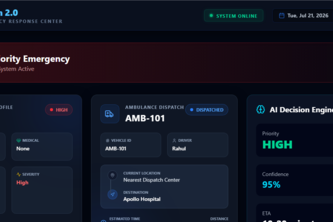
The company appears to be a single-person project (DHRUV Na) submitted to the OpenAI 2026 hackathon. It describes an AI-powered emergency response system named Arogyam-2.0, which uses image analysis and chat interfaces to assess injuries, recommend first aid, and simulate connections with hospitals and ambulances.
The author states that the system is built using FastAPI, React, Google Gemini Vision, Telegram bot integration, and a mock dashboard. It simulates real-time emergency workflows but does not include live integrations or actual deployment in production.
The single most important open question
Is there any evidence of traction, revenue, customer adoption, or real-world deployment beyond the hackathon submission?
What The Product Actually Is
- The description states that Arogyam-2.0 is an AI-powered emergency response system.
- It allows users to upload injury images via a Telegram bot.
- The system uses Google Gemini Vision for injury analysis and classification of severity (Low, Medium, High).
- It generates first-aid recommendations and simulates dispatching ambulances and assigning doctors.
- A React-based dashboard displays real-time emergency information including patient data, AI reasoning, hospital availability, ambulance status, confidence score, and estimated response time.
Inference The system is described as a full-stack prototype built for demonstration purposes in a hackathon setting. It includes components for user interaction (Telegram), backend processing (FastAPI), AI analysis (Gemini Vision), and visualization (React dashboard).
Positioning & Claim Evolution
- The author claims that Arogyam-2.0 bridges the gap between injury assessment and timely medical help during emergencies.
- It positions itself as an intelligent first responder that supports faster decision-making through AI.
- The system is described as having a chat interface for user interaction, suggesting it aims to be accessible and simple.
Inference The positioning reflects a focus on accessibility and speed in emergency response, using AI to guide users toward appropriate care. However, the claim of being an "intelligent first responder" is based on self-reporting without evidence of real-world use or validation.
Target Customer & ICP
- The description states that Arogyam-2.0 targets individuals who experience medical emergencies and need quick access to injury assessment and emergency services.
- It is designed for users who may not know how to assess the severity of an injury or locate nearby hospitals and ambulances.
Inference The target customer appears to be general public in emergency situations, particularly those with limited access to immediate medical support. No specific segmentation beyond this broad user group is evident.
Business Model & Pricing Evidence
- Not evidenced.
The description does not mention any pricing structure, monetization strategy, or business model. It only describes a prototype system built for demonstration purposes.
Technical & Delivery Signals
- The project uses FastAPI for backend processing.
- Google Gemini Vision is used for injury image analysis.
- A Telegram bot handles user input.
- A React dashboard visualizes emergency data in real time.
- The system integrates with mock datasets for hospitals, ambulances, and doctors.
- It includes features like JSON response handling, API quota management, and full-stack architecture.
Inference The technical stack suggests a modern, scalable approach to building an AI-powered platform. However, the use of mocks implies that no real-world integration has occurred yet.
Traction & Maturity Signals
- Not evidenced.
There is no evidence of revenue, customers, user adoption, or product maturity beyond the hackathon submission. The project is described as a prototype with simulated components.
Competitive Context
- Not evidenced.
No mention of competitors or market analysis is provided in the description. No indication of existing solutions or competitive positioning is available.
Open Questions & Risks
- Single-person team: Only one member (DHRUV Na) is listed, which may limit execution capacity.
- Prototype-only: The system is described as a hackathon prototype with mock integrations; no live deployment or real-world testing is evident.
- No traction or monetization: No evidence of users, revenue, or business model beyond the project description.
- Unverified claims: All functionality and performance are self-reported without independent verification.
Questions the description leaves open
- What is the current status of real-world testing or pilot programs?
- Are there any plans to integrate with actual hospital, ambulance, or doctor APIs?
- How does the AI model perform in terms of accuracy and reliability for injury classification?
- Has the team considered regulatory compliance (e.g., healthcare data privacy)?
- What is the long-term roadmap beyond the hackathon submission?
Overall Assessment
- Not evidenced.
There is no evidence of revenue, customers, or traction to support an investment or partnership decision. The project is described as a hackathon prototype with no indication of commercial viability or scalability. Any potential value lies in future development, but that remains speculative.
User Stories BotA demo video on every pull request
Get a demo video on every new feature
GitHub App that watches your pull requests and records a narrated, captioned demo.
Save time on demo prep and make informed decisions faster with a video walkthrough of every new feature.
Source
Submitted to the OpenAI 2026 hackathon on Devpost. Project home on Devpost. Back to the full gallery on Devpost.
This competitive analysis was produced by top-founders.com (opens in a new tab)
Generated by a language model from this project's public Devpost page — its tagline, the author's own write-up and any built-with tags listed there — as captured in August 2026. Short quotations are the author's words. It is an opinion on the idea as a business, not on the people behind it, and it reflects the description as published then. If the project has moved on, request a correction below. The analysis is not independent research and contains no verified traction, revenue or customer data.
An independent guide by KFG International LLC — not affiliated with, endorsed by, or connected to Devpost or OpenAI.