

Archive position — measured, not model output
0 likes on Devpost
2,263 of the 7,850 archived projects have more likes, and 5,587 share exactly 0 — so this project's #4,059 place in the like-ranked listing is a tie-break inside that group, not a ranking.
Projects (log scale)
Likes on Devpost. ▲ marks this project's group.
Show the figures
| Likes | Projects | Share of archive |
|---|---|---|
| 0 | 5,587 | 71.2% |
| 1 | 1,758 | 22.4% |
| 2 | 284 | 3.6% |
| 3–4 | 132 | 1.7% |
| 5–9 | 75 | 1.0% |
| 10+ | 14 | 0.2% |
 User Stories BotA demo video on every pull request
Get a demo video on every new feature
GitHub App that watches your pull requests and records a narrated, captioned demo.
Save time on demo prep and make informed decisions faster with a video walkthrough of every new feature.
Executive Summary
FareKE is a self-reported community-powered platform for Kenyan commuters to check matatu fares between routes. The project was built by a single developer (Deve Sal) as part of the OpenAI 2026 hackathon, using AI-assisted development tools like Codex. It claims to help users search routes, view reported fares, and contribute fare data to build a centralized database.
The description states that FareKE aims to make commuting more transparent and help Kenyans budget for daily journeys. However, no evidence of revenue, customers, traction or adoption is provided beyond the author's own account.
Key commercial due-diligence question: Is there sufficient evidence of user demand or engagement to support a scalable business model beyond the initial prototype?
What The Product Actually Is
The description states that FareKE is a platform where users can:
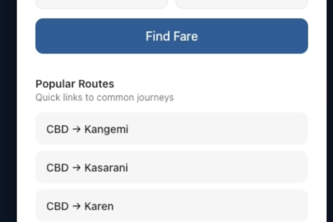
- Search for transport routes between locations
- View fares reported by the community
- Contribute new fare reports to keep information current
- Help build a centralized source of public transport fare information
It is described as a web-based application built with JavaScript, Node.js, and PostgreSQL, designed for mobile usability.
Inference: The product appears to be a simple data collection and display tool that relies on community input rather than formal partnerships or APIs from transport providers.
Positioning & Claim Evolution
The author positions FareKE as:
- A solution to an everyday problem faced by millions of Kenyans
- A way to make commuting more transparent and easier to budget for
- A community-driven platform that builds a centralized fare database
The project evolved from a personal observation about the lack of centralized fare information in Kenya, with the goal of turning this into a working product.
Inference: The positioning is rooted in local problem-solving and community participation, not formal market research or user validation.
Target Customer & ICP
The description states that FareKE targets:
- Kenyan commuters who use matatus (public transport)
- Students and daily commuters who need to budget for travel
- Anyone seeking reliable fare information before traveling
It is implied that the primary users are individuals rather than institutions or businesses.
Inference: The target customer segment is defined by geography (Kenya) and behavior (daily public transport use), but no evidence of actual user segmentation or persona development exists.
Business Model & Pricing Evidence
The description does not mention any pricing model, monetization strategy, or business model. It focuses on the platform's functionality and community-driven nature.
Inference: No commercial structure is evident beyond the initial prototype; there is no indication of how the platform might generate revenue or sustain operations.
Technical & Delivery Signals
The project was built using:
- JavaScript
- Node.js
- PostgreSQL
- AI tools like Codex for development acceleration
It emphasizes speed, simplicity, and mobile usability. The author notes challenges in designing a fast, readable interface suitable for use while traveling.
Inference: The tech stack suggests a basic web application with minimal infrastructure requirements, but no evidence of scalability or robustness beyond the prototype stage.
Traction & Maturity Signals
The description states that this is a hackathon submission and that the author built it in a short time using AI-assisted development. There is no mention of:
- Users
- Revenue
- Customer adoption
- Product usage metrics
- Iteration history or product maturity
Inference: The project appears to be at an early prototype stage with no demonstrated traction or user engagement.
Competitive Context
No competitive landscape or existing alternatives are mentioned in the description. The author does not reference other platforms, apps, or systems that might address similar needs.
Inference: There is no evidence of market analysis or awareness of competitors; the project seems to be positioned as a novel solution without context.
Open Questions & Risks
- Unverified claims: All statements are self-reported and unverified.
- No traction: No evidence of users, customers, or adoption.
- Single-person development: The entire product was built by one developer, raising questions about scalability and long-term maintenance.
- Unclear monetization: No business model or revenue plan is evident.
- Dependence on community input: Reliance on user-generated data introduces risks around accuracy, consistency, and sustainability.
Questions the description leaves open
- What specific problem are you solving, and how do you know it affects enough people to justify a scalable solution?
- How will you ensure the accuracy of community-reported fare data?
- Have you validated your idea with actual users in Kenya?
- What is your plan for building a sustainable user base beyond the initial prototype?
- Are there any existing systems or apps that already attempt to solve this problem?
- How do you intend to monetize or scale this platform?
Overall Assessment
Not evidenced
The description provides no evidence of revenue, customers, traction, or a viable business model. The project is presented as a hackathon prototype with no indication of commercial viability or market readiness.
This is a self-reported idea with no external validation or data to support its potential for growth or investment. Any further diligence would require independent verification of user engagement, market demand, and technical feasibility beyond the author’s own account.
User Stories BotA demo video on every pull request
Get a demo video on every new feature
GitHub App that watches your pull requests and records a narrated, captioned demo.
Save time on demo prep and make informed decisions faster with a video walkthrough of every new feature.
Source
Submitted to the OpenAI 2026 hackathon on Devpost. Project home on Devpost. Back to the full gallery on Devpost.
This competitive analysis was produced by top-founders.com (opens in a new tab)
Generated by a language model from this project's public Devpost page — its tagline, the author's own write-up and any built-with tags listed there — as captured in August 2026. Short quotations are the author's words. It is an opinion on the idea as a business, not on the people behind it, and it reflects the description as published then. If the project has moved on, request a correction below. The analysis is not independent research and contains no verified traction, revenue or customer data.
An independent guide by KFG International LLC — not affiliated with, endorsed by, or connected to Devpost or OpenAI.