

Archive position — measured, not model output
0 likes on Devpost
2,263 of the 7,850 archived projects have more likes, and 5,587 share exactly 0 — so this project's #6,022 place in the like-ranked listing is a tie-break inside that group, not a ranking.
Projects (log scale)
Likes on Devpost. ▲ marks this project's group.
Show the figures
| Likes | Projects | Share of archive |
|---|---|---|
| 0 | 5,587 | 71.2% |
| 1 | 1,758 | 22.4% |
| 2 | 284 | 3.6% |
| 3–4 | 132 | 1.7% |
| 5–9 | 75 | 1.0% |
| 10+ | 14 | 0.2% |
 User Stories BotA demo video on every pull request
Get a demo video on every new feature
GitHub App that watches your pull requests and records a narrated, captioned demo.
Save time on demo prep and make informed decisions faster with a video walkthrough of every new feature.
Executive Summary
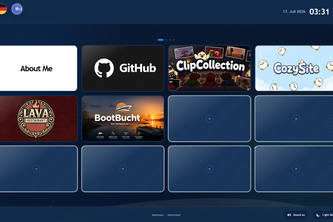
Portfolio Hub is a self-contained, interactive portfolio project built by a single developer (D. Henschel) using a mix of modern web technologies including Astro, TypeScript, JavaScript, and AI tools like OpenAI Codex. The author describes it as a "personal portfolio that feels more like opening a game console than reading a résumé," aiming to offer an exploratory, playful experience for visitors to navigate through the creator's projects.
The project was submitted to the OpenAI 2026 hackathon, indicating it may have been developed in a short timeframe with AI assistance. It is described as a personal showcase rather than a commercial product or service, and there is no evidence of revenue, customers, or adoption beyond its own authorship.
The single most important open question is: What is the intended use case for Portfolio Hub beyond personal branding? The description does not indicate whether it is meant to be a template, a tool for others, or a standalone portfolio with broader utility. This ambiguity makes it difficult to assess potential commercial viability or scalability.
What The Product Actually Is
The description states that Portfolio Hub is a personal portfolio website, built using modern web technologies such as Astro, TypeScript, JavaScript, and Node.js. It uses AI tools like OpenAI Codex for development assistance.
It is described as an interactive, console-inspired interface where projects are presented as "channels" that users can browse — similar to how one might navigate a game console's menu. The author mentions using APIs such as the Gamepad API and Web Audio API to achieve this experience.
The project also includes features like:
- Responsive design
- Dark mode
- Fullscreen API
- Web accessibility support
It is built with static site generation, and uses tools like Vite, GitHub Actions, and npm for development and deployment.
Inference: The product appears to be a personal showcase website, not a commercial SaaS offering or marketplace. It is self-reported as a developer's own portfolio, not intended for public use by others.
Positioning & Claim Evolution
The author positions Portfolio Hub as:
- A playful, interactive alternative to traditional résumés or portfolios.
- A personal hub that allows visitors to explore projects in a more engaging way than scrolling through cards or links.
- An example of how AI-assisted development can be used to create something unique and expressive, not generic.
The project evolved from:
- A simple need: “I had built quite a few websites but there was no simple way to view them all in one place.”
- To an ambitious interface inspired by game consoles.
- To a demonstration of AI-assisted development that still retains human creativity and personality.
Claim: The author claims the project shows how AI can help with implementation while preserving individuality and design intent.
Inference: This is a self-directed creative project, not a product targeting an external market. It may be intended as a portfolio piece or hackathon submission, not a scalable tool for others.
Target Customer & ICP
The description does not clearly identify a target customer or ideal customer profile (ICP).
It is stated that the author created it to:
- Share work with friends who “often forget the individual links or did not know which projects I had already created.”
- Demonstrate what AI-assisted development can do.
There is no indication of:
- A specific audience beyond personal use
- A B2B or B2C target
- Any commercial intent or customer acquisition strategy
Inference: The primary user is likely the creator themselves, and possibly friends or peers in a developer community. There is no evidence of a defined customer segment or market.
Business Model & Pricing Evidence
There is no evidence of any business model, pricing structure, or monetization strategy.
The author describes Portfolio Hub as:
- A personal project
- A demonstration of AI-assisted development
- A way to showcase work and ideas
It is not described as a product that can be sold, licensed, or used by others. It appears to be self-contained, built for the creator’s own use.
Inference: No commercial business model is evident. The project may be intended as a personal brand asset or demo, not a revenue-generating tool.
Technical & Delivery Signals
The project was built using:
- Astro
- TypeScript
- JavaScript
- Node.js
- OpenAI Codex
- GitHub Actions
- Vite
- CSS3, HTML5, Web Audio API, Gamepad API
It uses:
- Static site generation
- Responsive web design
- Web accessibility features
- Fullscreen and history APIs
- JSON-LD for SEO
The author mentions using AI tools to assist in development but emphasizes that the final result still reflects human creativity.
Inference: The technical stack is modern and suitable for a developer portfolio. It shows a high level of technical sophistication, especially with the use of APIs and AI-assisted development.
Traction & Maturity Signals
There is no evidence of traction, adoption, or user engagement beyond the author’s own use.
The project:
- Was submitted to an OpenAI hackathon
- Is described as a personal showcase
- Has no mention of customers, users, or revenue
It was built in a short timeframe (likely during the hackathon) and is presented as a personal creative effort, not a product with market traction.
Inference: The project is at an early stage of development. It has no measurable traction or maturity beyond its own creation.
Competitive Context
The description does not provide any information about:
- Competitors
- Market positioning
- Similar tools or platforms in the portfolio space
It is described as a unique, personal project, not a product competing in a marketplace. It is not compared to other portfolio tools or platforms.
Inference: No competitive context is evident. The project does not appear to be part of an existing ecosystem or market.
Open Questions & Risks
- No commercial intent: The project is described as personal, with no evidence of a business model or target audience beyond the creator.
- No traction or adoption: There is no data on usage, engagement, or customer feedback.
- Unproven scalability: It is a single-developer tool, not designed for reuse by others.
- Self-reported only: All claims are unverified and based solely on the author’s own description.
Inference: The project is not a commercial product, but a personal creative endeavor, which raises questions about its potential for investment or partnership.
Questions the description leaves open
- Is Portfolio Hub intended to be a reusable tool for others, or is it purely personal?
- What are your plans for monetization or scaling the project beyond personal use?
- Have you received any feedback from users or peers on its usability or appeal?
- How do you plan to evolve the project if it were to be used by others?
- Are there any plans to open-source or license Portfolio Hub?
Overall Assessment
Not evidenced.
There is no evidence of:
- Revenue
- Customers
- Market traction
- Commercial viability
- Scalability
The project is described as a personal portfolio, built for the creator’s own use, with no indication of broader commercial intent or utility. It was submitted to a hackathon and does not appear to be a product designed for others.
Inference: This is likely a creative or experimental project, not a viable investment or partnership opportunity at this time. It may have value as a personal brand asset, but lacks evidence of commercial potential.
User Stories BotA demo video on every pull request
Get a demo video on every new feature
GitHub App that watches your pull requests and records a narrated, captioned demo.
Save time on demo prep and make informed decisions faster with a video walkthrough of every new feature.
Source
Submitted to the OpenAI 2026 hackathon on Devpost. Project home on Devpost. Back to the full gallery on Devpost.
This competitive analysis was produced by top-founders.com (opens in a new tab)
Generated by a language model from this project's public Devpost page — its tagline, the author's own write-up and any built-with tags listed there — as captured in August 2026. Short quotations are the author's words. It is an opinion on the idea as a business, not on the people behind it, and it reflects the description as published then. If the project has moved on, request a correction below. The analysis is not independent research and contains no verified traction, revenue or customer data.
An independent guide by KFG International LLC — not affiliated with, endorsed by, or connected to Devpost or OpenAI.