

Archive position — measured, not model output
0 likes on Devpost
2,263 of the 7,850 archived projects have more likes, and 5,587 share exactly 0 — so this project's #6,021 place in the like-ranked listing is a tie-break inside that group, not a ranking.
Projects (log scale)
Likes on Devpost. ▲ marks this project's group.
Show the figures
| Likes | Projects | Share of archive |
|---|---|---|
| 0 | 5,587 | 71.2% |
| 1 | 1,758 | 22.4% |
| 2 | 284 | 3.6% |
| 3–4 | 132 | 1.7% |
| 5–9 | 75 | 1.0% |
| 10+ | 14 | 0.2% |
 User Stories BotA demo video on every pull request
Get a demo video on every new feature
GitHub App that watches your pull requests and records a narrated, captioned demo.
Save time on demo prep and make informed decisions faster with a video walkthrough of every new feature.
Executive Summary
What the company appears to be
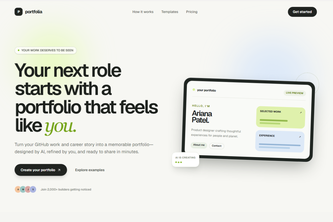
Portfolia is a self-reported project submitted to the OpenAI 2026 hackathon. The description states it is a tool for creating personal portfolios that "feel like you", with no further commercial or product details.
What changed
This is a single-person hackathon submission with no evidence of prior development, traction, or market validation.
The single most important open question
Is this project intended to become a commercial product, and if so, what is its path to market adoption?
Analysis basis
The entire analysis is based on the self-reported description supplied by the caller. No external verification, archived history, or third-party sources are available. All claims are unverified.
What The Product Actually Is
The description states that Portfolia is a tool for creating personal portfolios that "feel like you". It was built as a hackathon submission using MongoDB, Next.js, Node.js, React, Tailwind, TypeScript, and Vercel.
Evidence
- The author states: “Your next role starts with a portfolio that feels like you.”
- Technology stack: MongoDB, Next.js, Node.js, React, Tailwind, TypeScript, Vercel.
- Submitted to the OpenAI 2026 hackathon on Devpost.
Not evidenced
- No product screenshots, user flows, or functional details are provided.
- No indication of how the portfolio "feels like you" is implemented.
- No information about whether it's a SaaS tool, marketplace, or platform.
Positioning & Claim Evolution
The tagline “Your next role starts with a portfolio that feels like you” positions Portfolia as a personal branding or job-seeking tool. It implies a focus on authenticity and self-expression in professional presentation.
Evidence
- Tagline: “Your next role starts with a portfolio that feels like you.”
Inference
- The positioning suggests it targets job seekers or professionals looking to build a strong online presence, possibly in tech or creative fields.
Not evidenced
- No evidence of prior positioning, branding evolution, or market testing.
- No indication of how the product differentiates from existing portfolio tools.
Target Customer & ICP
The description does not specify target customers or ideal customer profiles (ICP). The tagline implies a focus on individuals seeking roles, but no further segmentation is evident.
Evidence
- Tagline: “Your next role starts with a portfolio that feels like you.”
Inference
- Likely targets job seekers, freelancers, or professionals in creative or technical fields.
- May be aimed at those who want to stand out through personalized portfolios.
Not evidenced
- No customer personas, user demographics, or use cases are provided.
- No evidence of market research or early adopter feedback.
Business Model & Pricing Evidence
There is no evidence in the description of a business model or pricing structure. The project is presented as a hackathon submission with no indication of monetization strategy.
Evidence
- No mention of revenue, pricing, subscriptions, or monetization.
Inference
- If commercialized, it may be a SaaS product with freemium or tiered pricing, but this is speculative.
Not evidenced
- No business model, pricing tiers, or monetization strategy are described.
- No evidence of customer acquisition or retention plans.
Technical & Delivery Signals
The project was built using modern web technologies (Next.js, React, Node.js, MongoDB) and deployed on Vercel, suggesting a technical foundation aligned with current development practices.
Evidence
- Built with: MongoDB, Next.js, Node.js, React, Tailwind, TypeScript, Vercel.
- Submitted to Devpost as a hackathon project.
Inference
- The stack suggests it is a web-based application, likely a single-page app or full-stack SaaS product in early development.
Not evidenced
- No evidence of scalability, performance metrics, or deployment architecture.
- No information on backend services, API design, or data handling.
Traction & Maturity Signals
There is no evidence of traction, user adoption, or product maturity. It is described only as a hackathon submission with no further development history.
Evidence
- Submitted to the OpenAI 2026 hackathon.
- Team size: 1 person (Muhammad Bin Yasir).
- No mention of users, customers, or usage data.
Inference
- Likely in early prototype stage, possibly with no live product or user base.
Not evidenced
- No metrics, user feedback, or growth indicators.
- No evidence of prior funding, partnerships, or product iterations.
Competitive Context
No competitive analysis is provided. The description does not mention similar tools or platforms in the portfolio or job-seeking space.
Evidence
- No mention of competitors or market landscape.
Inference
- Likely competes with existing portfolio builders like Behance, Dribbble, or personal website generators (e.g., Webflow, Squarespace).
- May be positioned as a more personalized or AI-enhanced alternative.
Not evidenced
- No evidence of competitive differentiation or market positioning.
- No mention of existing tools or platforms in the space.
Open Questions & Risks
The project is a single-person hackathon submission with no traction, business model, or product maturity. It lacks any evidence of commercial viability or scalability.
Evidence
- Submitted as a hackathon project.
- Team size: 1.
- No revenue, customers, or product development history.
Inference
- High risk of being a prototype with no path to market adoption.
- Lack of team capacity or funding may limit future development.
Not evidenced
- No evidence of IP protection, legal risks, or scalability concerns.
- No indication of how the founder plans to transition from hackathon project to product.
Questions the description leaves open
- What is the intended path from this hackathon submission to a commercial product?
- How does "feeling like you" translate into user experience or product features?
- Are there any early users or feedback loops?
- What is the business model and monetization strategy?
- Is there a plan for team expansion or product development beyond this prototype?
Overall Assessment
Not evidenced.
The project is described only as a hackathon submission with no evidence of traction, revenue, or commercial viability. The lack of any product details, user feedback, or business model makes it impossible to assess its potential for investment or partnership.
Confidence Very low. This analysis is based entirely on self-reported information and lacks any verifiable data or market signals.
User Stories BotA demo video on every pull request
Get a demo video on every new feature
GitHub App that watches your pull requests and records a narrated, captioned demo.
Save time on demo prep and make informed decisions faster with a video walkthrough of every new feature.
Source
Submitted to the OpenAI 2026 hackathon on Devpost. Project home on Devpost. Back to the full gallery on Devpost.
This competitive analysis was produced by top-founders.com (opens in a new tab)
Generated by a language model from this project's public Devpost page — its tagline and any built-with tags listed there, since the author published no write-up — as captured in August 2026. Short quotations are the author's words. It is an opinion on the idea as a business, not on the people behind it, and it reflects the description as published then. If the project has moved on, request a correction below. The analysis is not independent research and contains no verified traction, revenue or customer data.
An independent guide by KFG International LLC — not affiliated with, endorsed by, or connected to Devpost or OpenAI.