

Archive position — measured, not model output
0 likes on Devpost
2,263 of the 7,850 archived projects have more likes, and 5,587 share exactly 0 — so this project's #4,057 place in the like-ranked listing is a tie-break inside that group, not a ranking.
Projects (log scale)
Likes on Devpost. ▲ marks this project's group.
Show the figures
| Likes | Projects | Share of archive |
|---|---|---|
| 0 | 5,587 | 71.2% |
| 1 | 1,758 | 22.4% |
| 2 | 284 | 3.6% |
| 3–4 | 132 | 1.7% |
| 5–9 | 75 | 1.0% |
| 10+ | 14 | 0.2% |
 User Stories BotA demo video on every pull request
Get a demo video on every new feature
GitHub App that watches your pull requests and records a narrated, captioned demo.
Save time on demo prep and make informed decisions faster with a video walkthrough of every new feature.
Executive Summary
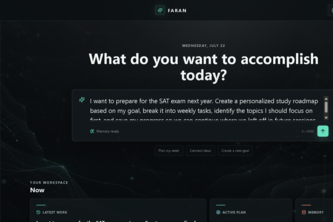
FARAN is presented as an AI-powered "Second Brain" system that translates natural-language goals into structured workflows using GPT-5.6 and Codex. The author describes it as a tool for turning goals into researched plans, actionable tasks, and durable long-term memory. It includes multi-agent orchestration, semantic memory, idea connections, and retryable workflows.
The project is self-reported as a hackathon submission with no evidence of revenue, customers, or traction beyond the author's own account. The system architecture is described using FastAPI, SQLite, SQLAlchemy, and GPT-5.6, but there are no independent validations or performance metrics.
Key open question
Does FARAN demonstrate a viable product-market fit for a real user base, or is it an experimental prototype with limited commercial potential?
What The Product Actually Is
The description states that FARAN is an AI Second Brain designed to convert natural-language goals into structured workflows. It uses GPT-5.6 and Codex to orchestrate multi-agent processes including:
- Planner
- Researcher
- Memory retriever
- Task creator
- Reasoning validator
- Writer
These components work together to generate durable outputs such as plans, tasks, evidence, and results that can be semantically retrieved later.
It also supports:
- Idea connections
- Retryable queued workflows
- Scheduling
- Conversation continuity
- Evaluation from expert corrections
The system is built using FastAPI with clean architectural boundaries, and integrates GPT-5.6 via OpenAI’s Agents SDK and Responses API. Memory is implemented through embeddings, vector records, semantic retrieval, and automatic idea connection discovery.
Inference The product appears to be a prototype or proof-of-concept rather than a production-ready solution, based on its hackathon origin and lack of external validation.
Positioning & Claim Evolution
The author positions FARAN as an AI assistant that goes beyond momentary utility by preserving work in a durable, searchable format. It aims to solve the problem of information loss after AI interactions, offering a continuous workspace for goal execution.
Claims include:
- Turning goals into researched plans and actionable tasks
- Providing long-term memory with semantic retrieval
- Supporting multi-agent workflows with retryable execution
- Offering correction-to-regression evaluation
The positioning evolves from a simple chatbot to a structured, persistent system that maintains context across time and actions. It emphasizes durability over ephemeral AI responses.
Inference The evolution reflects an attempt to move beyond basic conversational AI toward a more sophisticated knowledge management tool, though this is not substantiated by user feedback or adoption data.
Target Customer & ICP
The description does not explicitly name target customers or personas. However, it implies a focus on individuals who:
- Set goals and need structured planning
- Require long-term memory retention of past work
- Want to automate parts of their workflow using AI agents
- Value semantic search and idea connection features
It may appeal to professionals working in knowledge-intensive roles such as researchers, strategists, or developers who benefit from persistent, organized AI assistance.
Not evidenced No specific customer segments, use cases, or buyer personas are provided. The ICP remains undefined beyond implied user needs.
Business Model & Pricing Evidence
There is no evidence of pricing models, monetization strategies, or business model claims in the description.
The author does not mention:
- Revenue streams
- Subscription tiers
- Freemium offerings
- Enterprise licensing
- Paid features
Not evidenced No indication of how FARAN intends to generate value or charge users.
Technical & Delivery Signals
The system is built with:
- FastAPI (clean architecture)
- GPT-5.6 via OpenAI Agents SDK and Responses API
- Codex as engineering partner for auditing/refactoring
- SQLite, SQLAlchemy, Alembic for storage
- Pydantic for schema validation
- GitHub CI with 73 automated tests
Key technical features:
- Agent handoffs
- Typed contracts
- Function tools
- Prompt caching
- Context compaction
- Semantic retrieval
- Idea connection discovery
Inference The architecture suggests a modular, testable system suitable for prototyping but lacks evidence of scalability or production readiness.
Traction & Maturity Signals
The project is described as a hackathon submission, with no evidence of:
- Revenue
- Customers
- User adoption
- Product-market fit
- Market traction
Accomplishments listed include:
- Real GPT-5.6 multi-agent orchestration
- Long-term memory and semantic retrieval
- Idea connection discovery
- Durable queue/retry/scheduling
- Correction-to-regression evaluation
- Bilingual workspace
- 73 automated tests and passing CI
However, these are self-reported achievements without external validation or usage data.
Not evidenced No signs of real-world deployment, user engagement, or measurable impact.
Competitive Context
The description does not reference existing competitors or market positioning. It does not compare FARAN to other AI second brains, productivity tools, or workflow automation platforms.
Not evidenced No competitive analysis, benchmarking, or differentiation from similar products.
Open Questions & Risks
- Prototype nature: Submitted to a hackathon; no evidence of commercial viability or product-market fit.
- Unverified claims: All features and capabilities are self-reported without independent verification.
- No revenue or traction: No data on users, customers, or monetization.
- Limited team size: Only one member (Emirhan Yolcu) involved in development.
- Overreliance on proprietary tech: Heavy dependence on GPT-5.6 and Codex without clear roadmap for future availability or cost.
- Unclear value proposition: While described as useful, the actual benefit to users is not demonstrated.
Inference The risk of failure is high due to lack of external validation, minimal team, and no evidence of real-world demand.
Questions the description leaves open
- What specific problem are you solving, and how do you know people care about it?
- How does FARAN differ from existing AI tools like Notion, Obsidian, or ChatGPT plugins?
- Have you tested this with any real users? If so, what feedback did they give?
- What is your plan for scaling beyond the current prototype?
- Are there any technical dependencies (e.g., GPT-5.6) that could limit long-term viability?
- How do you intend to monetize the product?
- What are the key metrics you track to measure success?
Overall Assessment
This is a self-reported prototype submitted to a hackathon, with no evidence of traction, revenue, or customer validation.
The author claims significant technical capabilities including multi-agent orchestration and semantic memory, but these are unverified. There is no indication of commercial intent or path forward beyond the initial concept.
Confidence level: Low
Assessment Not ready for investment or partnership consideration at this stage. Further due diligence would require evidence of user testing, market validation, and a clear go-to-market strategy.
User Stories BotA demo video on every pull request
Get a demo video on every new feature
GitHub App that watches your pull requests and records a narrated, captioned demo.
Save time on demo prep and make informed decisions faster with a video walkthrough of every new feature.
Source
Submitted to the OpenAI 2026 hackathon on Devpost. Project home on Devpost. Back to the full gallery on Devpost.
This competitive analysis was produced by top-founders.com (opens in a new tab)
Generated by a language model from this project's public Devpost page — its tagline, the author's own write-up and any built-with tags listed there — as captured in August 2026. Short quotations are the author's words. It is an opinion on the idea as a business, not on the people behind it, and it reflects the description as published then. If the project has moved on, request a correction below. The analysis is not independent research and contains no verified traction, revenue or customer data.
An independent guide by KFG International LLC — not affiliated with, endorsed by, or connected to Devpost or OpenAI.