

Archive position — measured, not model output
3 likes on Devpost
128 of the 7,850 archived projects have more likes, and 93 share exactly 3 — so this project's #133 place in the like-ranked listing is a tie-break inside that group, not a ranking.
Projects (log scale)
Likes on Devpost. ▲ marks this project's group.
Show the figures
| Likes | Projects | Share of archive |
|---|---|---|
| 0 | 5,587 | 71.2% |
| 1 | 1,758 | 22.4% |
| 2 | 284 | 3.6% |
| 3–4 | 132 | 1.7% |
| 5–9 | 75 | 1.0% |
| 10+ | 14 | 0.2% |
 User Stories BotA demo video on every pull request
Get a demo video on every new feature
GitHub App that watches your pull requests and records a narrated, captioned demo.
Save time on demo prep and make informed decisions faster with a video walkthrough of every new feature.
Executive Summary
What the company appears to be
Aming Claw is described as a local-first governance runtime for coding agents (e.g., those using Codex or GPT-5.6), designed to manage long-running agent workflows by enforcing position, role, and legal-action constraints. It aims to reduce drift in agent behavior by pushing structured context and rules rather than relying on pull-based reasoning.
What changed
The project was extended during OpenAI Build Week using Codex and GPT-5.6, with a focus on integrating governance into the development process itself — essentially dogfooding the system while building it.
Single most important open question
Is there any evidence of actual usage or adoption beyond the author’s own development work? The description does not indicate whether Aming Claw has been used by others, tested in production, or integrated into real workflows outside of its own construction.
What The Product Actually Is
The description states that Aming Claw is a local-first governance runtime for Codex and other coding agents. It pushes structured information such as:
- Current role and contract;
- Verified project and task position;
- Next legal action;
- Allowed and blocked operations;
- Required evidence;
- Gate for verifying completion.
It combines:
- A commit-bound project graph (using Git);
- Contracts that turn plans into checkable rules;
- Durable backlog and timeline state;
- Independent worker and QA identities;
- Direct, parallel, and batch execution paths;
- A dashboard for human oversight.
The system is built with Python (runtime and MCP server), NetworkX (project relationships), SQLite (durable local state), Git (binding claims to code states), and React/TypeScript/Vite (dashboard UI).
Inference The product appears to be a tool for managing agent behavior in software development, particularly around task positioning, evidence tracking, and preventing drift.
Positioning & Claim Evolution
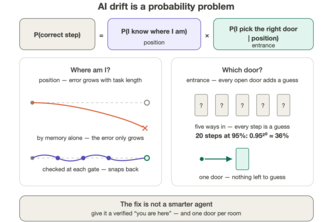
The author positions Aming Claw as an alternative to pull-based reasoning systems where agents must reconstruct their own context. Instead, it pushes governance rules and state to the agent.
Key claims:
- Long-running coding agents fail not because they can't write code, but because they lose track of position.
- The model used is:
$$
P(\text{correct step}) = P(\text{correct position}) \times P(\text{correct entrance} \mid \text{position})
$$
- Aming Claw pushes rather than pulls context and constraints.
Inference This suggests a shift from reactive, memory-dependent agent behavior to proactive, rule-enforced workflows. The positioning implies a solution for managing complexity in multi-agent systems or long-running tasks.
Target Customer & ICP
Not evidenced.
The description does not name specific customer types, use cases, or target industries. It describes the tool as being useful for "coding agents" but does not clarify who would deploy or use it beyond the developer building it.
Business Model & Pricing Evidence
Not evidenced.
There is no mention of pricing models, monetization strategies, or commercial arrangements in the description.
Technical & Delivery Signals
The system uses:
- Python for runtime and MCP server;
- NetworkX for representing project relationships;
- SQLite for durable local state;
- Git to bind runtime claims to exact code states;
- React/TypeScript/Vite for the human oversight dashboard.
It supports:
- Direct, parallel, and batch execution paths;
- Commit-bound project graph;
- Contract-based task enforcement;
- Evidence provenance and QA identity separation;
- Restart-safe batch integration epochs.
The author notes that Codex and GPT-5.6 were used during Build Week to extend the system, including implementing contracts, managing backlogs, and handling retries with evidence tracking.
Inference The architecture is designed for local-first, deterministic execution with strong state management and traceability — suitable for complex, multi-step development workflows.
Traction & Maturity Signals
Not evidenced.
There is no indication of:
- Revenue;
- Customers or users;
- Adoption beyond the author’s own work;
- Product maturity or deployment history;
- Any form of traction or market validation.
The project was submitted to an OpenAI hackathon and built during a short time window; there is no evidence of prior usage or iteration outside of that context.
Competitive Context
Not evidenced.
No mention of competitors, existing tools in the space, or how Aming Claw compares technically or functionally to similar systems.
Open Questions & Risks
- Lack of external validation: The entire description is self-reported and unverified. No third-party confirmation or evidence of real-world usage.
- Single-person team: Only one member listed (Aming Zhang), which may limit scalability or operational capacity.
- No commercial traction: No evidence of revenue, customers, or product-market fit beyond the author’s own development.
- Limited scope: The tool is described as a governance runtime for coding agents — not yet a full-fledged SaaS or platform offering.
- Unclear adoption path: It's unclear how this would be adopted by teams or integrated into existing workflows.
Questions the description leaves open
- What specific types of coding agents does Aming Claw govern? Are there any examples of real-world usage?
- How is the governance enforced — through contracts, runtime checks, or other mechanisms?
- Has the system been tested in production-like environments beyond the author’s own development?
- What are the scalability limitations of the local-first approach?
- Is there a plan to move beyond the current prototype into a more general-purpose tool or platform?
Overall Assessment
Not evidenced.
There is no evidence of:
- Revenue;
- Customers;
- Product-market fit;
- Commercial traction;
- Funding history;
- Strategic partnerships or use cases outside of the author’s own development.
The description indicates a prototype built during a hackathon, with no indication of commercial viability or broader market relevance. The tool appears to be an experimental governance system for coding agents, but there is no evidence that it has moved beyond concept or demonstration stage.
Confidence level Low — based entirely on self-reported content with no external validation or traction signals.
User Stories BotA demo video on every pull request
Get a demo video on every new feature
GitHub App that watches your pull requests and records a narrated, captioned demo.
Save time on demo prep and make informed decisions faster with a video walkthrough of every new feature.
Source
Submitted to the OpenAI 2026 hackathon on Devpost. Project home on Devpost. Back to the full gallery on Devpost.
This competitive analysis was produced by top-founders.com (opens in a new tab)
Generated by a language model from this project's public Devpost page — its tagline, the author's own write-up and any built-with tags listed there — as captured in August 2026. Short quotations are the author's words. It is an opinion on the idea as a business, not on the people behind it, and it reflects the description as published then. If the project has moved on, request a correction below. The analysis is not independent research and contains no verified traction, revenue or customer data.
An independent guide by KFG International LLC — not affiliated with, endorsed by, or connected to Devpost or OpenAI.