

Archive position — measured, not model output
1 like on Devpost
505 of the 7,850 archived projects have more likes, and 1,758 share exactly 1 — so this project's #2,096 place in the like-ranked listing is a tie-break inside that group, not a ranking.
Projects (log scale)
Likes on Devpost. ▲ marks this project's group.
Show the figures
| Likes | Projects | Share of archive |
|---|---|---|
| 0 | 5,587 | 71.2% |
| 1 | 1,758 | 22.4% |
| 2 | 284 | 3.6% |
| 3–4 | 132 | 1.7% |
| 5–9 | 75 | 1.0% |
| 10+ | 14 | 0.2% |
 User Stories BotA demo video on every pull request
Get a demo video on every new feature
GitHub App that watches your pull requests and records a narrated, captioned demo.
Save time on demo prep and make informed decisions faster with a video walkthrough of every new feature.
Executive Summary
What the company appears to be
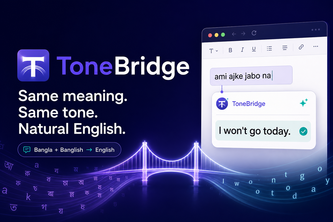
ToneBridge is a self-reported open-source browser extension that converts Bangla or Banglish text into natural English within web editors, preserving meaning and tone. It is built as a Manifest V3 Chrome/Edge extension using JavaScript, React, and various LLMs including OpenAI’s gpt-oss-120b via Groq.
What changed
The project was submitted to the OpenAI 2026 hackathon by one developer (Saiful Alam Fahim), indicating an early-stage prototype or proof-of-concept. No prior version, funding, or commercial traction is evidenced.
Single most important open question
Is there any evidence of user adoption, feedback loops, or real-world usage beyond the author’s own development and testing?
What The Product Actually Is
The description states that ToneBridge is an open-source Chrome and Edge browser extension designed to convert Bangla or Banglish into natural English directly inside supported web editors. It uses a content script to detect text inputs, displays floating suggestions via Shadow DOM, and allows users to approve or reject translations.
It supports both automatic and manual translation modes, with configurable behavior per website, protected vocabulary, and style preferences (e.g., spelling and contractions). The system includes modular provider architecture for hosted or local LLMs such as OpenAI’s gpt-oss-120b via Groq and Ollama.
The extension does not store translation history, collects no analytics, and allows users to export settings or delete all data locally. It is built with technologies including JavaScript, React, Vite, HTML, CSS, and uses GitHub Actions for CI/CD.
Evidence
- The author states it is a Manifest V3 browser extension.
- It integrates into standard text inputs, textareas, and rich contenteditable editors.
- It uses a Shadow DOM to isolate UI from host websites.
- It supports multiple LLM providers (hosted and local).
- It includes features like protected vocabulary, keyboard-triggered translation, and per-site configuration.
Inference It is likely intended for use by Bengali speakers communicating in English within web-based tools such as email clients or freelance platforms.
Positioning & Claim Evolution
The author positions ToneBridge as a writing assistant, not just a translation tool. It aims to reduce friction in multilingual communication by offering real-time suggestions that preserve tone and intent, rather than generic machine translations.
It explicitly contrasts itself with general translators or grammar tools by stating it follows a strict "translation contract" that:
- Preserves meaning and tone.
- Does not add or remove information.
- Keeps names, brands, and technical terms exact.
- Leaves original text unchanged until user approval.
The project also emphasizes privacy, noting no analytics or stored data, and includes protections for accessibility and performance.
Evidence
- The tagline: “An open-source assistant that turns Bangla or Banglish into natural English inside any web editor—preserving meaning and tone.”
- The author claims it removes friction from communication flows.
- It defines a translation contract with specific rules.
- It highlights privacy-first design principles.
Inference The positioning is focused on user control, trust, and multilingual writing efficiency, especially for freelancers or content creators working across languages.
Target Customer & ICP
The description states that ToneBridge targets Bengali speakers who struggle to express themselves naturally in English, particularly those communicating with international clients (e.g., freelancers on platforms like Fiverr).
It also implies a broader audience interested in faithful translation and privacy-preserving tools, especially among users of web-based editors.
Evidence
- The inspiration section mentions “Bangladeshi freelancers communicating with international clients.”
- It is designed for use inside web editors, suggesting a B2C or B2B professional user base.
- It supports multiple languages beyond Bangla in its roadmap.
Inference The ICP likely includes non-native English speakers using online tools, especially those working in freelance or remote collaboration environments.
Business Model & Pricing Evidence
There is no evidence of a business model, pricing strategy, monetization plan, or revenue streams. The project is described as open-source and does not mention any paid features, subscriptions, or commercial partnerships.
Evidence
- The project is declared open-source under Apache-2.0 license.
- No mention of paid tiers, usage fees, or monetization strategies.
- No indication of customer acquisition costs or pricing models.
Inference The business model remains unclear; it may be intended as a community tool or platform for future monetization, but no evidence supports this.
Technical & Delivery Signals
ToneBridge is built using modern web technologies including:
- Manifest V3 browser extension architecture
- JavaScript, React, HTML, CSS
- Content scripts and background service workers
- Shadow DOM for UI isolation
- GitHub Actions CI/CD pipeline
- Modular provider system supporting hosted and local LLMs
It includes:
- 44 deterministic tests
- Dataset validation
- Secret scanning
- Protected branches in GitHub
- Contributor documentation
Evidence
- Built with React, Vite, JavaScript, HTML, CSS.
- Uses content scripts and background workers.
- Implements Shadow DOM for UI rendering.
- Supports multiple LLM providers (OpenAI via Groq, Ollama).
- Includes CI/CD via GitHub Actions.
- Has a test suite and dataset validation.
Inference The technical approach suggests a modular, extensible system, with attention to security, privacy, and compatibility across modern web editors.
Traction & Maturity Signals
There is no evidence of user adoption, customer base, or real-world usage beyond the developer’s own testing. The project is described as a v1.0.0 release candidate, submitted to a hackathon, with no mention of downloads, active users, or feedback loops.
Evidence
- It is a v1.0.0 release candidate.
- Submitted to OpenAI 2026 hackathon.
- No data on user engagement, retention, or usage metrics.
- No mention of customer acquisition, revenue, or market traction.
Inference The project is in early development and lacks any demonstrated traction or product-market fit.
Competitive Context
No competitive analysis is provided. The author does not reference existing tools for multilingual writing assistance or translation within web editors.
Evidence
- No mention of competitors.
- No comparison to other browser extensions, translation tools, or AI writing assistants.
Inference There is no evidence of market awareness or competitive positioning beyond the self-reported goals.
Open Questions & Risks
- No commercial traction or user feedback: The project is a prototype submitted to a hackathon and lacks any real-world usage data.
- Single-person team: With only one developer, scalability and long-term maintenance are uncertain.
- Unproven translation quality: While it defines a “translation contract,” there is no evidence of actual performance or user validation.
- Limited language support: It starts with Bangla/Banglish but has no evidence of broader language adoption yet.
- Open-source nature: While beneficial for community involvement, open-source projects often lack commercial viability without clear monetization paths.
Evidence
- No revenue, customers, or usage metrics.
- One-person team.
- No external validation or user testing.
- No roadmap beyond initial release and Android keyboard.
Inference The project is at a very early stage with significant uncertainty around viability, scalability, and commercial potential.
Questions the description leaves open
- What specific problems are you solving for users, and how do you know they exist?
- Have you conducted any user research or usability testing beyond your own development?
- How will you monetize this tool if it remains open-source?
- What is the plan for expanding to other languages beyond Bangla/Banglish?
- Are there any known technical limitations or edge cases in real-world usage?
- What are the long-term maintenance and update plans for the extension?
- Do you have a strategy for building an active user community around this tool?
Overall Assessment
Not evidenced.
The project is described as a v1.0.0 prototype submitted to a hackathon, with no evidence of traction, revenue, or commercial viability. It is built by one individual and lacks any indication of market validation or scalable business model.
Confidence Level Low This analysis is based entirely on self-reported information from the author. No independent verification or external data supports the claims made about product-market fit, user adoption, or business potential.
User Stories BotA demo video on every pull request
Get a demo video on every new feature
GitHub App that watches your pull requests and records a narrated, captioned demo.
Save time on demo prep and make informed decisions faster with a video walkthrough of every new feature.
Source
Submitted to the OpenAI 2026 hackathon on Devpost. Project home on Devpost. Back to the full gallery on Devpost.
This competitive analysis was produced by top-founders.com (opens in a new tab)
Generated by a language model from this project's public Devpost page — its tagline, the author's own write-up and any built-with tags listed there — as captured in August 2026. Short quotations are the author's words. It is an opinion on the idea as a business, not on the people behind it, and it reflects the description as published then. If the project has moved on, request a correction below. The analysis is not independent research and contains no verified traction, revenue or customer data.
An independent guide by KFG International LLC — not affiliated with, endorsed by, or connected to Devpost or OpenAI.